|
|
|
|
How Far Is Digital Media Influencing Academic Journalism
Bijith Vakkalary 1
 ,
G Anne Florentyana 2
,
G Anne Florentyana 2 , Kubeshwar.
R 3
, Kubeshwar.
R 3
1 Assistant
Professor, PG Department of Journalism and Communication, Dwaraka Doss Goverdhan Doss Vaishnav College (Autonomous), Arumbakkam, Chennai, India
2 News
Correspondent, Inc42 Media, 4th Floor, Jujhar Tower, 59/16, RD Marg, Block K,
Kalkaji, New Delhi, Delhi, India
3 BA Journalism Student, PG Department of
Journalism and Communication, Dwaraka Doss Goverdhan
Doss Vaishnav College (Autonomous), Arumbakkam,
Chennai, India
|
|
|
ABSTRACT |
|
|
Academic journalism is persistently
shaping the parallel via the advancement in digital media technology that is
altering the general inspective leaving technology acceptance model (TAM),
which highlights the importance of perceived utility and simplicity of using
technology acquisition employed in the study to examine the adaptation of
digital media and journalism curricula. Study looks into
how journalism students view digital tools and readiness for their workforce.
According to the finding, a sizable major students think that in comparison
traditional print, digital media into their comprehension journalistic principle speedup information
availability. Further, it offers new appealing methods to consume use the
finding emphasizes house students choose digital platforms for conducting
index research producing material and honing their abilities to meet
industries standards. General consensus suggests
reasons to employ Adobe digital tools despite a minor percentage having in
neutral or mixed centimeters to incorporate digital media into general school
the job that is becoming more and more line on
technology and career path. |
|||
|
Received 15 October 2024 Accepted 10 November 2025 Published 16 December 2025 Corresponding Author Bijith Vakkalary, bijithvakkalary@gmail.com
DOI 10.29121/ShodhVichar.v1.i2.2025.49 Funding: This research
received no specific grant from any funding agency in the public, commercial,
or not-for-profit sectors. Copyright: © 2025 The
Author(s). This work is licensed under a Creative Commons
Attribution 4.0 International License. With the
license CC-BY, authors retain the copyright, allowing anyone to download,
reuse, re-print, modify, distribute, and/or copy their contribution. The work
must be properly attributed to its author.
|
|||
|
Keywords: Digital Media,
Academic Journalism, Digital Literacy, Technology Acceptance Model, Media
Education |
|||
1. INTRODUCTION
The rapid growth of digital media technologies has led to a significant shift in the way journalism is approached today. Digital media is characterized by the use of various platforms and tools, such as social media, blogs on digital platforms, podcasts in audio and video, and multimedia storytelling. They constantly transform how news is created, shared, saved, published, transmitted or consumed.
There is a need to include such technologies in journalism education, so that future journalists can be trained for the changing media environment and also interact with a wider audience in an affirmative manner. In assimilating digital media into journalism teaching, it is also critical to understand the value of such technologies and the impact it has on student learning. The Technology Acceptance Model (TAM) is a useful framework for examining both students’ and educators’ perceptions and use of digital tools in journalism. TAM argue that perceived ease of use and perceived usefulness of using a new technology are important predictors of whether or not individuals accept that technology. With this framework, researchers can understand the factors influencing the adopting digital media in journalism education. In other words, not only do students learn through digital media, they also learn the necessary skills for the 21st century workforce. When students use a range of digital tools including data visualization and the ability to tell a story with multimedia across a range of platforms, they learn data-driven journalism and how to engage audiences. The paper investigates the implication of adopting digital media in media education by taking the technology acceptance model as a theoretical frameworks and finds out several determinants to shape the influence of acceptance and its significance on journalism education in the future.
2. Review of literature
The fast-changing media world made the incorporation of digital media into journalism education even more important. Adopting the Technology Acceptance Model (TAM) as an axial structure of acceptance variables, this literature review explores salient themes attendant to the uptake of digital media technologies in journalism education.
Emergence of digital media has brought about a notable transformation in the way that news is consumed. As per Karambelkar (n.d.), “This makes 60% of readers prefer the digital medium than print media for real time news updates, only 40% are left to print, that too being majorly the elders who think print average. This Change raises concerns about misinformation and demands adaptive strategies from traditional outlets. Similarly, Pavlik (2014) emphasizes how AI and drones are transforming journalism, offering immersive storytelling but posing ethical risks like job displacement and privacy invasion. Studies reveal mixed outcomes in adopting digital tools for learning. Auma (2017) notes that while students extensively use smartphones, academic applications like Google Scholar are underutilized due to distractions from social media. Matsiola et al. (2019) demonstrate that hands-on, technology-enhanced courses (e.g., radio production) improve student engagement and technical skills. However, Miliou et al. (2022) stress that inadequate infrastructure and teacher training hinder ICT’s potential, calling for policy interventions to bridge these gaps. The demand for digital literacy in journalism is growing. Pavlović and Milosavljević (2021) discovered that 76% of students recognize its importance, yet 44% feel inadequately trained. Talib and Saberi (2022) emphasize mobile technology’s role in solo journalism, enabling real-time reporting but challenging traditional teamwork models. Kioko (2022) argues that curricula must evolve to include multimedia and social media skills, blending academic rigor with industry needs to prepare graduates for a digital-first landscape. Research on AI in journalism underscores trust and usability as critical factors. Trang et al. (2021) and Granic (2023) identify performance expectancy, regulatory support, and social influence as key drivers in Vietnamese press agencies. Their findings suggest that user-friendly AI tools and targeted training can accelerate adoption, though ethical concerns about transparency persist.
3. Data analysis, interpretation and findings
The study surveyed 103 journalism students to understand their adoption of digital media in education. The age distribution revealed most respondents were between 18 and 21 years old, with 19-year-olds forming the largest group (28.2%), followed by 18-year-olds (21.4%). Gender-wise, 57.3% were female, and 42.7% male, with no transgender respondents. Academically, the sample was well-distributed across undergraduate and postgraduate levels.
Figure 1

Figure 2
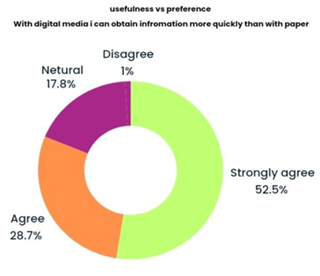
The data shows a strong preference for digital media across learning, research, and skill-building. A significant majority (83.5%) agreed that digital media improves their understanding of journalism concepts. Over 80% believed that it provides faster access to information than traditional formats. Also, more than 64% of the respondents prefer reading news digitally than print medium, as it is more comfortable.
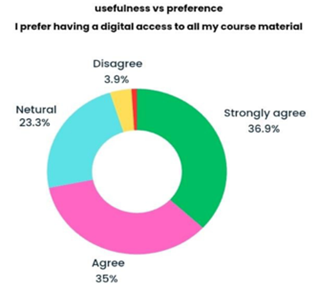
In terms of academic usage, nearly 72% preferred accessing course materials digitally, highlighting a shift towards convenience and flexibility. About 80% of students find it manageable to use digital tools for ease of content creation. Similarly, searching for specific topics was considered more efficient with digital platforms, supported by almost 80% of the respondents.
Figure 3
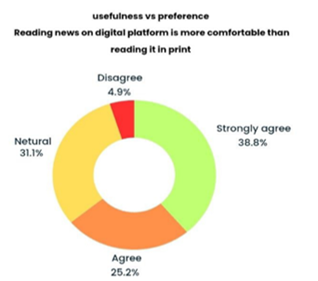
Figure 4
Students also showed confidence in downloading and saving digital journalism resources, with 70% expressing satisfaction. Furthermore, social networking sites were commonly used for journalism-related research; nearly 70% reported actively using them for this purpose.
Figure 5
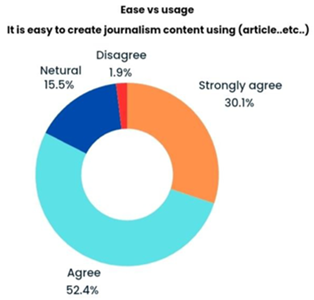
Figure 6
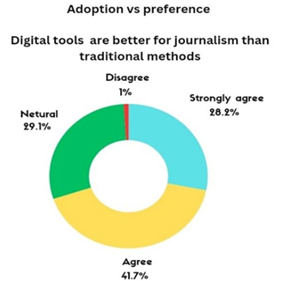
Evidently, adoption and adaptability to new platforms show 80.6% stating they could easily integrate new digital tools into their journalism practice. A clear majority (69.9%) preferred digital tools over traditional methods, showing a broad trend of digital transition in journalism education. Similarly, 68% of respondents believed that digital media enhanced their academic performance, while 71% agreed it helped develop their journalism skills.
There was overwhelming agreement (83%) that digital media is essential for future journalists. Correspondingly, 77.7% supported its inclusion in journalism education curricula. Additionally, 71% of respondents said they felt at ease utilizing digital platforms for academic tasks, demonstrating increasing digital reliance. Lastly, 72.8% of students expressed openness to experimenting with new digital media tools, confirming a strong willingness to adapt and evolve with technological advancements in journalism.
In summary, the findings reflect a favourable attitude among students toward digital media in journalism education. Most respondents find it accessible, effective, and essential for both academic success and professional development. While a small segment remains neutral or hesitant, the overall trend points toward high acceptance, readiness, and preference for digital tools in journalism training. These insights encourage the continued inclusion of digital media in journalism curricula and underscore the growing importance of digital literacy for emerging media professionals.
4. Conclusion
The findings of this study provide more than just a glimpse of digital media usage among journalism students—they signal a profound transformation in journalism education’s experience, expectations, and allows future media professionals to internalize their knowledge. As students increasingly rely on digital tools to learn, engage, and express, there is a great deal of redefinition in journalism pedagogy and newsroom readiness. Yet, while the data affirms a strong leaning toward digital media, it also increases critical questions that deserve deeper institutional and pedagogical reflection. What does it imply if the journalism classroom becomes indistinguishable from a content creator's studio? Are we preparing students to be thinkers, analysts, and questioners—or just efficient users of digital platforms? The risk here is not digital adoption itself, but the potential for tech-centric learning to overshadow critical thinking and ethical grounding—core tenets of journalism. This highlights the necessity to move beyond the binary of digital vs. traditional. It is evident that the goal must be set on creating a hybrid learning ecosystem where digital media enhances the educational experience, and not replacing legacy tools or practices. Digital fluency needs to be accompanied by epistemic curiosity. Knowing how to use a tool is not the same as awareness of when to use it, and why. Without such awareness, students may become media technicians, but not its ethical stewards. Moreover, the role of educators must evolve. The idea that students are “digital natives” can be misleading. Familiarity with platforms like Instagram or YouTube does not equate to professional competence in data journalism, ethical reporting, or multimedia storytelling. Institutions must confront this myth and instead invest in structured, intentional digital training—without presuming proficiency. The digital divide, even among young people, still exists—not in access alone, but in purposeful usage and critical application.
The bigger challenge lies in curriculum reform. If digital media is central to how students learn and practice journalism today, then why do many journalism programs still treat digital literacy as an add-on rather than a foundational layer? Embedding digital thinking into every aspect of the syllabus—from reporting and editing to ethics and media law—is not optional; it’s urgent. The failure to do so, risks producing graduates who are mismatched with the demands of the media industries they are about to enter. Additionally, the growing dependency on digital platforms opens up a complex web of concerns around surveillance, platform monopolies, misinformation, and algorithmic biases. Journalism students must not only learn on digital platforms but also learn about them. A critical media education must interrogate the structures that underpin digital tools—their business models, their algorithms, their influence on public discourse—and equip students to critique, resist, and reimagine them when necessary.
Finally, as students’ shows willingness to adapt and innovate, institutions must match that agility. This extends not only updating infrastructure and teaching tools but also rethinking assessment strategies, mentorship systems, and internship structures that reflect the realities of digital journalism. There’s also a need to cultivate digital ethics and emotional resilience—given the 24/7 nature of online media and its mental health implications. In sum, the study affirms a crucial shift: students are no longer just learning about journalism—they’re co-authoring its future through their digital practices. The onus now lies on educators, institutions, and policymakers to harness this momentum, critically analyze its implications, and build frameworks that are not only technologically current but intellectually and ethically sound. The future of journalism is undeniably digital—but whether it will also be thoughtful, inclusive, and transformatory depends on the choices one makes today in how people teach, adapt, and evolve.
5. RECOMMENDATIONS
Groundwater is a main source for drinking and domestic purposes in study area. So based on the findings of this study we recommend that: community must not depend totally on ground water as main source for fluoride, and community in study area should be use other sources for fluoride intake to obtain on daily required amount of fluoride for protection the health.
CONFLICT OF INTERESTS
None.
ACKNOWLEDGMENTS
None.
REFERENCES
Firmansyah, F., Novita, S., Rachmiatie, A., Santana, S. K., Sobur, A., and Putri, D. W. (n.d.). How the Print Media Industry Survived in the Digital Era. Universitas Islam.
Granic, A. (2023). Technology Acceptance and Adoption in Education. In O. Zawacki-Richter and I. Jung (Eds.), Handbook of Open, Distance and Digital Education. Springer. https://doi.org/10.1007/978-981-19-2080-6_1
Hassan, I., Abubakar, U. I., Nasidi, Q. Y., Azmi, M. N. L., and Shehu, A. (2021). Challenges and Opportunities for Newspapers in the Age of Digital Communication. International Journal of Academic Research in Business and Social Sciences, 11(6), 1473–1486. https://doi.org/10.6007/IJARBSS/v11-i6/10058
Kalombe, C., and Phiri, J. (2019). Impact of Online Media on Print Media in Developing Countries. Open Journal of Business and Management, 7, 1983–1998. https://doi.org/10.4236/ojbm.2019.74136
Karambelkar, N. (n.d.). Impact of Digital Media on Print Media. Department of Information Technology, Keraleeya Samajam (Regd.) Model College.
Kioko, P. M. (2022). The Adoption of Artificial Intelligence in Newsrooms in Kenya: A Multi-Case Study [Doctoral dissertation, Aga Khan University]. https://doi.org/10.19044/esj.2022.v18n22p278
Matsiola, M., Spiliopoulos, P., Kotsakis, R., Nicolaou, C., and Podara, A. (2019). Technology-Enhanced Learning in Audiovisual Education: The Case of Radio Journalism Course Design. Education Sciences, 9(1), Article 62. https://doi.org/10.3390/educsci9010062
Melnik, G. S., and Teplyashina, A. N. (2019). The Impact of Digitalization of Network Space on Journalism Education. Media Education (Mediaobrazovanie), 59(1), 86–92. https://doi.org/10.13187/me.2019.86
Nguyet Trang, T. T., Chien Thang, P., Dinh Hai, L., Thi Phuong, V., and Quang Quy, T. (2022). Understanding the Adoption of Artificial Intelligence in Journalism: An Empirical Study in Vietnam. Vietnam Journal of Media Studies.
Pasha, S. A., Sharif, H., and Hashmat, S. (2022). Factors Affecting Digital Media Acceptance for Journalistic Purposes: From the Theory of Planned Behavior Perspective. Journal of Applied Research and Multidisciplinary Studies, 3(1), 1–15. https://doi.org/10.32350/jarms.31.05
Pavlik, J. V. (2014). Transformation: Examining the Implications of Emerging Technology for Journalism, Media, and Society. Athens Journal of Mass Media and Communications, 1(1), 9–24. https://doi.org/10.30958/ajmmc.1-1-1
Rajagukguk, D. L. (n.d.). Journalism Transformation: Print Media Towards the Digitalization Era for Generation X. Universitas Nasional.
Talib, Z. A., and Saberi, S. (2022). Mobile Technology Adoption and its Direction Toward a Future Career in Broadcasting and Journalism as a Solo Broadcast Journalist. International Journal of Law, Government and Communication.
Timotheou, S., Miliou, O., Dimitriadis, Y., Villagrá Sobrino, S., Giannoutsou, N., Cachia, R., Martínez Monés, A., and Ioannou, A. (2022). Impacts of Digital Technologies on Education and Factors Influencing Schools’ Digital Capacity and Transformation. Education and Information Technologies, 27, 669–689. https://doi.org/10.1007/s10639-022-11431-8
|
|
 This work is licensed under a: Creative Commons Attribution 4.0 International License
© ShodhVichar 2025. All Rights Reserved.