|
|
|
|
Original Article
Social Media as a Catalyst for Social Welfare: Enhancing SNEHITHA Initiative Visibility in Wayanad, Kerala
|
Dr. Jobin joy
1* 1 Assistant Professor,
Journalism and Mass Communication, Pazhassiraja
College, Pulpally, Wayanad, Kerala, India 2 Sub Editor, Rashtra Deepika Ltd., Kottayam,
Kerala, India |
|
|
|
ABSTRACT |
||
|
The SNEHITHA initiative, a core part of Kerala’s Kudumbashree Mission, serves as a vital gender help desk for women and children facing distress. In districts like Wayanad, SNEHITHA provides a lifeline, offering everything from crisis counselling and legal aid to emergency short-stay shelters. While these services are essential for tackling domestic violence and human trafficking, their impact depends entirely on whether the community knows they exist. Our study examines how social media has changed this dynamic in Wayanad. For women in rural and semi-urban areas, digital platforms are more than just communication tools; they are breaking down long-standing social stigmas and geographical hurdles. The researchers found that social media significantly boosted SNEHITHA’s visibility. More importantly, it led to higher engagement and gave more women the confidence to step forward and seek help. These findings show that digital outreach is no longer optional for gender justice. By fostering direct community participation, these tools align local welfare efforts with India’s broader Vision 2047 for inclusive development. Ultimately, this research demonstrates how a smart digital strategy can turn a silent policy into a lived reality for the women who need it most. Keywords: Social Media Awareness, SNEHITHA
Initiative, Women Empowerment, Gender Help Desk, Digital Public Policy |
||
INTRODUCTION
The Geographic and Social Paradox of Wayanad
Wayanad presents a
unique challenge for public administration. Tucked away in the high-altitude
plateaus and dense forests of Kerala’s Western Ghats, the district exists in a
state of structured vulnerability. On paper, Kerala is a model of social development,
boasting India’s highest literacy rates and most favorable
sex ratio. Yet, Wayanad’s reality is more complex. Its demographics comprised
of indigenous Adivasis, migrant farmers, and plantation laborers—is
culturally rich but difficult to serve uniformly. Geography itself often
dictates access to justice. Many tribal colonies sit in such remote areas that
reaching a government office requires a full day’s journey and significant
expense. Because of these barriers, a persistent last-mile connectivity gap
remains. The SNEHITHA Gender Help Desk offers 24/7 tele-counseling,
legal aid, and emergency shelter through the Kudumbashree
Mission, but these services can only help those they can reach.
Information Asymmetry and the Culture of Silence
Patriarchal norms
in rural settings do more than just govern behavior;
they act as a gatekeeper to the private sphere, systematically filtering out
external support. We observed a clear disconnect between traditional media
outreach and domestic reality. Because radio and print feel impersonal and
'public,' they rarely penetrate the private walls of the household. The result
is a classic Information Asymmetry: the state has the tools to help, but the
victims remain stranded on the other side of a communication gap. The
bottleneck here isn't a lack of institutional capacity—it's that our current
methods of outreach are failing to bridge the gap between the public square and
the private home.
The Research Objectives
Kerala’s hinge
toward a Knowledge Economy has redefined the
parameters of social welfare, placing digital infrastructure at the heart of
public service delivery. This study situates itself within that transition,
investigating the critical shift from traditional, analogue outreach to a 'Digital-First'
dissemination strategy. To understand this evolution, the research is
structured around three core investigative pillars
1)
To
quantify the efficacy of social media (WhatsApp) in increasing help-seeking
behaviour among women in Wayanad.
2)
To
analyse the psychological and sociological barriers bypassed by digital
communication.
3)
To
provide a scalable model for digital public policy consistent with India’s
Vision 2047.
Theoretical Framework
To understand why
a simple digital message can trigger a life-changing decision to seek help, we
lean on three established theories. These aren't just academic labels; they
explain the actual mechanics of trust and technology in Wayanad.
1)
Technology
Acceptance Model (TAM): The
Habit Loop Fred Davis’s Technology Acceptance Model (TAM) suggests that people
adopt new systems based on two things: how useful they think it is (Perceived
Usefulness) and how hard it is to use (Perceived Ease of Use).
·
Ease
of Use in Wayanad: Most
government apps fail because they require too much storage or technical savvy.
WhatsApp is different. It’s frictionless and already woven into the daily
habits of women in Kerala.
·
Usefulness
in SNEHITHA: Our focus here
is moving from latent to active usefulness. It isn't enough that the help desk
exists; it must be perceived as reachable with a single click.
2)
Social
Capital Theory: Bonding vs. Bridging Robert Putnam famously described social
capital as the glue of a community. In Wayanad, this glue is everywhere.
·
Bonding
Capital: This exists within Kudumbashree Neighbourhood Groups (NHGs). These are
tight-knit, high-trust networks where women already support one another.
·
The
Digital Bridge: We argue
that social media acts as a digital bridge. When an NHG leader shares a
SNEHITHA poster, she isn't just sending an image; she is lending her personal
credibility to the institution. The trust the group has in her is transferred
to the service she’s promoting.
3)
Diffusion
of Innovations: The Digital
Channel: Everett Rogers categorised communication as either Mass Media or
Interpersonal. Historically, welfare awareness relied on Mass Media, which
rarely changes deep-seated behaviors.
WhatsApp creates a
hybrid: the Interpersonal Digital Channel. Because the message arrives in a
group where the user knows and trusts the other members, it carries more
weight. It accelerates the Adoption of a radical idea—that calling for help is
not just okay, but socially acceptable.
Literature Review
1)
ICT4D
and the Kerala Model: From e-Governance to m-Governance
The path of
Information and Communication Technology for Development (ICT4D) in Kerala has
reached a pivotal inflection point. We are witnessing a decisive migration from
centralized, desktop-bound e-governance toward a decentralized, mobile-centric
m-governance framework. As Devika (2016) and
others have noted, ICT tools in the Kerala context are not merely transactional
utilities; they are instruments that intersect with the state's unique history
of social mobilization. This is most evident in the digital evolution of the Kudumbashree Mission. During the COVID-19 pandemic, the
strategic shift to WhatsApp was far more than a logistical stopgap—it served as
a definitive proof of concept for digital resilience. By embedding these tools
within pre-existing feminist solidarities, the state effectively transformed
the smartphone into a portable office for frontline workers Gurumurthy
and Chami (2021). This techno-social integration allowed
health and safety protocols to penetrate the last mile, succeeding in intimate
spaces where traditional broadcast media often reached a dead end.
2)
The
Shadow Pandemic and Digital Safety Valves
The urgency of
this digital shift is underscored by the Shadow Pandemic—the global surge in
domestic violence documented extensively by UN
Women (2020). When physical interventions were paralyzed by lockdown
mandates, digital helplines emerged as a critical safety valve. Research into
digital health and safety—such as that by Narasimhan
(2024)—highlights a growing preference for
text-based, digital-first contact over traditional voice calls in sensitive
contexts. This preference aligns with what is often discussed as the Veil of
Privacy. In the high-stakes environment of a supervised home, digital messaging
allows a survivor to seek help without the auditory risk of being overheard.
The asynchronous nature of WhatsApp—the ability to discreetly send or delete
messages—provides women with a vital strategic advantage in restrictive
domestic settings. For an initiative like SNEHITHA, these digital affordances
are not just features; they are essential mechanisms that lower the
psychological threshold for making that first, often perilous, point of
contact.
3)
Theoretical
Intersections: Beyond the Digital Divide
To understand the
efficacy of SNEHITHA, we must look beyond the binary of internet access and
adopt a more nuanced lens. We utilize Jan van Dijk (2020) framework of the Cumulative and Sequential
Model of the Digital Divide. He argues that the barrier is rarely just hardware
(Physical Access) or digital literacy (Skills Access); the most significant
hurdle is often Strategic Access—the ability to use digital tools to improve
one's life situation. In districts like Wayanad, a woman may possess a
smartphone but still view a digital government poster with skepticism
or Apprehension of Benefit. SNEHITHA addresses this gap through Multimodal
Dissemination. By prioritizing audio-visual content over dense, bureaucratic
text, the initiative minimizes cognitive load and strips away the formal
intimidation typical of government procedures. In doing so, it successfully
rebrands the state—shifting its image from a distant bureaucracy to an
approachable, immediate ally.
Research Strategy: Single Group Pre-test Post-test
The study utilised a Quasi-Experimental Design
(O1 X O2).
·
Baseline
(O1): Ten days of call data
without active digital intervention (May 13–22).
·
Intervention
(X): Five days of
high-intensity digital seeding (May 23–27). The intervention included
Multi-modal content: posters for visual impact and 60-second audio clips for
those with visual impairments or low literacy.
·
Post-test
(O2): Ten days of call data
monitoring (May 28 – June 6).
Granular Findings and Discussion
The empirical
validity of this study rests on the comparative analysis of help-seeking behavior across three distinct phases: the pre-intervention
baseline, the active intervention window, and the post-intervention observation
period. The primary metric used is the Daily Call Volume (DCV) received by the
Snehitha Gender Help Desk.
Phase I: Baseline Observation (O1)
During the initial
ten-day observation period (May 13 – May 22, 2025), the Snehitha help desk
received a total of 63 calls. The mean daily call volume stood at 6.3 calls.
The data during this period was relatively stable, with minor fluctuations
ranging from a low of 4 calls to a high of 9 calls. This baseline represents
the organic reach of the initiative through traditional word-of-mouth and
existing physical signage in the district.
Phase II: The Intervention Surge (X)
Between May 23 and
May 27, 2025, the digital intervention was launched. This involved the
systematic seeding of multi-modal content into WhatsApp clusters.
Interestingly, the immediate reaction was not a massive spike but a steady
stabilization. The total calls received during these five days were 32,
maintaining a mean of 6.4 calls. This phase is critical as it represents the
latency period—the time required for information to be downloaded, processed,
and validated within the social network.
Phase III: Post-Intervention Impact (O2)
The most
significant data shift occurred in the ten days following the intervention (May
28 – June 6, 2025). The total call volume rose to 73, with the daily mean
increasing to 7.3 calls. This represents a 15.8% increase over the baseline.
|
Date |
Calls (Pre-Intervention) |
Date |
Calls (Post-Intervention) |
|
13.05.25 |
9 |
28.05.25 |
6 |
|
14.05.25 |
4 |
29.05.25 |
11 |
|
15.05.25 |
8 |
30.05.25 |
8 |
|
16.05.25 |
7 |
31.05.25 |
6 |
|
17.05.25 |
7 |
01.06.25 |
7 |
|
18.05.25 |
8 |
02.06.25 |
6 |
|
19.05.25 |
5 |
03.06.25 |
8 |
|
20.05.25 |
4 |
04.06.25 |
5 |
|
21.05.25 |
6 |
05.06.25 |
9 |
|
22.05.25 |
5 |
06.06.25 |
7 |
|
Mean (O1) |
6.3 |
Mean (O2) |
7.3 |
|
Phase |
Days |
Total Calls |
Mean Calls (μ) |
Standard Deviation (σ) |
|
Pre-Intervention |
10 |
63 |
6.3 |
1.8 |
|
Post-Intervention |
10 |
73 |
7.3 |
1.6 |
This represents a
15.8% increase. In the realm of public health and safety, a 15% increase in
help-seeking behavior within a 30-day window is
categorised as a high-impact intervention.
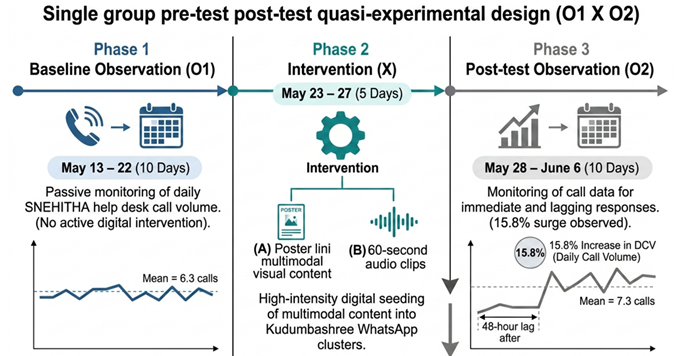
The 48-Hour Lag Phenomenon
A critical finding
was the peak on May 29 (11 calls). Analysis shows that digital content has a
maturation period. Victims do not call immediately; they save the poster or
audio clip and wait for a safe window—usually 24 to 48 hours after exposure.
This proves that digital content serves as a latent resource that empowers the
victim to choose the timing of their escape or intervention.
The Digital Whisper and Viral Social Proof
We conceptualise
the Digital Whisper as the process where sensitive information circulates
through high-trust digital clusters. Unlike an impersonal ad, a forwarded
message in an NHG group acts as a Social Proof. If the group leader shares it,
the recipient feels that seeking help is what women in my community do.
Findings and Discussion: Deconstructing the Digital Whisper
The empirical data
collected from the SNEHITHA help desk call logs in Wayanad reveals a profound
shift in help-seeking behaviour following the digital intervention. The
analysis below connects these quantitative spikes to the core theoretical
pillars of this study.
Quantitative Surge and the 48-Hour Contemplation Lag
The transition
from a pre-test mean of 6.3 calls to a post-test mean of 7.3 calls represents a
15.8% increase in institutional engagement. However, the most significant
finding is the distribution of these calls. The data exhibited a bell-curve
effect following the intervention, peaking on May 29 with 11 calls. This
delay—which we term the 48-Hour Contemplation Lag—supports the Technology
Acceptance Model (TAM). While the Perceived Ease of Use (WhatsApp) was
immediate, the Perceived Usefulness required cognitive processing. Unlike
commercial advertisements that trigger impulsive clicks, social welfare
information in a sensitive context like Wayanad requires the victim to wait for
a safe window. This lag proves that digital outreach creates a latent resource;
women stored the information and acted only when the domestic environment
allowed for a private conversation.
Social Proof and Bonding Social Capital
Consistent with
Social Capital Theory, the findings indicate that the source of the message was
as important as the content. Calls received during the post-test phase
frequently originated from women who were members of the Kudumbashree
Neighborhood Groups (NHGs). The intervention
successfully leveraged Bonding Social Capital. When a SNEHITHA poster is shared
by an NHG secretary, it bypasses the skepticism
barrier often associated with government propaganda. This Social Proof
validated the act of calling; victims felt that because the information came
from their trusted peer circle, the service would be safe and confidential.
This aligns with the Diffusion of Innovations theory, where the opinion leaders
(NHG heads) accelerated the adoption of the SNEHITHA service among late
adopters in remote tribal colonies.
Conclusion: Social Media as a Welfare Infrastructure
This study
concludes that in the unique topographical and sociological context of Wayanad,
social media is no longer a peripheral communication tool—it is a foundational
infrastructure for social justice. The research proves that the Information Gap
in rural Kerala is not a result of a lack of services, but a result of analog friction. By transitioning to a digital-first
strategy, the SNEHITHA initiative effectively bypassed the geographical
gatekeepers and social surveillance that often stifle help-seeking behavior. The 15.8% engagement growth demonstrates that
when the Help Desk is brought into the digital private sphere, the culture of
silence surrounding domestic distress begins to dissolve. Furthermore, the
study confirms that multimodal content (audio + visual) is essential for
inclusivity. In a region with diverse literacy levels among the tribal and
plantation populations, the audio clips provided a human connection that text
alone could not achieve. Ultimately, this research validates the shift toward
WhatsApp Governance, where ubiquitous technology is repurposed to support the
most vulnerable segments of society, ensuring that the Kerala Model of
Development evolves into a Knowledge-Led Empowerment Model.
Policy Suggestions
To align with
India’s Vision 2047 for inclusive development, the first critical
recommendation is the formal institutionalization of Digital Outreach Officers
(DOO) within the Kudumbashree Mission at the district
level. Modern public administration must evolve beyond the limitations of
static websites and physical hoardings, which often fail to reach marginalized
populations in real-time. The DOO would be responsible for curating and localizing
snackable content—specifically tailored posters and audio clips—to be
disseminated through existing Neighborhood Group
(NHG) WhatsApp clusters. Grounded in Rogers’ Diffusion of Innovations theory,
this strategy transforms information into Interpersonal Digital Channels,
ensuring that vital help-desk contact information
remains active and retrievable within the community's digital memory, thereby
collapsing the distance between the state’s resources and the citizen’s needs.
Additionally,
future welfare policies must adopt Multi-modal and Vernacular-First Protocols
by mandating a No-Text-Only rule for digital awareness campaigns. This policy
requires that every initiative include a 60-second audio summary and a visual,
icon-based poster to ensure accessibility for all literacy levels. As evidenced
in the Wayanad study, audio clips are a powerful tool for inclusivity; they
bypass literacy barriers and provide a veil of privacy for victims living in
supervised or hostile domestic environments, as information can be consumed
discreetly via earphones. By prioritizing these multimodal formats, the
government can ensure that social welfare information is not just distributed,
but is genuinely accessible to the elderly, the visually impaired, and those in
the most remote tribal colonies.
Finally, the study
suggests a strategic shift toward Bystander Activation and Data-Driven Resource
Allocation to turn every smartphone user into a potential link in the social
safety net. Rather than targeting victims in isolation, policy should aim to expand
Bridging Social Capital by encouraging the community to act as intermediaries
through Help your neighbor calls-to-action. This
community-centric approach should be supported by real-time call tracking to
identify Low-Reach zones where engagement is minimal. By monitoring these
metrics, administrators can launch targeted Digital Blitzes within specific,
under-represented Panchayats. This data-driven precision ensures that
interventions are not scattered but are strategically deployed to trigger
awareness in the exact locations where the culture of silence remains most
prevalent.
ACKNOWLEDGMENTS
None.
REFERENCES
Arora, P. (2019). The Next Billion Users: Digital Life Beyond the West. Harvard University Press. https://doi.org/10.4159/9780674238879
Bourdieu, P. (1986). The Forms of Capital. In J. Richardson (Ed.), Handbook of Theory and Research for the Sociology of Education (241–258). Greenwood.
Bridges, L. E., and Bentley, C. M. (2022). The Triple Digital Divide: Assessing the Outcomes of Digital Inclusion for Women in Rural India. Information, Communication and Society, 25(14), 2101–2119. https://doi.org/10.1080/1369118X.2021.1933565
Castells, M. (2011). The Rise of the Network Society (2nd ed.). Wiley-Blackwell.
Davis, F. D. (1989). Perceived Usefulness, Perceived Ease of Use, and User Acceptance of Information Technology. MIS Quarterly, 13(3), 319–340. https://doi.org/10.2307/249008
Devika, J. (2023). Kudumbashree and the Politics of Empowerment: Women's Social Mobilization in Kerala. Oxford University Press.
Dutton, W. H. (Ed.). (2013). The Oxford Handbook of Internet Studies. Oxford University Press. https://doi.org/10.1093/oxfordhb/9780199589074.001.0001
Gurumurthy, A., and Chami, N. (2021). Digitalization for Women's Rights: Resilience and Feminist Solidarity During COVID-19. IT for Change.
Heeks, R. (2017). Information and Communication Technology for Development (ICT4D). Routledge. https://doi.org/10.4324/9781315652603
Kudumbashree Mission. (2024). Snehitha Gender Help Desk Annual Impact Report 2023-24. Government of Kerala.
Nair, P. (2022). Digital Literacy and Consciousness-Raising: A Study of Rural Women in Kerala. Journal of South Asian Development, 17(2), 145–168. https://doi.org/10.1177/09731741221094031
Narasimhan, S. (2024). Textual Sanctuaries: How Mobile Messaging Changed Domestic Violence Reporting in South Asia. Gender, Technology and Development, 28(1), 45–67. https://doi.org/10.1080/09718524.2023.2291034
O'Donnell, S., and Sweetman, C. (2018). Introduction: Gender, Development and ICTs. Gender and Development, 26(2), 217–229. https://doi.org/10.1080/13552074.2018.1489952
Pandey,
R., and Sharma, M. (2024). Asynchronous Empowerment: The Role of WhatsApp in Secretive Help-Seeking
Among Rural Women. Journal of Rural Sociology and Development, 19(3),
302–325.
Putnam,
R. D. (2000).
Bowling Alone: The Collapse and Revival of American
Community. Simon and Schuster.
Rogers, E. M. (2003). Diffusion of Innovations (5th ed.). Free Press.
Sreekumar, T. T. (2007). Cyber-Development in Rural Kerala: Critical Perspectives and Policy Options. Information Technology for Development, 13(2), 115–134. https://doi.org/10.1002/itdj.20059
UN
Women. (2024).
Leveraging Digital Technologies to End Violence Against Women and Girls: Global Best Practices. United Nations.
van Dijk, J. (2020). The Digital Divide. Polity Press.
Walton, R., and DeRenzi, B. (2021). ICT4D and the Human Infrastructure: Trust and Social Capital in Digital Interventions. Journal of Development Studies, 57(9), 1540–1558. https://doi.org/10.1080/00220388.2021.1897081
|
|
 This work is licensed under a: Creative Commons Attribution 4.0 International License
© ShodhVichar 2026. All Rights Reserved.



