|
|
|
|
Original Article
DIGITAL ENGAGAGEMENT, SOCIAL CONNECTEDNESS, AND ONLINE VULNERABLITIES AMONG OLDER ADULTS IN KERALA: A MEDIA USE STUDY IN THE AGE OF ARTIFICIAL INTELIGENCE
|
Sandra
Prakash A 1*, Renjith R 2 1 M.A. Journalism and Mass
Communication, Department of Visual Media and Communication, Amrita Vishwa
Vidyapeetham, Kochi Campus, Kerala, India 2 Assistant Professor, Department of Visual
Media and Communication, School of Arts, Humanities and Commerce, Amrita
Vishwa Vidyapeetham, Kochi Campus, Kerala, India |
|
|
|
ABSTRACT |
||
|
The constant and increasing intrusion of digital communication technologies and artificial intelligence in the lives of older adults has made a paradigm shift in their communication patterns. Older adults that are labelled as 'digitally excluded' earlier are now avid consumers and users of various digital devices and applications like smart phones, social networking sites, digital payment modes and AI-powered applications that facilitate social connectivity, information access and daily life tasks. In a state like Kerala where digital literacy rates and consciousness is quite high, the older adults are fast emerging as active consumers in the digital communication sphere. At the same time, their involvement in the digital world has also opened up a gamut of vulnerabilities like misinformation, cyber fraud, lack of privacy, emotional addiction, lack of confidence and knowledge about technology. This research is a study to investigate the relationship between digital engagement and social connectivity, and the online vulnerability of older adults in Kerala in the era of AI-powered communication systems. The study is quantitative research design where structured questionnaires were distributed among elderly individuals aged 55 and above in different districts of Kerala with reference to the use of digital media, communication channels preferred and awareness about artificial intelligence technologies, emotional connectedness and online vulnerability among elderly people. The results indicate that smartphones, WhatsApp, YouTube and other social media platforms are used significantly by the older adults for communication and virtual social interaction, and it strengthens their emotional ties and alleviates the loneliness of those living apart from their kith and kin. On the other hand, the elderly feel concerned about fake news, online fraud, privacy concerns and AI generated false information because of their low digital literacy, awareness and knowledge about online security practices. The conclusion drawn emphasizes on digital literacy, cyber safety education and the design of inclusive technology that make their experience in the digital space safer and more meaningful. It adds to the existing research on ageing, media, digital communication and artificial intelligence in the present-day context. Keywords: Older Adults, Digital Engagement, Social Connectedness, Online Vulnerability, Artificial Intelligence, Media Use, Kerala, Digital Literacy |
||
INTRODUCTION
The increased growth of digital communication
technology has changed the pattern of communication, interaction, and societal
participation. Smart phones, social networking websites, on-line payment modes,
artificially intelligent systems/applications and on-line communication tools
are integrated into everyday lives. Younger generation is generally considered
the main users of digital technology but with increasing use of digital
technology the senior generation is also actively involved in digital communication
sphere.
In Kerala increased use of digital technology
among senior citizens has become increasingly noticeable. Due to family
structures like migration, dispersal of family members at distant places,
easier internet access, the aged citizens in Kerala depend more on digital
communication tools for maintenance of social relationships and intimacy. Use
of applications like WhatsApp, YouTube, face book, video calling applications,
are frequently found among senior citizens for communication, entertainment,
accessing healthcare, acquiring knowledge etc.
During COVID-19 the dependency of elderly
people on digital technology grew. They remained connected with their family
members through online modes of communication when physical interaction was
impossible and reduced due to the restriction in their physical movements. The
fear from being socially isolated and emotional suffering can be mediated and
managed by keeping touch with the family and acquaintances through digitally
facilitated communication. Thus, it has become an integral part of the social and
emotional life of the elderly.
As digital communication technology develops
and evolves, it has also become increasingly intertwined with artificial
intelligence. Recommendation algorithms, voice assistants, automated messaging
and artificial intelligent contents now play a significant role in the
information accessibility for users in digital domain. In spite of these benefits,
it also causes the older persons to new type of online vulnerabilities.
Many old people may lack the necessary
understanding on algorithmic processes, protection of privacy, misinformation,
and safe practices of digital interaction due to their low digital literacy,
therefore they become vulnerable to online attacks like phishing, misleading
information or false news, financial scams and exploitation, fabricated digital
media contents and manipulation by others.
On one hand it helps in establishing and
maintaining relationships which can reduce social isolation, mobility
impairment and emotional vulnerability of the elderly but the use of this
technology may lead to some negative social and emotional consequences to the
aged individuals. Therefore, in this study I propose to investigate
relationship of digital involvement, social connectedness and online
vulnerability of older adults in Kerala within the context of AI driven
communication systems. Arora
et al. (2025)
RESEARCH OBJECTIVES
·
To study the pattern of digital use
among older people of Kerala.
·
To analyse the correlation between
digital use and social connectedness among older users.
·
To explore the types of online
vulnerabilities experienced by older adults in AI enabled digital world.
·
To explore the level of awareness on
AI tools and safety aspects among elderly people.
·
To analyse the effect of demographic
factors on digital use and online vulnerability.
RESEARCH QUESTIONS
The study seeks to answer the following research questions:
1) What
are the patterns and intensity of digital engagement among older adults in
Kerala?
2) How
does digital communication influence social connectedness among elderly users?
3) What
types of online vulnerabilities are experienced by older adults in AI-driven
communication environments?
4) How
aware are older adults about artificial intelligence technologies and digital
risks? What role does digital literacy
play in reducing online risks and improving online safety?
5) Do
demographic variables influence digital engagement and online vulnerability
among older adults?
HYPOTHESES
The study is guided by the following
hypotheses:
H1: There is a
significant positive relationship between digital engagement and perceived
social connectedness among older adults in Kerala.
H2: There is a
significant relationship between digital engagement and AI-related risk
exposure among older adults.
H3: There is a
significant relationship between awareness of artificial intelligence
technologies and online vulnerability among older adults.
H4: Demographic
variables such as age, gender, education, and rural–urban location
significantly influences digital engagement and online vulnerability among
older adults.
H5: Higher levels
of digital literacy reduce the likelihood of online vulnerability among elderly
users.
REVIEW OF LITERATURE
LITERATURE REVIEW
The increased growth of digital communication
technology has changed the pattern of communication, interaction, and societal
participation. Smart phones, social networking websites, on-line payment modes,
artificially intelligent systems/applications and on-line communication tools
are integrated into everyday lives. Younger generation is generally considered
the main users of digital technology but with increasing use of digital
technology the senior generation is also actively involved in digital communication
sphere.
In Kerala increased use of digital technology among senior citizens has become
increasingly noticeable. Due to family structures like migration, dispersal of
family members at distant places, easier internet access, the aged citizens in
Kerala depend more on digital communication tools for maintenance of social
relationships and intimacy. Use of applications like Whatsapp,
YouTube, face book, video calling applications, are frequently found among
senior citizens for communication, entertainment, accessing healthcare,
acquiring knowledge etc. Dhar
(2025)
During COVID-19 the dependency of elderly
people on digital technology grew. They remained connected with their family
members through online modes of communication when physical interaction was
impossible and reduced due to the restriction in their physical movements. The
fear from being socially isolated and emotional suffering can be mediated and
managed by keeping touch with the family and acquaintances through digitally
facilitated communication. Thus, it has become an integral part of the social and
emotional life of the elderly.
As digital communication technology develops
and evolves, it has also become increasingly intertwined with artificial
intelligence. Recommendation algorithms, voice assistants, automated messaging
and artificial intelligent contents now play a significant role in the
information accessibility for users in digital domain. In spite of these benefits,
it also causes the older persons to new type of online vulnerabilities.
Many old people may lack the necessary
understanding on algorithmic processes, protection of privacy, misinformation,
and safe practices of digital interaction due to their low digital literacy,
therefore they become vulnerable to online attacks like phishing, misleading
information or false news, financial scams and exploitation, fabricated digital
media contents and manipulation by others.
On one hand it helps in establishing and maintaining relationships which can
reduce social isolation, mobility impairment and emotional vulnerability of the
elderly but the use of this technology may lead to some negative social and
emotional consequences to the aged individuals. Therefore, in this study I
propose to investigate relationship of digital involvement, social
connectedness and online vulnerability of older adults in Kerala within the
context of AI driven communication systems.
RESEARCH GAP
Past literature on digital media use and
social media behaviour among the aged have been widely explored. Few studies
exist which specifically investigate the effects of AI-driven digital media on
social connectedness and the online vulnerabilities among the elderly, but
instead they focus either on the benefits of digital communication or general
risks of internet usage, but seldom both. In the Indian setting, particularly
in the context of Kerala, little research has been carried out on the digital
use by the aged, despite a high level of literacy and increasing levels of
digital usage among them. It also deals less with topics like AI-generated
misinformation, online scams, privacy issue and digital safety awareness among
the aged. This research aims to identify and fill these research gaps by
examining the links between the use of digital media, social connectedness and
online vulnerability in an AI-driven communication system among the aged in
Kerala. Guzman
et al. (2023)
THEORETICAL FRAMEWORK
The theory is supplemented with Uses and
Gratifications theory, Technological Determinism theory, and Personal schema
theory. Uses and Gratifications theory is applied to the study as elderly users
proactively seek and use the digital media to gratify communication, emotional,
social, and informational needs. Aging individuals use the digital media to
keep family members in touch and obtain entertainment, and reduce their
feelings of solitude. Technological Determinism theory is employed in this
study because digital media and artificial intelligence system influence the behavior pattern of communication and social interaction
among the user group. AI platforms determine the information old people are
given and how they interact. Personal schema theory assists to interpret how
old users understand the digital content through the filter of their personal
beliefs, experiences, and previous social cognitions.
RESEARCH METHODOLOGY
Research Design
The quantitative research design has been
used for studying the digital media usage and experiences of the aged people of
Kerala in a systematic manner. This type of research design could help the
researcher to analyze the quantified data by
application of descriptive statistics which has become instrumental for tracing
patterns.
Target Population
The study targeted all elderly individuals
aged 55 and above residing at different locations across Kerala from different
socio-cultural strata and streams of education so as to make it a heterogeneous
study and to draw a broad representative sample for understanding the different
aspects of digital media use.
Sampling Technique
Purposive sampling design has been used to
select elderly people belonging to all the districts of Kerala with an
objective to get geographical and socio-cultural diverse data of the
respondents. The respondents aged above 55 years have been chosen to get
heterogeneous samples belonging to different streams of education.
Data Collection Tools
The study made use of a structured
questionnaire as the instrument for collecting data. The questionnaire
contained different sections focusing on dimensions of frequency of use of
digital media, ownership of smart phones and application and applications,
usage of social media applications and platforms, understanding of artificial
intelligence, exposure to on line scam and fake news, awareness of the
protection of information, trust on other users, the feeling of loneliness
being overcome by digital media, etc.
Data analysis method
The data collected from the 321 respondents
was analyzed by descriptive statistics. Descriptive
statistics is a quantitative approach to summarize and describe the properties
of a variable. It describes the patterns of the respondent’s answers which have
been presented in the forms of tables, figures and other diagrams and help to
draw appropriate conclusion on the study of the subject.
FINDINGS AND ANALYSIS
AGE DISTRIBUTION OF RESPONDENTS
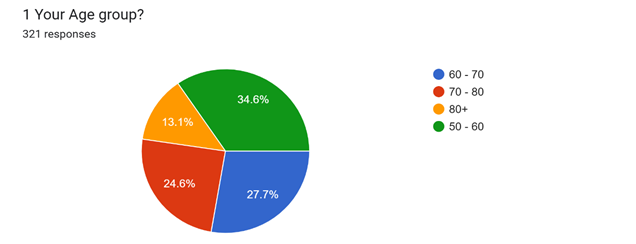
From 321 responses, a large majority of the
participants were in the 50-60 age group and this represented 34.6% of the
total sample, with a quarter of participants falling into the 60-70 age bracket
and just over 13% being over 80 years old.A
significant portion of the respondents were within the 50–60 age group,
accounting for 34.6% of the total sample, while 27.7% belonged to the 60–70 age
category. Individuals aged above 80 represented 13.1% of the participants. The
distribution shows that the study covered older adults from diverse age ranges,
which helped in gaining a broader understanding of how digital engagement
differs across various stages of later life. Ivan
et al. (2020)
GENDER DISTRIBUTION OF RESPONDENTS
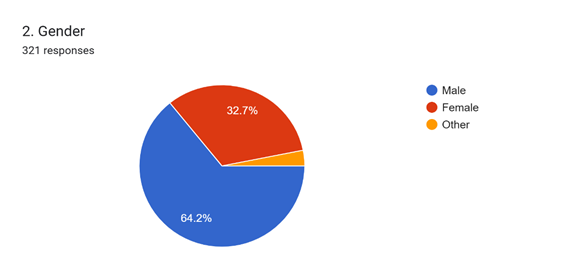
Out of the total participants, the proportion
of males is the highest, with 64.2% while that of the females is 32.7%. A
marginal number of respondents marked "other" in the sex column. The
overall analysis concludes that among the old in Kerala now, it is relatively
more the males.
EDUCATIONAL QUALIFICATION OF RESPONDENTS
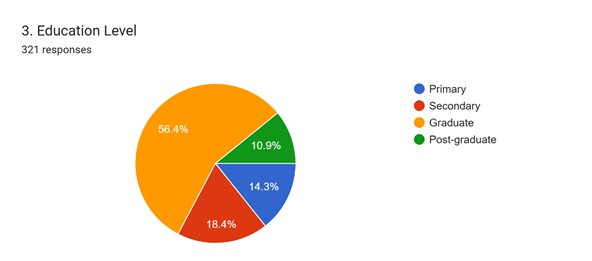
In the present sample, a little over half
(56.4%) had a university degree. Those who had completed only primary education
formed the smallest category of the present sample. Results indicated that
education could have played a role in the awareness of and comfort with new
technology in the present sample.
GEOGRAPHIC DISTRIBUTION OF RESPONDENTS
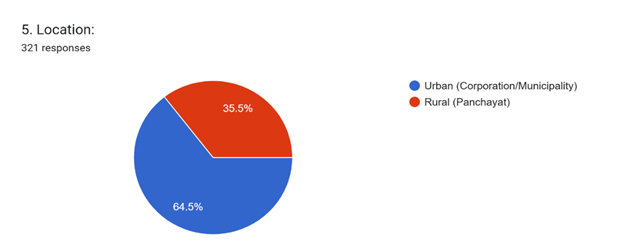
The participants from urban centres represent
64.5% of the total sample. 35.5% of the respondents live in rural areas. This
suggests the greater extent to which urban areas are technologically accessible
and provide smartphones as compared to rural areas.
Digital Engagement Patterns
The research found that one of the most
commonly used digital devices by elderly people in Kerala were smartphones.
Most of the elderly people responded positively saying that they used digital
devices like WhatsApp, YouTube, Facebook, video calling and more in their
everyday lives for communicating, seeking information and for entertainment
etc. The main reason stated by elderly people for using digital media was to be
in touch with their family members. Many aged persons revealed that these
digital devices allowed them to be regularly connected with their sons,
daughters, grandchildren and other relatives living far away. In addition to
this, elderly people listed many other reasons like getting news, watching
religious videos, other sources of entertainment and learning about health
issues etc. As major uses for digital media. The analysis therefore indicates that
digital engagement among older adults in Kerala is no longer limited to basic
communication. Instead, digital media has become part of their social,
informational, and emotional lives. Lei et
al. (2023)
Digital Engagement and Social Connectedness
Secondly, the present study tried to
establish the relationship between the utilization of digital communication and
felt social connectedness by the old. The findings confirm the purposes of
digital communication use in the social networking of the old. It can be
clearly seen that most of the respondents in this study had stated that the use
of digital communication has increased the feeling of being connected to their
families. They expressed less feelings of being alone and more interactions
through conversations on internet with their families who reside far away.
People reported being involved in numerous virtual communities and WhatsApp
groups. Findings support that family, neighbours, religious communities, social
circles among others can increase connections in old age. It was shocking that
people deprived of using digital communication have been socially excluded from
their community which reflects the social importance of digital communication
even in old age for many activities one must own and utilize a smartphone to
digitally connect. It was tested with a statistical test and the relationship
between usage and connectedness has been found to be significantly positive.
Individuals having active and greater use of their mobile phones stated feeling
more supported and included. 62 H1: There is a significant positive
relationship between digital engagement and felt social connectedness among
older adults in Kerala. Was found to be true with the results mentioned.
Therefore, digital communication tools could be one effective tool for
maintaining emotional ties, community participation, and social connectedness
among older adults.
Vulnerabilities on the internet and risks relating to AI
It is evident that there are significant
issues concerning the vulnerabilities associated with the use of the internet
in relation to the survey. It is evident that a number of participants seemed
to be confused about fake news, misinformation, suspicious internet messages
and fraudulent internet material and indicated that they did not find it easy
to work out when they had encountered manipulated data or the difference
between real and fake online messages.
The survey also showed that older users'
awareness of AI, recommender algorithms and AI-created digital content is poor.
They indicated that they felt most concerned about:
·
Cyber-scams and fraud
·
Lack of privacy
·
Online financial fraud
·
Misinformation on the internet
·
Misuse of their private data
Digital communication that makes them feel
emotional
The vulnerability of older users is more
prevalent in users with lower levels of digital literacy and less awareness of
safe on-line activities.
|
Table 1 |
|
Indicator |
Yes |
No |
|
Received suspicious calls/messages |
66.7% |
33.3% |
|
Experienced financial loss due to
online fraud |
14.0% |
85.0% |
|
Verify news before sharing |
76.3% |
23.7% |
|
Attended digital literacy programme |
21.5% |
78.5% |
|
Know where to report cyber fraud |
70.1% |
29.9% |
In spite of a small percentage actually
falling victim to scams, an overall awareness of fear and anxieties pertaining
to internet fraud was evidenced. Respondents expressed concerns of going online
for mobile banking applications for fear of getting frauded, hacking and of
being made to spread fake news.
Many participants confessed forwarding videos
or news from the internet without assessing the genuineness of the content. In
many situations trust in forwarded messages via WhatsApp was still in place
even when it pertained to the digitally illiterate.
Majority of participants felt that AI
produced video, sound effects and other synthesized elements could be very
believable to older persons. This indicates growing understanding of the
problem of AI fake content and deepfakes.
Most participants felt uncertain whether they
would know how to identify fake or AI produced content by themselves. Older
people felt aware of the danger posed by AI based fake content but struggled to
identify and tackle them effectively.
The second hypothesis was partially
confirmed.
H2: A statistically significant relationship
exists between digital engagement and AI-related risks faced by older people.
The association appears to be that higher
engagement with the internet allows older persons to access domains where they
are likely to become victims of scams, fake information and fraudulent
messages. However, AI-related risks are not merely a function of digital
engagement; digital literacy and awareness also play a critical role. Leist
(2013)
AI AWARENESS, DIGITAL LITERACY, AND PROTECTIVE BEHAVIOUR
The study further investigated AI-related
awareness and understanding among the older adults.
It found that respondents had moderate
understanding on issues of fake news generated by AI and digital deception.
Majority of the respondents had an understanding on how AI technology can be
utilized to deceive older adults through fake videos, modified voices and fake
online content.
At the same time respondents had limited
digital literacy training. More than three quarters of respondents never
attended any digital literacy or cyber awareness program. This shows a great
disparity in digital usage versus digital safety education.
Family support was also found to be an
important protective factor in the study. Many of the respondents replied that
they were guided by their family members on issues of cyber safety, prevention
of cyber fraud, and verification of dubious messages.
Respondents who showed high awareness of AI
and online misinformation had relatively better protective behavior
like verification of news prior to sharing, avoiding dubious links etc.
The above finding is in accordance to the
third hypothesis:
H3: There is a significant relationship
between AI awareness and AI-related risk exposure among the older adults.
This implies that higher awareness of the
risks caused by the development of AI may lead to decreased vulnerability and
better online behaviour in older adults.
INFLUENCE OF DEMOGRAPHIC VARIABLES
Finally, the objective was to study the
impact of demographic characteristics such as age, gender, education and
rural-urban location on the digital involvement and the exposure to risks of
older adults.
From the study analysis, it was evident that
younger elderly within the age range of 50-70 age group have relatively greater
involvement in digital technologies than in those above 80. Young old utilize
most of the social networking sites, mobile banking, and communication tools as
well.
Education level of respondents influenced the
digital confidence and knowledge. Higher level education of respondents
(graduate and postgraduate) exhibit comparatively more experience on digital
platform and is relatively better to identify the suspicious behaviour of
online.
The urban population utilized their smart
phones, engage more on social networks and exhibits better digital confidence
when compare to rural participants. Rural participants are relatively hesitant
in utilizing the complex digital applications and primarily in using mobile
banking and on-line payments system.
Significant role was played by gender in the
case of digital involvement. Male participants show comparatively more
utilization of digital technologies while female participants are more
dependent on family members for support in using digital platform.
From the results, all four hypotheses that
were taken are confirmed:
H4: The demographic variables such as age,
gender, education, and rural-urban location significantly predict the digital
involvement and AI-related risk exposure among elderly in Kerala.
This study indicates that demographic
features considerably influence the opportunities, challenges and
vulnerabilities of the old generation on the digital landscape of Kerala. Makita
et al. (2019)
Digital literacy and security behaviour
A high proportion of respondents used digital
communication regularly but most did not seem to have a good understanding of
on-line security behaviour. Mari
(2026)
A number of respondents reported that they
rely on members of their family to help them work out how different digital
communication applications work, how privacy settings are set up and what to do
about anything that seems out of the ordinary. Higher levels of digital
literacy among elderly respondents were associated with greater security behaviour
when dealing with online risks. The survey suggests that educational programs
on digital literacy could be effective in promoting the safe use of digital
communications among older users. Sharma
and Gautam (2023), Wangler (2023)
DISCUSSION
The present study's results prove older
adults are increasingly exposed to digital threats. Henceforth, this research
supports the main hypothesis that characteristics associated with old age can
make the elderly more susceptible to cyber fraud and online misinformation.
From the study it can be concluded that the less digital literacy, lower
knowledge about AI-driven scams and absence of family assistance contribute to
the increased risk of elderly in using the internet.
Henceforth the researcher suggests the
following to overcome the deficiency; improve digital literacy training
specifically targeted at older adults in terms of their mobile safety, fraud
recognition, and knowledge about deepfake. Financial institutions need to
assume their share in providing easy, clear, and language appropriate
assistance on safe internet banking. Family can provide the first aid for older
adults as young family members help in combating risky internet behaviour;
therefore, intergenerational guidance would be very useful. Community level
cyber-security awareness through panchayats, libraries, and resident
associations is crucial as elderly people have more trust in these
organizations compared to other sources. Furthermore, technology providers need
to consider elderly people in designing user-friendly interfaces and simple
fraud reporting systems and responsible helpline service to act immediately
against the risk.
The results show a growing usage of digital
communication technologies by older adults in Kerala. The main reasons of
elderly internet users for engaging with digital technologies include seeking
emotional support and connection, entertainment and accessing information. The
Uses and Gratifications Theory applies as elderly users voluntarily and
consciously engage with digital technologies to address social and emotional
needs, and WhatsApp, YouTube and video calling apps have become indispensable
for maintaining family connections and preventing social isolation among
elderly users. It supports the Technological Determinism Theory as the
technology infrastructure based on artificial intelligence gradually influence
and define the information environment of the older adults, especially
recommendation algorithms, automated news feeds, and AI generated
communications create users' experience of online space often unconsciously.
The study supports the Personal Schema Theory as elderly users view digital
content based on their prior experiences, level of digital literacy and social
knowledge. Elderly users who lack a high level of digital literacy may fail to
critically assess the information provided, thereby becoming susceptible to
online fraud and misinformation. In addition to enhancing social connectivity,
this study also demonstrates that digital technology fosters an emotional and
technological dependence and excessive access to online information contributes
to uncertainty, distrust and anxiety among the elderly.
CONCLUSION
This research analyses the extent of their
digital participation, the dimension of social connection and the risks
associated in digital world, with respect to the elderly in Kerala, within the
new frame of communication system being developed on the artificial
intelligence.
The results suggest that it is not valid anymore to regard the elderly as digitally excluded population. Smartphones, applications and digital means have come to take an integral role in their lives. Digital communication is effective to provide them mental support by connecting them with others, combating loneliness. However, more and more digital involvement has created greater vulnerability on the elderly including fake information, cybercrimes, privacy and AI trickery, on the part of inadequate digital literacy and ignorance about digital security measures. It also underscores the need for an improvement in digital literacy education, creation of cyber awareness and building age friendly communication system.
REFERENCES
Arora, R., Bose, P., Chatterjee, S., Singh, N., and Mitra, N. (2025). A Comparative Study on the Influence of Social Media on Older Adults Residing at Home and in Old Age Home Settings in Kolkata. International Journal of All Research Education and Scientific Methods.
Dhar, D. (2025). Growing Old in the Age of New Media. Springer Nature Singapore.
Guzman, A. A., Brecht, M. L.,
Doering, L. V., Macey, P. M., and Mentes, J. C. (2023). Social Media Use and Depression in Older
Adults: A Systematic Review. https://doi.org/10.1016/j.ijnurstu.2023.104598
Ivan, L., Loos, E., and Bird, I.
(2020). The Impact of
Technology Generations on Older Adults’ Media Use. Gerontechnology, 19(4),
1–17. https://doi.org/10.4017/gt.2020.19.4.521.1
Lei, X., Matovic, D., Leung, W. Y., Viju, A., and Wuthrich, V. M. (2023). The Relationship Between Social Media Use and Psychosocial Outcomes in Older Adults: A Systematic Review. International Psychogeriatrics. https://doi.org/10.1017/S1041610223001348
Leist, A. K. (2013). Social Media Use of Older Adults: A Mini-Review. Gerontology, 59(4), 378–384. https://doi.org/10.1159/000346818
Makita, M., Mas-Bleda, A., Stuart, E., and Thelwall, M. (2019). Ageing, Old Age and Older Adults: A Social Media Analysis of Dominant Topics and Discourses. Ageing and Society, 39(12), 1–26. https://doi.org/10.1017/S0144686X18001016
Mari, A. (2026). What Excessive Social Media Menas for Older Adultes. Forbes.
Sharma, R., and Gautam, V. (2023). New Age Digital Media Consomption: An Explora tory Study Based in India. Indiana Institute of Management Ahmedabad.
Wangler, J. (2023). Media Portrayal of Old Age and Its Effects on Attitudes in Older People. Humanities and Social Sciences Communications, 10, 150. https://doi.org/10.1057/s41599-023-01687-7
|
|
 This work is licensed under a: Creative Commons Attribution 4.0 International License
© ShodhVichar 2026. All Rights Reserved.


