|
|
|
|
Original
Article
A STUDY ON THE INFLUENCE OF DIGITAL APPLICATIONS ON THE PURCHASE DECISIONS OF URBAN WOMEN
|
Adithya Sibal
1*, S. Dinesh Babu 2 1 MA JMC Student, Department of Visual Media and Communication, School of Arts, Humanities and Commerce, Amrita Vishwa Vidyapeetham, Kochi Campus, Kerala, India 2 Assistant Professor
(SG), Department of Visual Media and Communication, School of Arts,
Humanities and Commerce, Amrita Vishwa Vidyapeetham, Kochi Campus, Kerala,
India |
|
|
|
ABSTRACT |
||
|
Urban societies have seen a major change in consumer purchasing Behaviour due to the quick development of smartphones, mobile internet and digital commerce platforms. Urban women have been treated as one of the most active consumers of digital shopping applications among various consumer groups because of their busy lifestyles, growing financial independence, and increased technological knowledge. This study looks at how metropolitan women between the ages of 18 and 45 make purchases in relation to digital shopping applications. The research mainly looks at how social influence, customized suggestions, ease of use, trust and security, app usability, and marketing strategies affects buying habits on the internet. The study uses Google Forms to distribute a structured online survey as part of quantitative method. From urban women who actively use digital shopping apps, 250 valid replies were collected. To understand consumer Behaviour in digital environments, the study includes ideas from the Technology Acceptance Model (TAM), Theory of Planned Behaviour (TPB), Social Influence Theory, Trust Theory, and Consumer Decision-Making Theory. Convenience, ease of navigation, home delivery services, customized recommendations, discounts, and platform trust are found to have an important effect on purchasing decisions. Additionally, the study suggests that influencer marketing, online communication, and social media reviews have an important effect on customers who value goods and services. Even older consumers prioritize on safety, security, and trust, younger women are willing to make impulsive and emotional purchases. The study results in the conclusion that in order to keep female consumers in a competitive online market, digital shopping apps need to set a high priority on customized user experiences, safe transactions, and effective communication methods in along with ease of usage. Keywords: Digital Shopping
Applications, Urban Women Consumers, Purchase Decision Behavior, Mobile
Commerce (M-Commerce), Consumer Trust and Security |
||
INTRODUCTION
Traditional retail markets have changed in the digital era. Online purchasing has increased because of smartphones, mobile networks and e-commerce platforms. Today, consumers depend on digital applications for purchasing goods and services. Applications for shopping offer flexibility, speed, and easy access to goods. One of the consumer segments in online transactions which is growing fastest are urban women. Their purchasing capacity and online engagement have improved because of greater job and educational involvement. Many urban women balance their personal lives, careers, and household responsibilities.
Customized recommendations, consumer feedback, discounts, safe payment methods, and delivery services are just some of the functions that modern shopping applications offer. Choices regarding what to purchase online are influenced by these factors. Before making a purchase via the internet, consumers also consider security, trust, and discounts taken into account. This study looks at the variables that affect urban women who actively use digital shopping applications and are between the ages of 18 and 45 while making purchases.
SIGNIFICANCE OF THE STUDY
This study is significant as it offers information on how metropolitan women between the ages of 18 and 45 make purchasing decisions based on internet shopping platforms. In order to satisfy the needs and preferences of this quickly growing demographic of educated and financially involved consumers, businesses may develop better methods.
The study highlights a number of key characteristics that influence purchasing decisions, including convenience, security, customization, and social influence. According to the study, social influence, convenience of use, security, and customization are some of the key factors that influence consumers' purchasing decisions. The study plays a role in the development of mobile commerce platforms that are more user-friendly and consumer-focused by examining these variables.
The study's conclusions will be helpful to digital marketers, mobile application developers, and e-commerce businesses who desire to bring in and engage female customers. Businesses may develop better user interfaces and focused marketing campaigns by knowing how urban women analyze application features, access the dependability of digital platforms, and react to marketing methods.
It offers to the body of knowledge in the fields of digital marketing and consumer Behaviour. It provides current studies on how buying habits in modern cities are influenced by digital platforms and technological developments.
RESEARCH OBJECTIVES
·
To examine how
convenience and app usability affect consumers' decision to buy.
·
To determine the
importance of trust and security.
· To examine the influence of social factors (influencers, reviews).
RESEARCH QUESTIONS
1) RQ: How much effect does convenience and app usability have on their purchase decisions?
2) RQ: What role do security and trust play in making decisions?
3) RQ: What effect do social media and reviews have on purchases?
LITERATURE REVIEW
The quick development of mobile
shopping and digital technology has increased the academic interest in online
consumer Behaviour. Scholars have investigated digital communication,
convenience, trust, and use of technology in online buying environments.
Abbas and Szabó (2022) investigated mobile shopping applications using the Technology
Acceptance Model. According to their research, users' views of shopping
applications are positively impacted by perceived value, comfort, and social
influence. The significance of technology acceptance in the adoption of mobile
commerce was also highlighted by the study.
Rashmi et al. (2020) investigated how customers behave while shopping on mobile devices.
There that perceived risk has a negative impact on online purchases.
Customer satisfaction in mobile shopping applications was the main goal of Ngubelanga and Duffett (2021). According to their research, user involvement, convenience, and trust all boost customer satisfaction and encourage users to stay with shopping applications.
Singh et al. (2024) focused on security and trust in digital marketplaces. The results
indicated that platform reliability, secure payment methods, and security
measures for privacy had significant effects on the choices made by customers
to make purchases online.
The influence of online
advertising on customer Behaviour was examined by Anoop (2017). According to the study, advertisements increase customer awareness,
but peer recommendations and evaluations influence final purchase decisions.
Lakshmi et al. (2024) examined urban Indian women consumers and their online shopping habits.
Their research showed the importance of online communication, traditional, and
social media for influencing women's buying habits.
Convenience, trust, social
influence, and technological ease of use have a significant impact on online
purchase Behaviour, according to previous studies. However, there is a lack of
study that particularly targets urban women's usage of digital shopping
applications to make purchases.
RESEARCH GAP
Current research mainly focuses
on Behaviour al intention and technology usage instead of actual purchasing
decisions. Rather than concentrating on urban women as a distinct demographic
group, several studies look at general consumer groupings.
Furthermore, previous studies
often look at psychological, social, or technological aspects separately. To
understand urban women's purchasing Behaviour, very few studies combine elements like convenience, customization,
security, trust, reviews, and social influence into a single structure.
To close these gaps, this study
examines how a variety of social and technological elements interact to affect
urban women's purchasing decisions while they use digital shopping
applications.
THEORETICAL FRAMEWORK
The study is founded on various assumptions regarding consumer Behaviour and technology usage. According to the Technology Acceptance Model, customers choose items that are useful and simple to use Davis (1989).
The Theory of Planned Behaviour states that attitudes, beliefs, and social influence all have an impact on online shopping decisions Ajzen (1991).
According to Social Influence Theory, ratings, reviews, and recommendations from influencers have an impact on consumer behaviour.
The significance of safe payment methods and reliable services in online buying is explained by trust theory. The methods that customers go through before making purchases are described by consumer decision-making theory. These ideas help in the explanation of how urban women's online purchasing Behaviour is influenced by convenience, trust, social influence, and personalized experiences.
RESEARCH METHODOLOGY
RESEARCH DESIGN
The study uses a quantitative
method to examine how urban women's purchasing decisions are influenced by
digital shopping applications.
RESEARCH METHOD
Using Google Forms, a structured
online survey was conducted. Convenience, app usability, trust, security,
personalized recommendations, and social
influence were some of the topics covered by closed-ended and Likert-scale
questions.
SAMPLING
Urban women between the ages of 18 and 45 who regularly use digital shopping applications belong to the target audience. Non-probability convenience sampling was used in the study. A total of 250 valid replies were collected from participants with different educational and professional backgrounds.
DATA COLLECTION TOOLS
A questionnaire was
shared through social media and personal networks
to collect data.
The questionnaire has sections on the following topics:
·
Usage of digital
shopping applications
·
UI/UX design of
applications
·
Convenience &
Accessibility of shopping applications.
·
Price Sensitivity
& Promotional Influence
·
Trust & Security
·
Impact of digital
shopping applications on purchase decisions
ETHICAL CONSIDERATIONS
Before taking part in the
survey, participants were informed about the purpose of the study. Throughout
the study, response privacy and confidentiality were protected. The information
was only collected for academic research.
DATA ANALYSIS
Using descriptive statistical methods like frequency analysis and percentages, the data collected was arranged and examined.
Demographic analysis
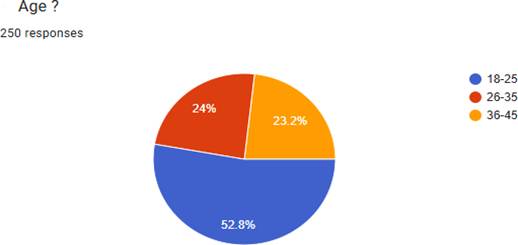
250 urban women between the ages of 18 and 45 took part in the survey. The majority of the Participants aged between 18-25 (52.8%). 24% of the participants were aged between
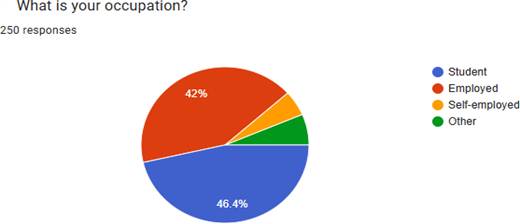
26-35 and (23.2%) were aged between 36-45. Most were students (46.4%), and employed
individuals (42%), self-employed individuals (5.2%), and others (6.4%).
Usage of Digital Shopping Applications
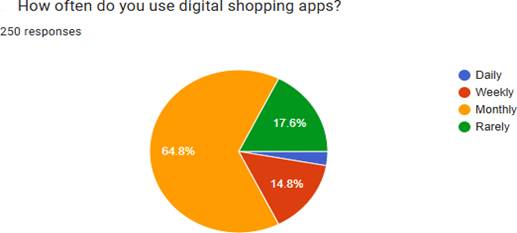
Frequency of use: Most participants (64.8%) use digital shopping applications monthly according to the analysis of results it suggests that most users prefer occasionally, but planned usage over regular involvement. Only 17.6% of respondents said they use these applications rarely, where 14.8% said they use it once a week. Only a very small portion of participants use digital shopping applications daily, showing a low level of daily dependence on these platforms. The results show that although urban women use digital shopping applications frequently but are mainly used occasionally rather than for regular shopping.
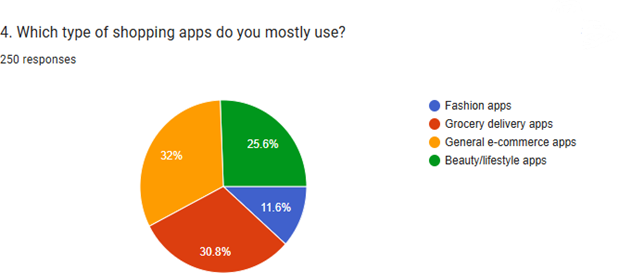
Types of apps used: According to
the findings, the most popular applications are those for general e-commerce
(32%) and grocery delivery applications (30.8%). Fashion applications (11.6%)
are the least popular although beauty and lifestyle applications (25.6%) are
also widely used. In general, urban women enjoy shopping applications that can
be easy and flexible.
UI/UX Design of Applications
Ease of navigation: According to
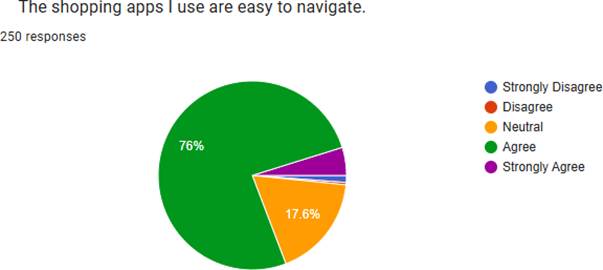
the results, a large majority (76%) believe that the Shopping applications that
they use are easy to navigate. Furthermore, 17.6% were neutral on the topic.
There was a little disappointment because only a percentage showed strong support or dissatisfaction. Most people
found that shopping applications are simple and easy to use.
Convenience AND Accessibility of Shopping Applications
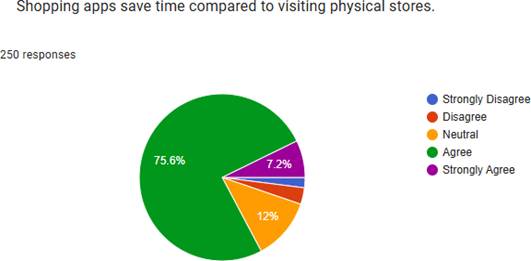
Most respondents (75.6%) agreed
that using shopping applications instead Going to actual stores saves time.
Just a small percentage disagreed, with 12% being neutral and 7.2% strongly
agreeing.
Trust and Security
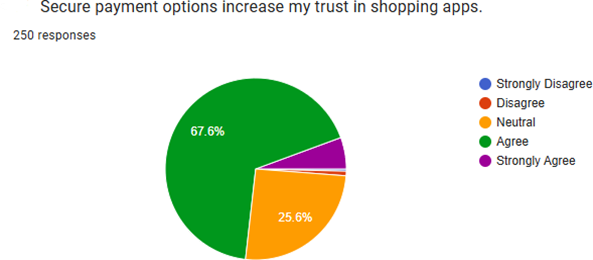
The results show that while
25.6% of respondents had no opinion, 67.6% of respondents agree that secure
payment methods boost their confidence in shopping applications. The statement
was strongly agreed with or disagreed by a percentage. Overall, the findings show that when urban women use
digital applications to shop, safe payment methods are important for building
trust.
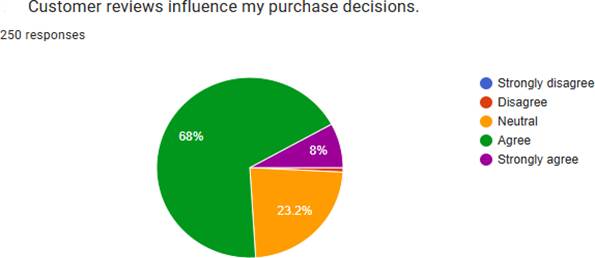
While 8% strongly agreed, most
respondents (68%) agreed that customer reviews have an impact on their
purchasing decisions. This shows how consumer purchasing
Behaviour in shopping applications is significantly influenced by customer feedback.
Impact of Digital Shopping Applications on Purchase Decisions
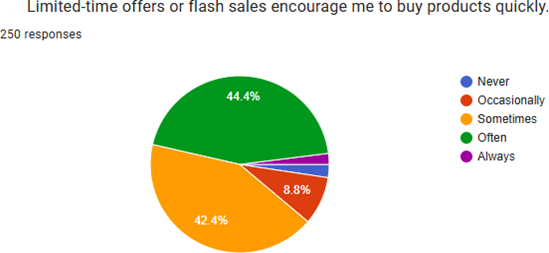
According to the results, 27.2%
of respondents stated that digital shopping applications occasionally affect
their purchasing decisions, while 30.4% of respondents stated that these apps
are frequently the primary cause for their purchases. Furthermore, 24.4% of respondents stated that using
shopping apps occasionally changed their minds about what to buy. A lower
proportion said that apps almost always cause purchases (10.4%) or rarely
affect purchases (7.6%).
Overall, the findings show that
digital shopping apps have a big impact on urban women's purchase decisions.
DISCUSSIONS
The study's findings show that digital shopping
applications have a significant impact on urban women's purchase decisions.
Many factors, including convenience, usability, trust, customisation, and
social value, influence consumers' online shopping behaviour. The findings suggest that
customers are ready to use digital shopping
applications when they believe products to be useful and convenient, which is
like the Technology Acceptance Model. Customer opinions on online buying are
positively influenced by user-friendly interfaces, efficient shopping methods,
and personalized experiences. By highlighting
the impact of consumer views and social influence on purchasing decisions, the
study further supports the Theory of Planned Behaviour. Online shopping Behaviour
is greatly influenced by peer opinions, influencer marketing, reviews, and recommendations.
As participants highlighted the importance of safe
payment methods and platform credibility, Trust Theory is clearly shown in the
results. If consumers have trust in digital platforms, they are ready to make
transactions online. The results also indicate
differences in online shopping habits between groups. While older customers
focus on security, reliability, and long-term value and younger women are more
likely to make impulsive purchases and engage in highly emotional shopping
experiences.
Customized ads, targeted
recommendations, and advertising campaigns are main examples of digital
marketing methods which have a significant effect on customer engagement and
purchase decisions.
The study highlights how
important is to combine social and emotional engagement with technological
efficiency to improve online purchasing experiences.
CONCLUSIONS
Digital shopping apps have a significant impact on purchasing decisions, according to this research of urban women (aged 18 to 45). Most respondents stated that the features of applications boost their purchasing Behaviour and evaluated as time-saving and convenient. Some of the most important findings include strong price sensitivity (about 70% compare pricing between different applications), widespread belief in safe payment methods (almost 60% feel safe paying via apps) and major social influence (most women check reviews before buying). All things considered, the online shopping environment which combines usability, convenience and special offers which have a significant impact on these consumers’ decisions
ACKNOWLEDGMENTS
None.
REFERENCES
Abbas, S. K., Kő, A., and
Szabó, Z. (2022).
Shopping Using Mobile Applications and the Role of the Technology Acceptance
Model: Purchase Intention and Social Factors. Hungarian Statistical Review,
5(2), 54–81. https://doi.org/10.35618/hsr2022.02.en054
Ajzen, I. (1991). The Theory of Planned Behavior.
Organizational Behavior and Human Decision Processes, 50(2), 179–211.
https://doi.org/10.1016/0749-5978(91)90020-T
Alshehri, A., Hussain, M., and Alghamdi, A.
(2022). Factors
Influencing Female Shoppers’ Intention to Reuse Online Shopping Websites.
Sustainability, 14(3), 1445. https://doi.org/10.3390/su14031445
An, S., Eck, T., and Yim, H. (2023). Understanding Consumers’ Acceptance
Intention to Use Mobile Food Delivery Applications Through an Extended
Technology Acceptance Model. Sustainability, 15(1), 832.
https://doi.org/10.3390/su15010832
Anoop, T. S. (2017). A Study on the Influence of Digital Advertisements in the Purchase Decision Making of People in Bengaluru. International Journal of Management and Commerce Innovations, 5(2), 941–950. https://www.researchpublish.com/upload/book/A%20Study%20on%20the%20Influence%20of%20Digital%20Advertisements%20in%20the%20Purchase%20Decision%20Making%20of%20People%20in%20Bengaluru-9064.pdf
Davis, F. D. (1989). Perceived Usefulness, Perceived Ease of
Use, and User Acceptance of Information Technology. MIS Quarterly, 13(3),
319–340. https://doi.org/10.2307/249008
Lakshmi, N. D. J., Bose, K.
S., and Ravi, J. (2024).
Assessment of Women’s Online Shopping Behavior in India: Model Design and
Analysis. International Journal of Experimental Research and Review, 43(Special
Issue), 71–92. https://doi.org/10.52756/ijerr.2024.v43spl.006
Musa, H. G., Fatmawati, I.,
Nuryakin, N., and Suyanto, M. (2024). Marketing Research Trends Using Technology Acceptance Model (TAM): A
Comprehensive Review of Researches (2002–2022). Cogent Business &
Management, 11(1), 2329375. https://doi.org/10.1080/23311975.2024.2329375
Nagy, S., and Hajdú, N. (2021). Consumer Acceptance of Artificial
Intelligence in Online Shopping Environments. Journal of Retailing and Consumer
Services. https://doi.org/10.1016/j.jretconser.2021.102574
Ngubelanga, A., and Duffett, R. (2021). Modeling Mobile Commerce Applications’
Antecedents of Customer Satisfaction Among Millennials: An Extended TAM
Perspective. Sustainability, 13(11), 5973. https://doi.org/10.3390/su13115973
Rafki, R., Nofriadi, N., Oktarina, Y.,
Nurhaida, N., Lestari, R., and Mustika, N. (2023). Factors Influencing Behavioral Propensity
to Use Mobile Shopping Apps in Generation X: The TAM Approach. ARRUS Journal of
Social Sciences and Humanities, 3(1). https://doi.org/10.35877/soshum1715
Rashmi, R., Shrinivasamayya,
D., and Joseph, A. S. (2020).
Comprehensive Approach Towards M Shopper’s Shopping Behavior Using Shopping
Apps – TAM Model Analysis. International Journal of Trend in Scientific
Research and Development, 5(1), 836–839.
https://www.ijtsrd.com/papers/ijtsrd38101.pdf
Singh, N., Misra, R., Quan, W., Radic, A., Lee, S.-M., and Han, H. (2024). An Analysis of Consumers’ Trusting Beliefs Towards the Use of E-Commerce Platforms. Humanities and Social Sciences Communications, 11, 899. https://doi.org/10.1057/s41599-024-03395
|
|
 This work is licensed under a: Creative Commons Attribution 4.0 International License
© ShodhVichar 2026. All Rights Reserved.


