|
|
|
|
Original Article
PUBLIC PERCEPTION OF SELF-CENSORSHIP IN MALAYALAM NEWS MEDIA
|
Adhithyan O 1*, S. Dinesh Babu 2 1 MA JMC Student, Department of Visual Media and Communication,
School of Arts, Humanities and Commerce, Amrita Vishwa Vidyapeetham, Kochi
Campus, Kerala, India 2 Assistant Professor
(SG), Department of Visual Media and Communication, School of Arts,
Humanities and Commerce, Amrita Vishwa Vidyapeetham, Kochi Campus, Kerala,
India |
|
|
|
ABSTRACT |
||
|
The growth of digital journalism has significantly transformed Malayalam news media in Kerala by increasing public access to information and audience engagement. At the same time, digital media has created new political, economic, and institutional pressures that affect journalistic freedom and editorial independence. This study examines public perception of self-censorship in Malayalam news media and explores how audiences view the influence of political pressure, corporate interests, legal risks, and digital media practices on journalism. It also analyses the relationship between perceived self-censorship and public trust in media organizations. The study used a qualitative and exploratory approach supported by survey analysis. Data was collected from 171 respondents across different districts of Kerala through questionnaires, along with secondary sources such as books, journal articles, and media studies. The findings show that a majority of respondents believe self-censorship exists in Malayalam news media, mainly due to political pressure, advertiser influence, selective reporting, and avoidance of controversial topics. Television news channels were perceived as the most self-censoring media platforms. The study concludes that self-censorship is a structural issue shaped by political, economic, technological, and psychological factors, highlighting the need for stronger editorial independence, transparency, and ethical journalism practices to maintain public trust. Keywords: Self-censorship, Malayalam News Media,
Public Perception, Media Trust, Digital Journalism, Kerala, Editorial
Independence, Political Pressure, Gatekeeping, Newsroom Culture |
||
INTRODUCTION
Media institutions play a vital role in democratic
societies by informing citizens, shaping public opinion, and ensuring
accountability through journalism. For media organizations to effectively
perform these functions, they must maintain editorial independence,
transparency, and public trust. However, modern journalism operates within
complex political, economic, and technological environments that often
influence editorial decisions. These pressures can lead journalists and editors
to suppress or avoid certain information due to fear of negative consequences,
a phenomenon commonly known as self-censorship. Scholars such as Cook (1998) and Schauer (2006) explain that
self-censorship emerges from institutional expectations, professional caution,
and fear of retaliation rather than direct censorship.
The growth of digital journalism has intensified these
challenges by exposing journalists to political pressure, online harassment,
advertiser influence, and audience-driven media practices. Herman and Chomsky (1988) argue that ownership
patterns, advertising dependence, and political alignments shape media
narratives and restrict diverse viewpoints. In Kerala, Malayalam news media
operates within a highly politicized and commercially competitive environment
where digital engagement metrics and advertiser interests increasingly affect
newsroom practices. This study examines public perceptions of self-censorship
in Malayalam news media and explores how political, economic, technological,
and institutional pressures influence journalistic practices and public trust
in journalism.
RESEARCH OBJECTIVES
• To examine fear as an analytical lens for
understanding newsroom behaviour.
• To identify key drivers of self-regulation in
digital journalism
• To explore journalists ’lived
experiences of editorial restraint.
• To assess the role of digital platforms and
economic structures in shaping content decisions.
SIGNIFICANCE OF THE STUDY
This study makes several significant contributions to media scholarship, journalism practice, and public understanding of the media ecosystem in Kerala. Theoretically, it contributes to expanding the scholarly discourse on censorship beyond its explicit and legally imposed forms to include internalized, structural forms of editorial control that operate through institutional culture, economic dependency, and psychological mechanisms. By cantering the analysis on Kerala's digital news environment, the study also highlights the unique and context-specific challenges faced by regional media systems that are often overlooked in research dominated by national or global perspectives.
By examining both dimensions of media newsrooms and public perceptions simultaneously, it provides a more complete and understanding of how self-censorship operates within media systems and its broader social and democratic implications. Such comprehensive understanding is essential for media organizations seeking to rebuild public trust, for policymakers designing frameworks to protect freedom of press, and for online platforms considering their role in shaping the present state of journalism.
REVIEW OF LITERATURE
Self-censorship
in journalism refers to the voluntary suppression, modification, or omission of
information by journalists due to perceived external pressures rather than
direct censorship. Scholars such as Cook (1998) and Schauer (2006)explain that journalists often avoid
sensitive topics because of fear of political retaliation, legal consequences,
professional risks, or public hostility Cook (1998) and Schauer (2006). Edward S. Herman and Noam Chomsky, through
the Propaganda Model, argue that political, economic, and institutional
structures shape media content by limiting critical voices and narrowing public
discourse Herman and Chomsky (1988). In digital media environments, the
“chilling effect” further intensifies as journalists anticipate online
harassment, criticism, and reputational damage Barendt
(2005).
Political influence, economic dependence, newsroom
culture, and audience reactions collectively contribute to self-censorship
practices. In Kerala’s Malayalam media landscape, political polarization,
advertiser pressure, and dependence on digital engagement metrics strongly
influence editorial decisions. Robert W. McChesney highlights how commercial
dependence and advertising pressures shape journalistic practices McChesney
(2008), while Pamela J.
Shoemaker and Tim P. Vos explain that newsroom culture and gatekeeping
normalize self-regulation within media institutions Shoemaker
and Vos (2009). Michel Foucault
further argues that institutional norms encourage individuals to discipline
their own behavior without direct coercion Foucault (1977). Additionally, online
hostility and organized trolling create psychological pressure on journalists,
encouraging cautious reporting and avoidance of controversial subjects,
particularly among female journalists.
RESEARCH GAP
Despite the rapidly growing importance of regional digital media in shaping public discourse and political communication in India, there remains a significant and consequential gap in scholarly research specifically examining self-censorship practices within Malayalam newsrooms. The existing body of research on media censorship and editorial constraint in India largely focuses on overt, legally imposed censorship mechanisms or addresses media dynamics at the national level, frequently overlooking the distinctive localized experiences, structural conditions, and political dynamics that characterize regional media systems. The specific pressures operating within Kerala's media environment — including the state's particular political culture, the dominance of specific media conglomerates, and the rapid digitization of news consumption — remain insufficiently studied.
Furthermore, the dimension of public perception of self-censorship has been substantially underexplored in the existing literature, which tends to focus on the experiences of journalists and editors rather than how audiences perceive and respond to editorial constraints. Given that public trust in media institutions is closely and demonstrably linked to audience perceptions of media credibility, editorial independence, and transparency, understanding how audiences perceive self-censorship is essential for comprehensively evaluating the health and democratic functioning of the media ecosystem. If audiences systematically believe that news content is shaped by hidden constraints rather than independent editorial judgment, the erosion of public trust may have profound and lasting consequences for democratic communication and civic participation.
THEORETICAL FRAMEWORK
A multi-level analytical architecture capable of addressing structural, organizational, and psychological dimensions of self-censorship simultaneously, offering a comprehensive theoretical foundation for interpreting the empirical findings of this study.
RESEARCH METHODOLOGY
Research Design
This study adopts a qualitative and exploratory research design to examine the phenomenon of self-censorship in Malayalam news media from the perspective of public audiences. A qualitative approach is considered particularly appropriate because the study aims to understand the subjective meanings, perceptions, and interpretive frameworks that audiences bring to their understanding of journalistic practices and media institutions. Rather than generating statistically generalizable numerical measurements, the research prioritizes in-depth interpretation of attitudes, experiences, and social understandings related to self-censorship. The exploratory dimension of the design reflects the relatively underexplored nature of the specific research questions being addressed, particularly the relationship between audience perception of self-censorship and public trust in regional media.
Research Hypotheses
•
H1 Public perception of self-censorship
significantly affects overall trust in Malayalam news media.
•
H2 Individuals who are familiar with the concept
of self-censorship are more likely to perceive its existence in Malayalam news
media.
•
H3 Individuals who primarily consume digital or
social media news perceive higher levels of self-censorship compared to
traditional media consumers.
Sampling Technique
and Sample Size
The study employed a non-probability convenience sampling method to collect survey responses from audiences across Kerala. Convenience sampling was selected as the most appropriate method given the study's focus on gathering opinions from individuals who are readily accessible and actively engaged with Malayalam news media. Respondents were selected based on their availability, willingness to participate, and self-reported familiarity with news consumption from any combination of television, newspapers, digital platforms, and social media networks. The survey included participants from multiple districts across Kerala to ensure geographical diversity in perspectives.
A total of 171 respondents participated in the survey.
Data Collection Method
Primary data was collected through a structured questionnaire survey designed to gather information about media consumption habits, awareness and understanding of self-censorship, overall trust in Malayalam news media. The survey was administered through Google Forms and distributed via social media networks, enabling participants from different districts of Kerala to respond conveniently and accessibly.
Data Analysis Method
The data collected was analysed using both descriptive interpretation and percentage analysis appropriate to the qualitative and exploratory orientation of the study. Graphs, charts, and percentage distributions were used to present the quantitative dimensions of the findings clearly and accessibly, while thematic analysis was employed to identify patterns and connections in respondents' perceptions.
ANALYSIS
Demographic Profile of Respondents
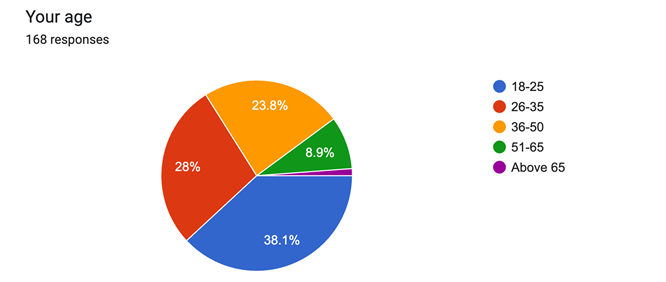
The survey attracted a predominantly young respondent base. The majority of respondents belong to the 18–25 age group (38.1%), indicating particularly strong participation from young adults who are intensive users of digital media platforms. The 26–35 age category accounts for 28% of respondents, while 23.8% belong to the 36–50 age group. Respondents aged 51–65 constitute 8.9% of the sample, and only a very small percentage are above 65 years of age. The demographic profile indicates that the study primarily reflects the opinions and media perceptions of younger and middle-aged audiences who engage most actively with digital platforms, television news channels, and online journalism platforms. Their participation provides particularly relevant insights into current public perceptions regarding self-censorship and media credibility in a rapidly digitalizing news environment.
District-Wise Distribution and Geographic Diversity
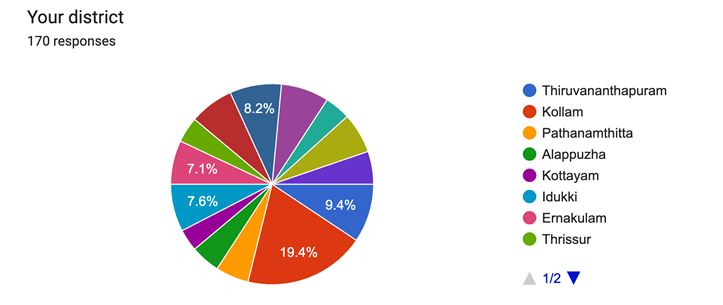
The geographic distribution of respondents reflects meaningful diversity across Kerala's districts. The highest concentration of respondents comes from Kollam (19.4%), followed by Thiruvananthapuram (9.4%). Respondents from Idukki (7.6%), Ernakulam (7.1%), and other districts including Alappuzha, Pathanamthitta, Kottayam, and Thrissur also contributed substantially to the survey. This geographical diversity strengthens the reliability of the data collected and ensures that the findings reflect broader audience perceptions across Kerala's diverse regional media environment rather than the perspectives of any single urban center or district.
Primary News Sources and Platform Preferences
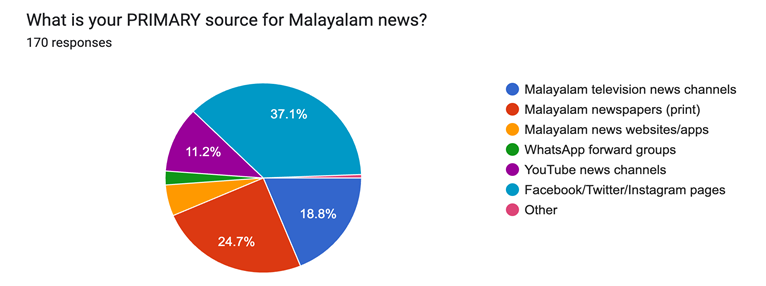
Social media platforms including Facebook, Twitter, and Instagram dominate as the primary source of Malayalam news among respondents at 37.1%, indicating a fundamental and far-reaching shift toward digital, easily accessible, and algorithmically curated news content. Malayalam print newspapers remain significant at 24.7%, reflecting a continuing degree of trust and loyalty toward traditional print media among a substantial segment of the audience. Television news channels account for 18.8% of primary news consumption, demonstrating that broadcast media still holds meaningful relevance but has clearly been displaced from its former dominance as the primary news source. YouTube news channels contribute 11.2% of primary news consumption, highlighting the growing influence of video-based digital news formats. The overall data reveals a decisive transition from traditional media toward social and digital platforms as the primary means of Malayalam news consumption, with significant implications for the conditions under which journalism is produced and consumed.
Public Perception of Self-Censorship
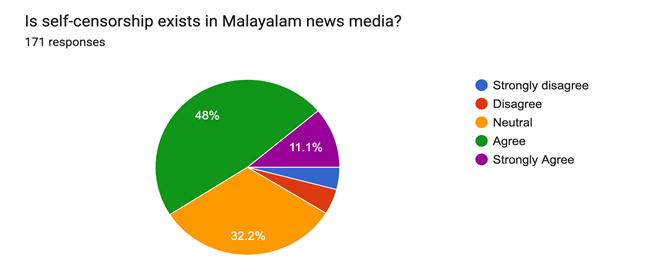
The survey findings provide compelling evidence of widespread public awareness and concern regarding self-censorship in Malayalam news media. Out of 171 responses, 48% agreed and 11.1% strongly agreed with the statement that self-censorship exists in Malayalam news media, demonstrating that nearly 59% of respondents perceive self-censorship as a significant and real phenomenon within the media landscape. Meanwhile, 32.2% of respondents remained neutral, suggesting either genuine uncertainty about the extent of the problem, limited direct exposure to discussions of media self-censorship, or deliberate caution in expressing strong positions on a sensitive topic. Only a small proportion of respondents actively disagreed or strongly disagreed with the presence of self-censorship, indicating that skepticism about the existence of self-censorship is a minority position among the surveyed population. These results reflect broad public concern about editorial pressures, political influence, and institutional constraints affecting journalistic freedom in Malayalam media.
OVERALL, Trust in Malayalam News Media
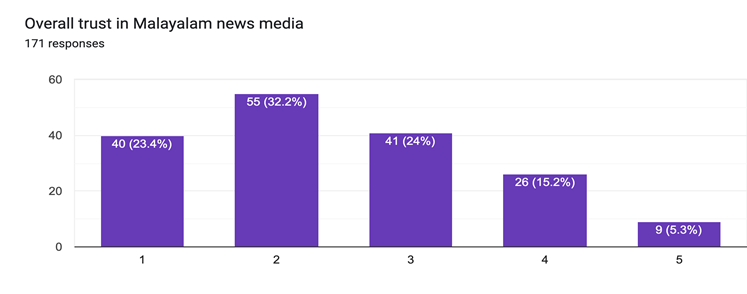
The distribution of trust levels among respondents reveals a pattern of moderate to low public confidence in Malayalam news media. Out of 171 responses, the highest proportion of participants rated their overall trust at level 2 on a 5-point scale (32.2%), followed by level 3 (24%) and level 1 (23.4%). In sharp contrast, only 15.2% of respondents selected level 4, and a mere 5.3% selected the highest trust level of 5. This distribution indicates that a significant majority of respondents hold limited or cautious trust in Malayalam news media, with few expressing high or very high confidence in media credibility and reliability. The concentration of responses at the lower end of the trust spectrum signals deep-seated skepticism about the objectivity, transparency, and journalistic independence of Malayalam news organizations.
Relationship Between Self-Censorship and Trust
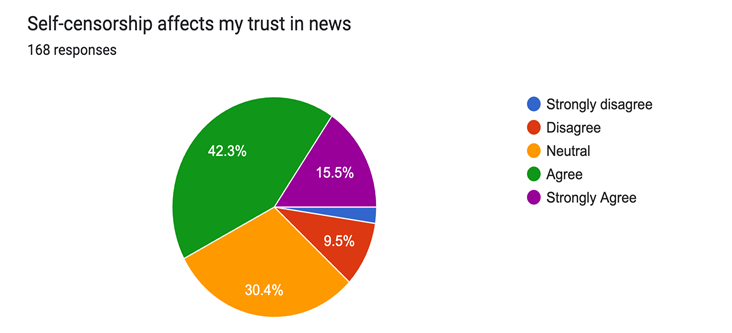
The survey data reveals a clear and significant relationship between respondents' perceptions of self-censorship and their overall trust in news media. A substantial 42.3% of respondents agreed and 15.5% strongly agreed that self-censorship directly influences and diminishes their trust in news media, representing nearly 58% of the total respondent population. In comparison, 30.4% maintained a neutral position, while a relatively small minority disagreed (9.5%) or strongly disagreed. The high proportion of respondents who acknowledge that perceived self-censorship directly affects their trust in journalism confirms the central hypothesis of this study and underscores the critical relationship between editorial independence and audience confidence in media institutions.
Key Drivers of Self-Censorship as Perceived by Audiences
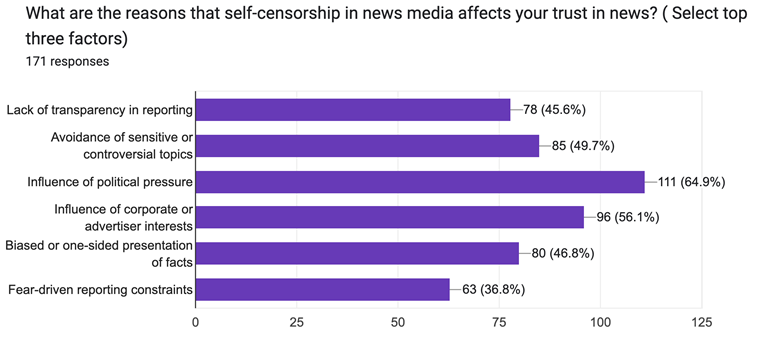
The survey findings identify political pressure as overwhelmingly the most significant factor perceived by audiences to drive self-censorship and erode trust in news media, selected by 64.9% of participants a clear majority that signals the centrality of political influence in shaping public understanding of media dynamics in Kerala. Corporate and advertiser interests were identified as the second most significant factor by 56.1% of respondents, reflecting substantial concern about commercial dependencies within media organizations and their effect on editorial freedom. Avoidance of sensitive or controversial topics was cited by 49.7% of respondents, while biased or one-sided presentation of facts was identified by 46.8%. A lack of transparency in reporting was noted by 45.6% of respondents, and fear-driven reporting constraints referring to journalists' personal fears of retaliation or consequences were identified by 36.8%. Together, these findings paint a picture of audiences who are sophisticated in their understanding of the multiple and interconnected pressures that shape journalistic practice.
Media Outlet Most Perceived to Practice Self-Censorship
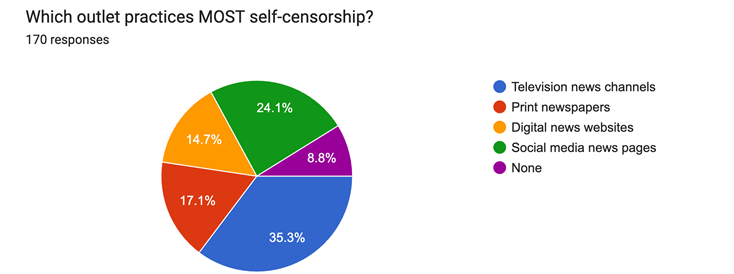
The survey results indicate that television news channels are perceived by the largest proportion of respondents (35.3%) as the media outlet most likely to practice self-censorship, making it the most frequently selected category by a clear margin. This finding is particularly significant given that television news channels still maintain substantial audiences and are often perceived as the most authoritative and influential mainstream news source. Social media news pages were identified as the second most self-censoring medium by 24.1% of respondents, reflecting growing concern about the editorial independence and reliability of news circulated through social media platforms. Print newspapers were identified by 17.1% of respondents, while digital news websites were cited by 14.7%. Only 8.8% of respondents believed that no media outlet practices self-censorship, confirming that the perception of self-censorship is widespread and near-universal among the surveyed population.
KEY FINDINGS
Based on comprehensive analysis of survey responses from 171 respondents across multiple districts of Kerala, the following key findings have emerged from this study:
· A substantial majority nearly 59% of respondents agreed or strongly agreed that self-censorship exists in Malayalam news media, reflecting widespread public awareness of structural and institutional constraints on journalistic independence.
· Public trust in Malayalam news media is predominantly moderate to low, with the largest group of respondents rating their trust at level 2 on a 5-point scale and only 5.3% expressing the highest level of trust.
· More than half (approximately 58%) of respondents agreed that self-censorship directly affects their confidence in news media, establishing a clear and significant relationship between perceived editorial constraint and audience trust.
· Political pressure was identified as the single most significant perceived driver of self-censorship, selected by 64.9% of respondents, followed by corporate or advertiser interests (56.1%), topic avoidance (49.7%), and biased reporting (46.8%).
· Television news channels are perceived as the media outlet most likely to practice self-censorship (35.3%), followed by social media news pages (24.1%), print newspapers (17.1%), and digital news websites (14.7%).
· Social media platforms dominate as the primary source of Malayalam news consumption (37.1%), reflecting a decisive shift from traditional to digital media that has significant implications for the conditions of both journalism and audience trust.
· The study sample was dominated by younger respondents (18–35 years), suggesting that concerns about self-censorship and media credibility are particularly prominent among digitally connected audiences who actively engage with multiple news platforms.
· Geographic diversity of respondents across Kerala's districts enhances the representativeness and reliability of the findings, capturing varied regional perspectives on Malayalam media practices.
DISCUSSIONS
The findings of this study strongly support existing
theories and research on media self-censorship. The widespread public
perception of self-censorship in Malayalam news media aligns with the
Propaganda Model proposed by Herman and Chomsky (1988), which explains how
political influence, ownership patterns, and advertising dependency shape media
content. The study identified political pressure as the major factor
influencing self-censorship, reflecting Kerala’s
politically polarized media environment where media organizations often face
pressure from political parties, government institutions, and organized public
groups. This supports theories of political parallelism, which argue that media
systems in politically competitive societies tend to align with particular
political interests.
The study also found that self-censorship negatively
affects public trust in Malayalam news media, suggesting that audiences
increasingly question the credibility and independence of journalism. Although
digital and social media platforms have become major sources of news
consumption, audiences still perceive these spaces as vulnerable to advertiser
influence, algorithmic control, and audience-driven pressures. The findings
further highlight the psychological dimensions of self-censorship, where
journalists may avoid sensitive reporting due to fear of political retaliation,
legal consequences, or online harassment. These results indicate that
self-censorship is shaped by both structural pressures and individual
psychological factors, emphasizing the need for stronger editorial independence
and institutional safeguards in Malayalam journalism.
CONCLUSIONS
This study examined public perception of self-censorship in Malayalam news media through a survey conducted among respondents across Kerala. The findings reveal that self-censorship is widely perceived as a major issue influenced by political pressure, advertiser influence, commercial interests, newsroom culture, and audience hostility. Political pressure emerged as the most significant factor affecting editorial independence, while growing commercialization and digital media competition further contribute to cautious reporting practices. The study also found that public perception of self-censorship negatively affects trust in Malayalam news media, supporting the view that editorial independence is essential for maintaining media credibility and democratic communication. The research highlights that self-censorship operates as both an individual and institutional phenomenon shaped by political, economic, and psychological pressures. In the digital era, journalists face challenges such as online harassment, political retaliation, and advertiser influence, which often encourage self-regulation in reporting. The study emphasizes the need for stronger editorial independence, transparent media practices, and better institutional protection for journalists to rebuild public trust and strengthen ethical journalism in Kerala’s evolving media landscape.
Limitations of the Study
The study has certain limitations that should be acknowledged. It was limited to Malayalam news media in Kerala and may not represent other media systems. The use of convenience sampling and online surveys may have restricted demographic diversity, particularly excluding less digitally connected populations. Most respondents belonged to younger age groups, which may have influenced the findings toward digitally active audiences. The research focused mainly on public perception and did not include direct newsroom observation or detailed interviews with journalists and editors. Additionally, self-reported responses may contain subjective bias, and the rapidly changing digital and political environment may affect the long-term relevance of the findings.
ACKNOWLEDGMENTS
None.
REFERENCES
Abraham, C. (2025). Marketing Strategies for the Digital World: A Case Study of Malayalam News Channels in Kerala. SDMIMD Journal of Management, 16(Special Issue), 65–76. https://doi.org/10.18311/sdmimd/2025/48905
Bandura, A. (1989). Human Agency in Social Cognitive Theory. American Psychologist, 44(9), 1175–1184. https://doi.org/10.1037/0003-066X.44.9.1175
Bandura, A. (1991). Social Cognitive Theory of Self-Regulation. Organizational Behavior and Human Decision Processes, 50(2), 248–287. https://doi.org/10.1016/0749-5978(91)90022-L
Barendt, E. (2005). Freedom of Speech (2nd ed.). Oxford University Press.
Carleton, R. N., McCreary, D. R., Norton, P. J., and Asmundson, G. J. G. (2006). Brief Fear of Negative Evaluation Scale: Revised. Depression and Anxiety, 23(5), 297–303. https://doi.org/10.1002/da.20142
Collins, K. A., Westra, H. A., Dozois, D. J., and Stewart, S. H. (2005). The Validity of the Brief Version of the Fear of Negative Evaluation Scale. Journal of Anxiety Disorders, 19(3), 345–359. https://doi.org/10.1016/j.janxdis.2004.02.003
Cook, T. E.
(1998). Governing with the News: The News Media as a Political
Institution (2nd ed.). University
of Chicago Press.
Couldry, N., and Mejias, U. A. (2019). The Costs
of Connection: How Data Is Colonizing
Human Life and Appropriating It for Capitalism. Stanford University
Press.
Deci, E. L., and Ryan, R. M. (1985). Intrinsic
Motivation and Self-Determination in Human Behavior. Plenum Press.
Foucault,
M. (1977).
Discipline and Punish: The Birth of the Prison (A. Sheridan, Trans.). Pantheon Books.
Gillespie, T. (2014). The Relevance of Algorithms. In T. Gillespie, P. J. Boczkowski, and K. A. Foot (Eds.), Media Technologies: Essays on Communication, Materiality, and Society, 167–194. MIT Press.
Henry, J. D., and Crawford, J. R. (2005). The Short-Form Version of the Depression Anxiety Stress Scales (DASS-21): Construct Validity and Normative Data in a Large Non-Clinical Sample. British Journal of Clinical Psychology, 44(2), 227–239. https://doi.org/10.1348/014466505X29657
Herman, E. S., and Chomsky, N. (1988). Manufacturing Consent: The Political Economy of the Mass Media. Pantheon Books.
Leary, M. R. (1983). A Brief Version of the Fear of Negative Evaluation Scale. Personality and Social Psychology Bulletin, 9(3), 371–375. https://doi.org/10.1177/0146167283093007
McChesney,
R. W. (2008). The Political Economy of Media: Enduring Issues, Emerging
Dilemmas. Monthly Review
Press.
Mehwish, Nauman, A., Boota, S., and Saeed, E. (2025). Self-Regulation, Fear of Negative Evaluation and Mental Health Problems in University Students. Social Sciences and Humanity Research Review, 3(1), 2152–2164.
Neal, D. J., and Carey, K. B. (2004). A Follow-Up Psychometric Analysis of the Self-Regulation Questionnaire. Psychology of Addictive Behaviours, 18(4), 414–417. https://doi.org/10.1037/0893-164X.18.4.414
Schauer, F. (2006). The Social Construction of the Concept of Law: A Reply to Julie Dickson. Oxford Journal of Legal Studies, 25(3), 493–501. https://doi.org/10.1093/ojls/gqi024
Shoemaker, P. J., and Vos, T. P. (2009). Gatekeeping Theory. Routledge.
White, D. M. (1950). The “Gate Keeper”: A Case Study in the
Selection of News. Journalism Quarterly, 27(4), 383–390.
https://doi.org/10.1177/107769905002700403
|
|
 This work is licensed under a: Creative Commons Attribution 4.0 International License
© ShodhVichar 2026. All Rights Reserved.


