|
|
|
|
Original Article
Influence of Generative AI Tools on the Creative Thinking Process of Design Students in Kerala
|
Sreya B 1*, Hari Krishnan D 2 1 MA JMC Student, Department
of Visual Media and Communication, Amrita Vishwa Vidyapeetham, Kochi Campus,
Kerala, India 2 Assistant Professor (Senior Grade) Department
of Visual Media and Communication, Amrita Vishwa Vidyapeetham, Kochi Campus, India |
|
|
|
ABSTRACT |
||
|
Through a mixed-methods research design, this study evaluates the impact of Generative Artificial Intelligence (GenAI) on the creative thinking processes of design students from Kerala. A structured questionnaire was administered to 184 design students aged 18 to 25 in Kerala, as well as semi-structured interviews and one focus group. The quantitative aspects of the results were evaluated using descriptive statistics while qualitative aspects were addressed using thematic analysis. Results indicate that 92.9% of design students participating in this study have actively used GenAI tools in their design work, and that 78.4% primarily use GenAI in the ideation/concept development stages of the design process. While 86.6% agreed that GenAI improves the efficiency of the design workflow, there were 65.5% of respondents who expressed concern that GenAI tools will reduce their ability to think creatively and independent of computers. This research fills an important gap in the area of research on AI-supported creativity, particularly as it relates to design education within South Asia, and offers key implications related to pedagogy, the curriculum in AI literacy, and the appropriate use of generative technologies in the creative learning environment. Keywords: Artificial Intelligence, Design Education, Creative Thinking, AI
Supported Creativity, Design Students |
||
INTRODUCTION
The rapid advancement of Artificial Intelligence (AI) has significantly transformed creative industries, communication practices, and educational environments globally. Among these developments, Generative Artificial Intelligence (GenAI) has emerged as a paradigm-shifting technological capability, enabling the autonomous production of text, images, videos, designs, and multimedia outputs based on user-defined prompts Dwivedi et al. (2023). Tools such as ChatGPT, Mi journey, DALL·E, Adobe Firefly, and Canva AI are increasingly being integrated into creative workflows, fundamentally reshaping how ideas are generated, structured, and executed Kasneci et al. (2023). Design education, traditionally rooted in human imagination, experimentation, and sustained cognitive engagement, is undergoing significant transformation owing to this widespread adoption.
Creative thinking has long been considered the cornerstone of design practice, relying on observation, sketching, analysis, iterative research, and problem-solving processes developed through prolonged effort Cross (2011). The emergence of GenAI introduces new dynamics between human creativity and machine-generated assistance, raising fundamental questions about the cognitive and emotional dimensions of the creative process.
PROBLEM STATEMENT
The integration of GenAI into design education presents a dual challenge. On one hand, these technologies offer unprecedented efficiency gains, enabling rapid ideation, visual experimentation, and creative exploration that would otherwise require substantial time and technical skill. On the other hand, their growing use raises serious concerns about the development of independent creative thinking, original problem-solving, and authentic design identity among students.
LITERATURE REVIEW
Understanding Creative Thinking in the Field of Design
When we think of creativity in design, it means new ideas and being able to take lots of different things, even if they don't have anything in common, and put them together in a meaningful way Hwang and Wu (2025). This is a cognitive process that requires you to come up with lots of ideas, evaluate them, and then think about how you did it. Medel-Vera et al. (2025) provides an enhanced version of Runco and Jaeger (2012) initial definition of creativity that defines creativity as building things that are both unique and effective. Medel-Vera et al. then extend Runco and Jaeger’s definition of creativity to include dimensions such as aesthetics, fluency, and flexibility specific to the fields of design and architecture. Huh et al. (2025) found that AI-generated image outputs can serve as cognitive collaborators with architects/interior designers, supporting the ideation of students' abstract thoughts into more tangible concepts. AI-generated images do not take the place of a designer's imagination but rather serve as a catalyst to motivate and guide designers during the design process by providing multiple models of iterative development of ideas. In this sense, AI is an augmenter (as opposed to a replacement) of human creative cognition, a theme throughout the literature.
The Literacy of Meaningful Prompts is also the Literacy of Design
One of the critical emergent themes found in recent literature is the literacy of prompts — the ability to write effective prompts that result in a high-quality output from an AI and are relevant to the context. Different researchers have found that students are able to meaningfully develop the quality of their prompts by implementing specific intentional strategies. Huh et al. (2025) and Hsu's and others' definition of contextualising prompts.
RESEARCH GAP
Previous scholarship on GenAI and creativity has predominantly focused on technological capability, productivity metrics, and measurable efficiency outcomes. Qualitative, experiential investigations of how students emotionally and cognitively navigate AI-assisted creative work remain rare. More critically, existing literature almost entirely lacks context-specific research in Indian or Kerala-based design education settings. Factors such as cultural values around craftsmanship, multilingual learning environments, and uneven institutional AI integration make Kerala a distinct and underexplored case.
OBJECTIVES
· To understand the frequency of GenAI use during the brainstorming process of design-by-design students in Kerala.
· To measure how GenAI usage affects design students’ original critical thinking.
· To examine the student's perception and experience of AI in their creative process
HYPOTHESIS
Design students in Kerala frequently use Generative Artificial Intelligence (GenAI) tools during the brainstorming phase of the design process.
· There is a significant relationship between the use of Generative Artificial Intelligence
· (GenAI) tools and the creative thinking abilities of designing students in Kerala.
· Design students in Kerala perceive Generative Artificial Intelligence (GenAI) tools as having a significant influence on their creative processes and design practices.
RESEARCH QUESTIONS
1) How frequently do design students in Kerala use GenAI tools during ideation?
2) How does GenAI influence the creative processes of design students in Kerala?
3) What benefits do design students perceive from using GenAI tools in their creative workflow?
SCOPE OF THE STUDY
The study is geographically limited to design students across Kerala, aged 18–25 years, enrolled in undergraduate or postgraduate programmes in graphic design, communication design, animation, filmmaking, and related disciplines. It focuses specifically on students' perceptions and self-reported experiences with GenAI tools, rather than measuring actual creative performance outcomes. The study does not evaluate specific AI platforms comparatively but treats GenAI as a broad category of AI-assisted creative tools.
THEORETICAL FRAMEWORK
The study is grounded in the Creative Cognition Theory proposed by Finke et al. (1992). This theory explains creativity as a cognitive process, involving idea generation, imaginative exploration, problem-solving, and the transformation of existing knowledge into new, meaningful concepts. Creative thinking emerges through mental activities that enable individuals to explore possibilities, combine disparate ideas, and develop innovative solutions through what Finke et al. term 'generative' and 'exploratory' cognitive structures.
Creative Cognition Theory suites well to this study because design education is fundamentally built on ideation, experimentation, and development of concept. The theory enables analysis of how students interact with AI-generated suggestions.
RESEARCH METHODOLOGY
RESEARCH DESIGN
This study used a mixed-methods research design, integrating quantitative survey data with qualitative insights from semi-structured interviews and a focus group discussion. It helps to know about the usage of GenAI patterns across the Kerala design students and the individual experiences, perceptions, and cognitive processes
METHOD USED
For quantitative analysis a structured questionnaire was developed and distributed via Google Forms to designing students of Kerala within the age group of 18-25. It helps to know about experience, usage, perceptions on GenAI.
For qualitative analysis semi-structured interviews were conducted with design students to explore their experiences, perceptions, and usage on Gen AI.
One focus group discussion was held with participants who had active GenAI experience. It helps to foster a clearer understanding to this study.
POPULATION
The target population was different disciples design students aged 18–25 years across Kerala, actively integrating GenAI tools in their creative process
SAMPLING
The quantitative survey collected 184. Convenience sampling by distributing the survey within the peer network. Snowball sampling extended reach by asking participants to share the survey with peers. Purposive sampling was used to collect responses physically from targeted students, for the purpose of qualitative data collection ensuring participants met the study's inclusion criteria.
Exclusion criteria were applied on non-design students, individuals outside the 18–25 age range, non-Kerala residents, respondents who do not use GenAI tools.
DATA COLLECTION TOOLS
· Structured questionnaire (Google Forms) for quantitative data on usage patterns, experience, and perceptions.
· Semi-structured interview with hand-picked students.
· Focus group discussions
DATA ANALYSIS METHOD
Quantitative data were analysed using frequencies, percentages, and Likert distributions from the survey responses to track the usage patterns and Beha virial experiences. Qualitative data from interviews and focus group discussions were subjected to thematic reviewing theme.
ETHICAL CONSIDERATIONS
All participants were informed and consent was obtained prior to data collection. Participants were assured of full anonymity. All data were stored securely and used exclusively for the purposes of this study.
DATA ANALYSIS / FINDINGS
This chapter explains the data collected for the study and
how it has been analysed. A survey was conducted to measure the usage and user
habits on GenAI in design among designing students across Kerala. 184 students
studying from various areas of Kerala took part in the online survey.
Interviews and Focus Group data is collected for additional insights to this
study. This chapter presents the findings in a simple and organised way.
Quantitative Findings

Among this sample group, 92.9% of respondents reported that they are using GenAI in design, while 7.1% indicated that they are not using. This finding indicates a high level of adoption and familiarity with AI-assisted technologies among design students in Kerala.
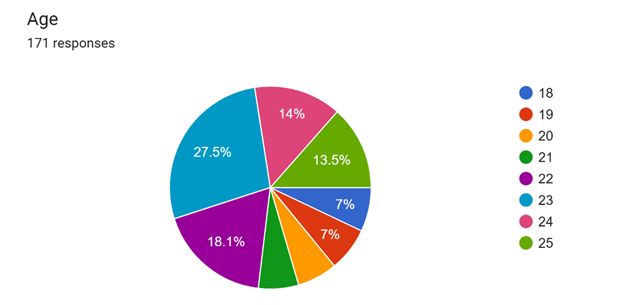
The age distribution indicates that the study mainly focused on young adult design students between 18–25 years. The majority of respondents belonged to the age group of 23 years (27.5%), followed by 22 years (18.1%), 24 years (14%), and 25 years (13.5%). The findings suggest that the study primarily reflects the perspectives of students who are actively engaged with digital creative practices and AI-assisted design tools.

From the responses design students across various districts in Kerala, showing geographical diversity. Among the respondents, the highest percentage was from Ernakulam (28.1%), followed by Thiruvananthapuram (14.6%), Kottayam (11.7%), and Kollam (11.1%) and the rest of districts were below 10%. The findings indicate that the study includes participants from different educational regions across Kerala.
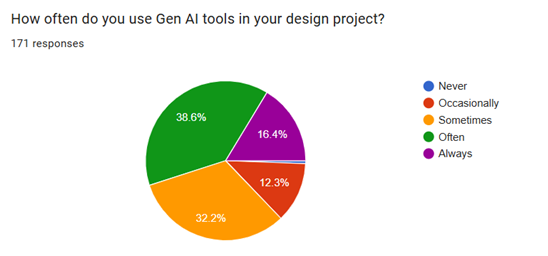
The data confirm that 87.2% of respondents use GenAI tools at least 'sometimes' in their design projects, with over half (55%) using them 'often' or 'always.' This represents a significant and widespread integration of AI technologies into everyday design practice.
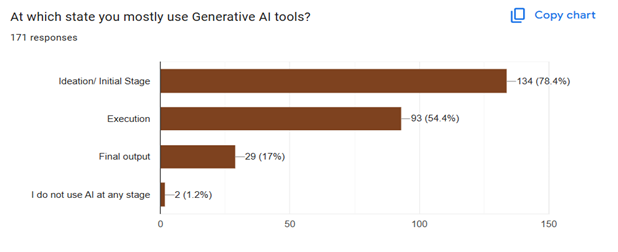
The findings show that the majority of design students use Generative AI tools primarily during the ideation and initial stage of the design process. Among 78.4% reported using AI during initial ideation and concept development, while 54.4% use AI during the execution stage. Only 17% stated that they use AI mainly for final outputs, and 1.2% reported not using AI at any stage. These results indicate that GenAI is predominantly utilized as a supportive tool for initiate brainstorming, idea generation, and early-stage creative exploration.
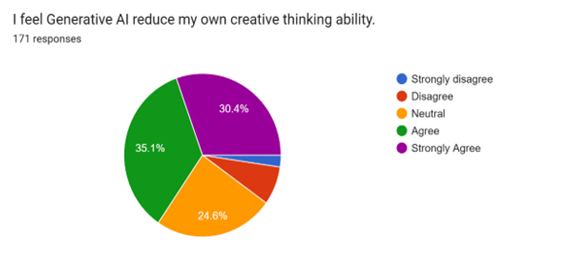
The data indicates that a majority of respondents believe Gen AI reduces their creative thinking ability. Around 65.5% of participants agreed or strongly agreed with the statement, while 24.6% 27 remained neutral. Only a small percentage disagreed. This suggests that many design students perceive increased dependence on AI tools as negatively affecting independent ideation and originality. The findings highlight concerns regarding the impact of generative AI on creativity within design education.

From findings a majority of respondents believe generative AI makes the design workflow easier and faster. About 86.6% of participants selected Agree or Strongly Agree, indicating strong acceptance of AI as a tool for improving efficiency and productivity in design processes. Only a very small percentage disagreed, while 11.7% remained neutral. This suggests that generative AI is widely perceived as beneficial in simplifying tasks, accelerating ideation, and enhancing workflow efficiency among design students.
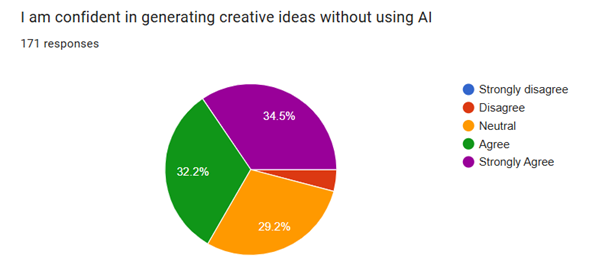
The data indicates that a majority of respondents are
confident in generating creative ideas without using AI. Around 66.7% of
participants agreed or strongly agreed with the statement, while 29.2% remained
neutral. Only a small percentage disagreed. This suggests that despite the
increasing use of generative AI tools, many design students still believe in
their independent creative abilities and view creativity as a skill that
extends beyond AI assistance.
QUALITATIVE FINDINGS
Thematic analysis of semi-structured interviews and focus group discussions generated five core themes that illuminate the experiential, emotional, and perceptual dimensions of GenAI use among design students in Kerala. Direct participant quotations are presented to substantiate each theme.
AI as a Collaborative Ideation Partner
The most prominent and consistent theme across all qualitative data was students' framing of GenAI as a collaborative assistant rather than an autonomous creative agent. Participants described using AI-generated outputs as reference points and starting positions for their own creative elaboration, rather than accepting them as completed work. As one participant stated:
"I use AI suggestions with my own idea and creativity — it gives me a direction, but the actual thinking is still mine." (Respondent 1)
Another participant reinforced this distinction: "AI output is a starting point, not a final answer" (Respondent 4), while Respondent 5 noted that AI helps in exploring "new visual directions quickly" but still requires personal modification based on creative judgment and project requirements. This framing positions students as active curators and critical editors of AI-generated content, maintaining human agency throughout the design process.
Creative Block Resolution
Multiple participants reported that GenAI played a significant role in overcoming periods of creative impasse. One student described how repeated attempts at a poster design for No Smoking Day failed until Google Gemini suggested effective keywords and visual directions that reoriented the conceptual process. Another participant described using AI-generated campaign ideas and taglines to break through a mental block during a branding project (Respondent 4). Respondent 6 highlighted how Midjourney facilitated visual experimentation during a branding project, providing alternative design directions when the student's own ideation had stalled. These experiences position GenAI as an effective cognitive scaffold during periods of creative difficulty — a 'creativity unblocked' that expands the solution space when independent exploration reaches its limits.
Dual Perceptions of Creativity — Enhancement and Risk
Participants held sophisticated, often contradictory views about GenAI's relationship with creativity, reflecting the dual finding in the quantitative data. While most agreed that AI can improve creativity by enabling faster idea generation and exposure to diverse visual possibilities, they simultaneously emphasised that authentic creativity depends on human interpretation, judgment, and emotional insight. Respondent 3 stated simply that "AI can improve creativity," while Respondent 4 described AI as expanding "possibilities, offering fresh inputs, and speeding up ideation." Yet Respondent 5 provided a critical counterpoint, arguing that "creativity becomes weaker when AI is used as a shortcut rather than as a supportive tool." This dual awareness reflects a maturity of perspective that distinguishes between AI as an amplifier of human creativity and AI as a substitution for it.
Dependency and Originality Concerns
Alongside enthusiasm for AI's efficiency benefits, participants consistently raised concerns about creative dependency and the homogenisation of design outputs. Respondent 3 cautioned that AI dependency "reduces the person to think more," while Respondent 4 warned that passive use of AI risks "weakening original thinking." Respondent 5 specifically highlighted that uncritical adoption of AI outputs, without reflective evaluation, could negatively impact originality and independent creative development over time. These concerns align with broader scholarly warnings about the attenuation of independent ideation skills through excessive AI reliance (Oguma et al. (2025)), and represent a self-aware critical stance toward the tools students themselves depend on.
Workflow Efficiency and Creative Confidence
All participants reported positive effects of GenAI on workflow efficiency and creative confidence. AI tools were credited with accelerating design processes, reducing time spent gathering references, and enabling rapid concept testing. Respondent 1 stated that AI "improved workflow," while Respondent 6 noted that AI-assisted tools made projects "easy to make" and "more efficient." Participants also associated AI use with enhanced creative confidence: Respondent 4 reported that AI reduced the fear of creative block, and Respondent 5 noted that AI increased confidence by enabling quick visualisation and testing of concepts. AI was particularly valued for its capacity to 'give life to thoughts' — rapidly translating abstract conceptual ideas into tangible visual representations that could then be critiqued and refined.
Summary of Hypothesis Testing
The findings of this study indicate that design students (particularly in Kerala) utilize ai (GenAI) technologies extensively throughout their processes of brainstorming and ideation. The first hypothesis (H1) is supported by the participants surveyed, as the majority of responders reported using GenAI on a repeated/regular basis. The second hypothesis (H2) is partially supported, with participants reporting that though GenAI can increase both creativity and efficiency in their output, there are also potential risks of creating dependent users; therefore, decreasing the amount of originality in their projects. Finally, the third hypothesis (H3) is supported by 100% of participants, with the majority of participants believing that GenAI is a strong influencer within the creative processes of individuals, however most report they see GenAI as a "support tool" for creative projects, rather than as a replacement for the creativity of their design skills.
CONCLUSION
Summary of Findings
This study provides contextual evidence that GenAI tools have become deeply embedded in the creative practices of design students in Kerala, with a 92.9% adoption rate and primary deployment during the ideation phase of design. The findings confirm all three hypotheses (H1 fully, H3 fully, H2 partially) and answer the three research questions through converging quantitative and qualitative evidence. GenAI is widely perceived as an efficiency-enhancing, confidence-building, and block-resolving creative tool. Simultaneously, a majority of students self-report concerns about its effects on independent creative thinking and originality.
The study's core argument is that GenAI functions as an effective augmentation of the generative phase of creative cognition while presenting measurable risks to the exploratory phase that develops deeper, more independent creative identity. This empowerment–dependency paradox is not a problem to be eliminated but a tension to be pedagogically managed. Students who engage GenAI critically and reflectively treating AI outputs as starting points rather than endpoint preserve and potentially enhance their independent creative capacity. Those who use AI as a frictionless shortcut risk the gradual attrition of the cognitive skills that sustain original, distinctive design practice.
RECOMMENDATIONS FOR FUTURE RESEARCH
Future studies would benefit from conducting longitudinal research that tracks development of creativity through multiple semesters using AI-integrated education; this type of research will allow for evaluation of how concerns over dependency on AI may manifest as measurable decreases in independent creative performance. Conducting comparative research across geographic regions, cultural contexts and different design disciplines will help increase the generalisability of these results. There is also a need for dedicated research into the multilingual aspects of GenAI use in non-English-speaking learning environments; specifically, more research is needed for Indian design education. Another area which requires further investigation is the gendered examination of the adoption of AI technologies, creative confidence and career-related anxiety. Mixed-methods designs that use both computational creativity assessment methods and ethnographic observations of design studio practice will provide extremely valuable information about the lived experience between human creativity and AI as it exists within a context.
ACKNOWLEDGMENTS
None.
REFERENCES
Amabile, T. M. (1983). The Social Psychology of Creativity. Springer-Verlag.
Atiker, M., et al. (2025). Cognitive Load and
Interface Design in AI-Mediated Creativity: A Comparative
Study of Text-to-Image and Sketch-to-Image Workflows.
Design Studies, 48(2), 112–134.
Bandura, A. (1977). Self-Efficacy: Toward a Unifying Theory of
Behavioral Change. Psychological Review, 84(2), 191–215.
https://doi.org/10.1037/0033-295X.84.2.191
Braun, V.,
and Clarke, V. (2006).
Using Thematic Analysis in Psychology. Qualitative Research in Psychology,
3(2), 77–101. https://doi.org/10.1191/1478088706qp063oa
Cherry, E., and Latulipe, C.
(2014). Quantifying the
Creativity Support of Digital Tools Through the Creativity Support Index. ACM
Transactions on Computer-Human Interaction, 21(4), Article 21.
https://doi.org/10.1145/2617588
Cross, N. (2011). Design Thinking: Understanding How Designers Think and Work. Berg Publishers.
Dwivedi,
Y. K., et al. (2023). So
What if ChatGPT Wrote It? Multidisciplinary Perspectives on Opportunities,
Challenges and Implications of Generative Conversational AI for Research,
Practice and Policy. International Journal of Information Management, 71,
102642. https://doi.org/10.1016/j.ijinfomgt.2023.102642
Facione, P. A. (1990). Critical Thinking: A Statement of Expert Consensus
for Purposes of Educational
Assessment and Instruction. American Philosophical Association.
Finke, R. A., Ward, T. B., and Smith, S. M. (1992). Creative Cognition: Theory, Research, and
Applications. MIT Press.
Fleischmann, K. (2024). Student Attitudes
Toward Generative AI in Graphic Design Education.
Design Education Research, 11(1), 45–62.
Goodfellow, I., Bengio, Y., and Courville, A. (2014). Deep Learning.
MIT Press.
Huh, M. B.,
Miri, M., and Tracy, T. (2025). Students' Perceptions of Generative AI Image Tools in Design
Education: Insights From Architectural Education. Education Sciences, 15(9),
1160. https://doi.org/10.3390/educsci15091160
Hwang, Y., and Wu, Y. (2025). The Influence of Generative Artificial
Intelligence on Creative Cognition of Design Students: A Chain Mediation Model
of Self-Efficacy and Anxiety. Frontiers in Psychology, 15, 1455015.
https://doi.org/10.3389/fpsyg.2024.1455015
Kasneci,
E., et al. (2023).
ChatGPT for Good? On Opportunities and Challenges of Large Language Models for
Education. Learning and Individual Differences, 103, 102274.
https://doi.org/10.1016/j.lindif.2023.102274
Lawson, B. (2006). How Designers Think: The Design Process Demystified (4th ed.).
Architectural Press.
McCormack,
J., et al. (2019). Is AI
Creativity Possible? Arts, 8(1), 26. https://doi.org/10.3390/arts8010026
Medel-Vera,
C., Britton, S., and Gates, W. F. (2025). An Exploration of the Role of Generative AI in Fostering Creativity
in Architectural Learning Environments. Computers and Education: Artificial
Intelligence, 9, 100501. https://doi.org/10.1016/j.caeai.2025.100501
Ouma, B. O., Mwangi, E. K.,
Okoth, A. A., and Njeri, A. W. (2025). Integrating Generative AI and ChatGPT in Design Education: Impacts on
Critical Thinking Development. International Journal of Graphic Design, 3(1),
1–18. https://doi.org/10.11054/yy0jcw48
Papert, S. A. (1980). Mindstorms: Children, Computers, and Powerful Ideas. Basic Books.
Runco, M.
A., and Acar, S. (2012).
Divergent Thinking as an Indicator of Creative Potential. Creativity Research
Journal, 24(1), 66–75. https://doi.org/10.1080/10400419.2012.652929
Runco,
M. A., and Jaeger, G. J. (2012). The Standard Definition of Creativity. Creativity Research Journal,
24(1), 92–96. https://doi.org/10.1080/10400419.2012.650092
Shen, Y. (2025). The Impact of Generative AI on the Career Path Choices of Undergraduate Students. Proceedings of the International Academic Conference, 225–230.
|
|
 This work is licensed under a: Creative Commons Attribution 4.0 International License
© ShodhVichar 2026. All Rights Reserved.


