|
|
|
|
PASSIVE SCROLLING AND MENTAL WELL-BEING: UNDERSTANDING ALGORITHMIC INFLUENCE ON YOUTH
|
Rameesha
Phasal 1*, Renjith R 2 1 M.A. Journalism and Mass
Communication, Department of Visual Media and Communication, Amrita Vishwa
Vidyapeetham, Kochi Campus, Kerala, India 2 Assistant Professor, Department of Visual
Media and Communication, School of Arts, Humanities and Commerce, Amrita
Vishwa Vidyapeetham, Kochi Campus, Kerala, India |
|
|
|
ABSTRACT |
||
|
This study investigates how social media algorithms affect the digital well-being, emotions, and daily routines of youth in Kerala. As platforms like Instagram and YouTube transition to algorithm-driven models, young users are increasingly exposed to curated content that shapes their self-perception and psychological states. Using a quantitative survey of 200 participants aged 18 to 25, the research identifies a strong correlation between passive scrolling and negative emotional outcomes, including anxiety, mental exhaustion, and Fear of Missing Out (FOMO). The findings suggest that while users are often aware of algorithmic curation, they remain trapped in "addictive loops" and "echo chambers" due to the ease of passive consumption Keywords: Social Media Algorithms, Digital
Well-being, Kerala Youth, Passive Consumption, Fear of Missing Out (FOMO),
Psychological Well-being |
||
INTRODUCTION
The digital landscape for adolescents and young adults has undergone a radical transformation over the past decade. Social media platforms have evolved from simple networking sites into sophisticated, algorithm-driven ecosystems that prioritize content using predictive analytics and machine learning. These systems analyze micro-interactions—such as likes, watch time, scrolling speed, and even pause duration—to create a personalized experience designed to sustain attention indefinitely. For contemporary youth, social media is no longer an external sphere but is deeply embedded in their identity formation, peer relationships, and emotional regulation.
Problem Statement: Despite the ubiquity of these platforms, there is a critical lack of understanding regarding how personalized recommender systems and passive consumption (browsing without interacting) specifically impact mental well-being in the unique socio-cultural context of Kerala. Existing research often relies on "screen time" as a metric, neglecting the structural architecture of the platforms that curate the reality users see.
Objectives
· To examine the psychological effects of algorithm-driven content on youth mental health.
· To analyze the role of algorithmic personalization in shaping emotions and social comparison.
· To explore youth awareness and lived experiences regarding these invisible systems.
· To assess how passive consumption influences overall well-being and FoMO.
Hypothesis
· H1: Algorithmic personalization of social media predicts negative self-perception and increased social comparison among young users.
· H2: Youth who engage in passive consumption of algorithm-curated content report lower levels of psychological well-being than those who engage in active or interactive use.
· H3: Youth who engage more in passive consumption of social media content experience higher levels of Fear of Missing Out (FoMO).
Significance of the Study: This research is vital as it moves beyond usage frequency to examine the structural influence of algorithmic design. By situating the study in Kerala—a region with high digital literacy and intense academic pressure—it provides localized empirical evidence on how global technological systems intersect with regional cultural realities.
REVIEW OF LITERATURE
The literature confirms that social media platforms are intentionally designed to maximize engagement, often at the expense of user well-being.
· Algorithmic Design and Addiction: Research highlights that algorithms utilize features like infinite scrolling, personalized feeds, and intermittent notifications to create addictive patterns. Costello et al. (2023) note that adolescents are particularly vulnerable because their emotional and cognitive regulation systems are still developing. These platforms prioritize engagement metrics over content quality, which can amplify idealized images and harmful content, leading to anxiety and low self-esteem.
· Filter Bubbles and Information Control: Algorithmic systems curate content by predicting preferences, which often results in filter bubbles and echo chambers. This narrowed exposure reinforces existing biases and limits diverse viewpoints, contributing to a fragmented online environment for young users. Swart (2021) points out that while some youth appreciate relevant recommendations, many feel a sense of low agency or suspicion regarding how their data is used to manipulate their feeds.
· Passive vs. Active Consumption: A significant theme in recent scholarship is the distinction between active use (posting, messaging) and passive use (scrolling). Passive consumption is strongly linked to loneliness, social comparison, and envy because it involves observing curated "highlight reels" without the benefit of meaningful social exchange. The Joint Research Centre (2024) found that intensive passive use correlates with higher loneliness, regardless of the total time spent online.
· Psychological Mechanisms and FoMO: Algorithms often amplify emotionally charged or sensational content, which can trigger "doom scrolling". This constant exposure to peer successes and idealized lifestyles fuels Fear of Missing Out (FoMO), where users feel a persistent anxiety that they are missing rewarding experiences. Furthermore, the stimulation of the brain's dopaminergic reward systems by algorithmic feedback loops reinforces compulsive checking behaviors.
THEORETICAL FRAMEWORK
This study integrates four major theories to provide a comprehensive understanding of how algorithmically curated environments affect users:
· Social Comparison Theory: Individuals evaluate their own lives against the idealized, high-engagement content prioritized by algorithms. Passive scrolling exposes youth to upward comparison targets, often resulting in reduced self-esteem and body dissatisfaction.
· Uses and Gratifications Theory (U&G): While users seek entertainment or connection, algorithms transform media consumption from an active choice into predictive mediation. Infinite scroll features reduce deliberate decision-making, making gratification externally structured rather than internally motivated.
· Self-Determination Theory: Psychological well-being depends on autonomy, competence, and relatedness. Algorithmic curation often frustrates autonomy because users feel they have limited control over their feeds, and it reduces relatedness when social interactions are replaced by passive observation.
· Cultivation Theory: Sustained exposure to algorithmically prioritized aesthetic standards and success narratives shapes a user's perception of "normal" reality. Over time, youth internalize these curated portrayals as normative standards, influencing their aspirations and self-concept.
These theories were selected because they collectively provide a multidimensional understanding of how algorithm-driven social media environments influence the mental well-being and behavioural patterns of youth. Social Comparison Theory helps explain how exposure to idealized and highly engaging content encourages users to compare themselves with others, affecting self-esteem and emotional well-being. Uses and Gratifications Theory is relevant in understanding how social media consumption has shifted from active and intentional media use to algorithmically guided engagement patterns shaped by personalized recommendations and infinite scrolling features. Self-Determination Theory is important in examining how algorithmic systems may affect users’ sense of autonomy, competence, and meaningful social connection, all of which are essential components of psychological well-being. Cultivation Theory further explains how repeated exposure to curated digital content gradually shapes users’ perceptions of reality, social norms, beauty standards, and success.
Together, these theories help the study move beyond simply measuring screen time or social media usage frequency. Instead, they allow for a deeper exploration of how algorithmic structures, passive scrolling behaviours, and personalized content environments psychologically and emotionally influence youth in the socio-cultural context of Kerala.
RESEARCH METHODOLOGY
This study utilizes a quantitative survey research design focused on youth in Kerala. The methodology was selected to systematically examine patterns of social media usage, passive scrolling behaviour, algorithmic influence, and their relationship with youth mental well-being.
· Population and Sampling: The population consists of youth aged 18–25 years, a demographic highly vulnerable to digital identity formation pressures and intensive social media engagement. This age group was selected because emerging adulthood is a critical developmental stage characterized by self-exploration, peer comparison, emotional sensitivity, and frequent digital interaction. A simple random sampling technique was used to gather 200 responses to ensure methodological neutrality and reduce sampling bias. This approach allowed respondents from different educational, social, and regional backgrounds to participate, improving the representativeness of the study.
· Study Area: Data was collected from major Kerala districts, including Ernakulam, Kozhikode, and Thiruvananthapuram, representing a population with high digital literacy and rapid platform adoption. Kerala was chosen as the study area due to its widespread internet accessibility, increasing social media penetration, and strong exposure to global digital culture. The selected districts also reflect diverse urban and semi-urban youth experiences, making them suitable for examining algorithm-driven social media behaviour within a regional socio-cultural context.
· Data Collection Tool: A structured online questionnaire using 5-point Likert scales was deployed between February and April 2026. The questionnaire method was chosen because it enables the collection of standardized responses from a large number of participants within a limited time frame. The use of Likert scales helped measure attitudes, perceptions, and emotional responses related to social media use in a quantifiable manner. The survey measured usage patterns, passive vs. active engagement, perceived algorithmic control, and psychological outcomes such as FoMO, anxiety, social comparison, and emotional exhaustion. An online format was preferred as the target demographic actively engages in digital platforms, making online data collection more accessible and efficient.
· Ethical Considerations: Participation in the study was entirely voluntary, and respondents were informed about the purpose of the research before participation. Strict confidentiality and anonymity were maintained to protect personal information and ensure ethical research practices. Ethical considerations were especially important because the study involved psychological experiences, emotional well-being, and personal digital behaviour. Respondents were given the freedom to withdraw from the survey at any stage without any pressure or consequences.
DATA ANALYSIS AND FINDINGS
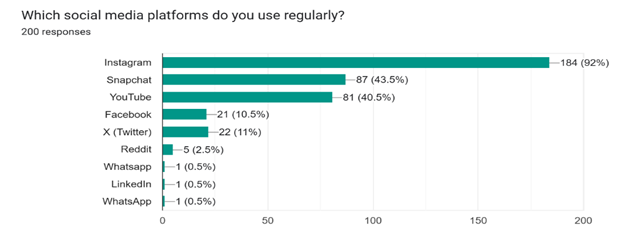
Demographic Profile and Platform Popularity: The survey captured 200 respondents, primarily aged 21–23 (43%), with 56% identifying as female. Instagram is the dominant platform, used regularly by 92% of the participants, followed by Snapchat (43.5%) and YouTube (40.5%).
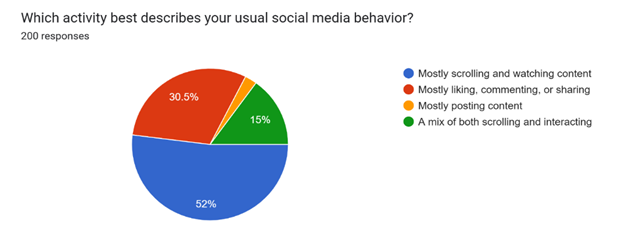
Usage Patterns and the Passive-Consumption Loop: A significant 61% of youth spend more than two hours daily on social media. The study identifies a dominant trend of passive consumption:
· 52% describe their behavior as "mostly scrolling and watching content".
· Only 2.5% primarily use platforms to post their own content.
· 58.5% admit to spending long periods passively watching reels or videos.
· 53% consume content recommended to them without searching for it themselves, showing a heavy reliance on algorithmic curation.
This data highlights a "Passive-Consumption Loop." Social media has transitioned from a participatory "social" tool into a personalized broadcasting service. Users have become observers of a curated reality rather than active communicators. Because more than half of users (52%) primarily scroll, the algorithm—not the user—effectively dictates their digital experience, mood, and daily routine.
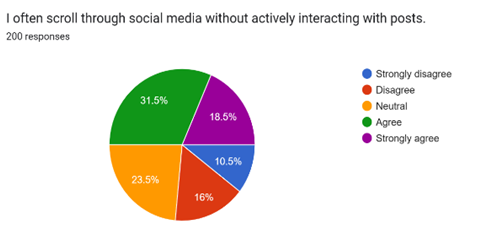
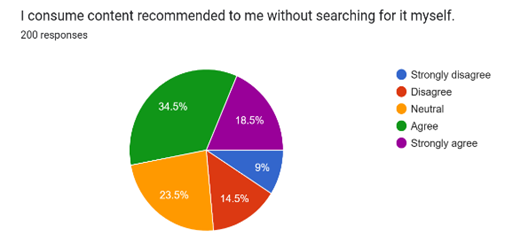
Conscious Passivity and Algorithmic Awareness: The data reveals a state of "conscious passivity":
· 70.5% of users notice content is based on their past activity.
· 67.5% are explicitly aware that algorithms decide what they see.
· 64% feel platforms are actively trying to keep them hooked as long as possible. Despite this high digital literacy, users continue to follow the "path of least resistance" by relying on curated feeds rather than active exploration.
This identifies a state of "Conscious Passivity." Even though youth possess high digital literacy and recognize that platforms are trying to keep them "hooked" (64%), they continue to follow the path of least resistance. The convenience of a curated, effortless feed outweighs the effort required for active digital exploration, making users willing participants in their own algorithmic manipulation.
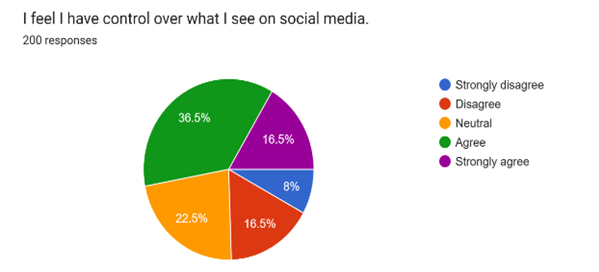
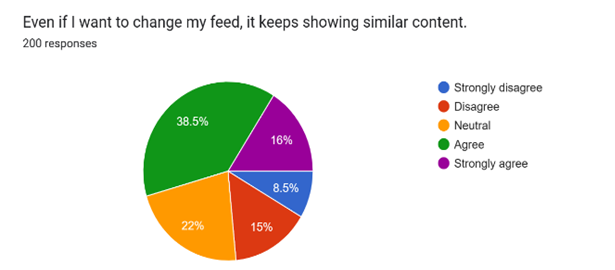
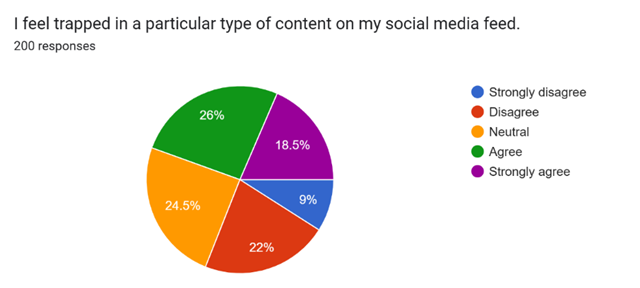
Perceived Control and "Feeling Trapped": While 53% feel they have control, a contradictory 54.5% report that even when they want to change their feed, it continues to show similar content. Furthermore, 44.5% feel "trapped" in a particular type of content on their social media feed, reinforcing the strength of algorithmic echo chambers.
This reveals the strength of "Algorithmic Persistence." The system's focus on past activity makes it nearly impossible for youth to diversify their experiences, leading to the "trapped" sensation reported by nearly half the group (44.5%). Even with the intention to see something new, the machine-learning models reinforce existing "echo chambers," effectively overriding user agency in favor of predicted engagement.
Psychological Impact and Well-Being: The automated delivery of "highlight reels" has significant mental health consequences:
· Social Comparison: 44% of respondents frequently compare their lives with others online. 45% feel that algorithmically recommended content directly increases this tendency.
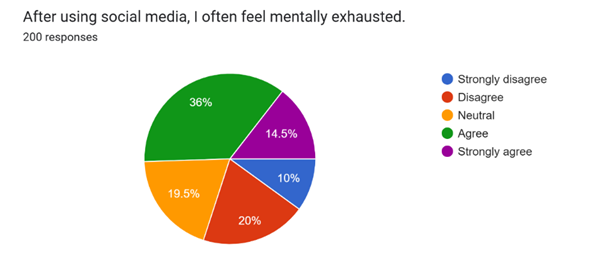
· Mood and Exhaustion: 50% report feeling anxious after long periods of scrolling, and 50.5% feel mentally exhausted after use.
· Digital Burnout: Only 38.5% feel emotionally balanced while using social media, suggesting that passive consumption leads to significant burnout.
The algorithm acts as a catalyst for inadequacy. By prioritizing highly polished, idealized portrayals of success and beauty, it forces users into upward social comparison. This results in a direct link to digital burnout, with over half (50.5%) feeling mentally exhausted and 50% feeling anxious specifically after long scrolling sessions. The data proves that passive use doesn't just pass the time; it actively erodes life satisfaction and emotional equilibrium.
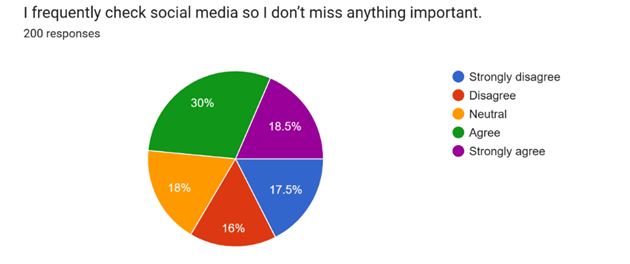
Fear of Missing Out (FoMO): FoMO is a critical driver of engagement:
· 48.5% feel compelled to check social media frequently to avoid missing updates.
· 41.5% feel anxiety when they fall behind on digital trends.
· 41% report that passive scrolling specifically increases their fear of being left out.
· 42.9% feel high exclusion anxiety when they see friends having fun without them through digital updates.
This creates a "Digital Tether" effect. For nearly 40% of users, the absence of information—specifically about what friends are doing—is a primary source of anxiety. Passive scrolling fuels this fear by providing a constant window into social events from which the user is absent, leading to exclusion anxiety (42.9%). The closer the social tie, the more acute the psychological pain of seeing curated "good times" online.
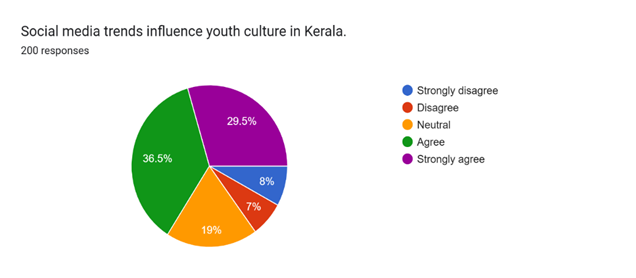
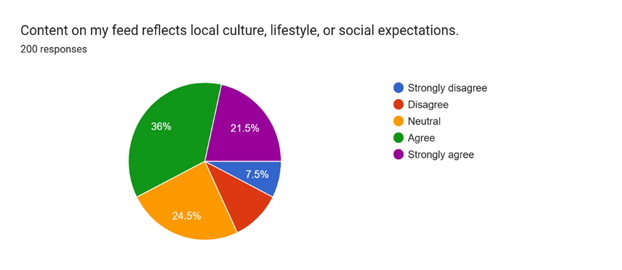
Cultural Context in Kerala: 66% of respondents agree that social media trends heavily influence youth culture in Kerala. 57.5% feel their feeds reflect local culture and social expectations, which intensifies the pressure to keep up with regional trends (reported by 41.5% of users).
Social media has become a primary source of "Cultural Currency." Because 57.5% of users see their local lifestyle and social expectations reflected in their feeds, there is an intense pressure (41.5%) to keep up with these trends to maintain social standing. The algorithm reinforces regional social pressures, making digital conformity feel like a requirement for real-world social acceptance within the Kerala context.
Findings
1) Social media is widely used by youth in Kerala, especially platforms like Instagram, YouTube, and Facebook. Most users spend a lot of time on these apps daily.
2) Many young users know that algorithms personalize content, but they do not fully understand how it affects their emotions and behaviour.
3) Algorithm-based content encourages long screen time and continuous scrolling without active interaction.
4) Passive use of social media is linked to stress, anxiety, loneliness, and emotional exhaustion.
5) Many users compare themselves with others online, leading to insecurity, low self-esteem, and dissatisfaction.
6) Repeated recommendations of similar content increase emotional dependency on social media.
7) Fear of Missing Out (FoMO) is common among youth, making them feel pressured to stay constantly updated online.
8) Passive users experience higher levels of FoMO than active users who interact and communicate more online.
9) Excessive exposure to social media negatively affects sleep, concentration, productivity, and emotional well-being.
10) Some positive effects were also identified, including entertainment, easy access to information, learning opportunities, and social connection.
11) The study confirmed that algorithm-driven passive social media use strongly affects self-perception, mental well-being, and FoMO among Kerala youth.
12) Overall, social media algorithms improve convenience and engagement but can also create psychological and emotional problems when used excessively.
DISCUSSION
The findings of this study show that social media has become a major part of everyday life for youth in Kerala, especially through platforms like Instagram, Snapchat, and YouTube. Most respondents spend several hours online daily, and a large number mainly use social media for scrolling and watching content rather than actively interacting or posting. This suggests that social media is increasingly becoming a space for passive consumption instead of genuine communication and social connection.
One of the most important findings of the study is the existence of a “Passive-Consumption Loop.” More than half of the respondents reported that they mostly scroll through reels and recommended content without actively searching for information or interacting with others. This shows how algorithms shape users’ online experiences by continuously providing personalized content that keeps them engaged for long periods. Over time, users become dependent on these curated feeds for entertainment, relaxation, and social updates.
The study also found that many young users are aware of how algorithms work. A majority of respondents understood that platforms track their activities and decide what content appears on their feeds. However, despite this awareness, most users still continue passive scrolling habits. This reflects a situation of “Conscious Passivity,” where users knowingly rely on algorithm-driven feeds because they are easy, convenient, and entertaining. The findings suggest that awareness alone may not be enough to reduce the influence of algorithms on user behaviour.
Another important finding is that many respondents feel a lack of control over their social media experience. Even when users try to change the type of content they see, platforms continue showing similar posts and videos based on previous activity. This creates a feeling of being “trapped” in repetitive content cycles or echo chambers. The algorithm keeps reinforcing the same interests, trends, and emotional triggers, making it difficult for users to explore different perspectives or reduce screen time.
The findings further show a strong connection between passive social media use and negative emotional experiences. Many respondents reported feelings of anxiety, mental exhaustion, and emotional burnout after long periods of scrolling. Constant exposure to carefully curated lifestyles, beauty standards, achievements, and entertaining content encourages users to compare themselves with others. This often creates feelings of insecurity, dissatisfaction, and reduced self-esteem. The study suggests that passive scrolling does not simply consume time; it can also affect emotional balance and overall psychological well-being.
Fear of Missing Out (FoMO) also emerged as a major factor influencing social media use. Many respondents felt the need to constantly check updates, trends, and online activities to avoid feeling left out. Seeing friends, influencers, or peers enjoying experiences online increased feelings of exclusion and social pressure among users. This creates emotional dependence on social media, where staying offline may lead to anxiety about missing social interactions or important trends.
The Kerala context adds another important dimension to the study. A majority of respondents agreed that social media trends strongly influence youth culture, lifestyle choices, fashion, beauty standards, and social expectations in Kerala. Since local culture and regional trends are heavily reflected in users’ feeds, young people feel pressure to stay updated and socially relevant. In this way, social media algorithms not only shape online behaviour but also influence real-life social identity and cultural participation.
Overall, the study shows that algorithm-driven social media platforms play a significant role in shaping the emotions, behaviours, and daily routines of youth. The findings highlight that the impact of social media is not only related to the amount of time spent online, but also to the type of engagement and the nature of algorithmically curated content. Passive scrolling, continuous recommendations, and social comparison together contribute to anxiety, emotional exhaustion, FoMO, and reduced well-being among young users.
Validation of Hypotheses: The statistical evidence supports all three research hypotheses:
1) H1 Accepted: Algorithmic personalization predicts negative self-perception and increased social comparison.
2) H2 Accepted: Passive consumption of algorithm-curated content is linked to lower psychological well-being (stress, anxiety, exhaustion).
3) H3 Accepted: Higher levels of passive consumption lead to increased Fear of Missing Out (FoMO).
CONCLUSION
This study examined how algorithm-driven social media platforms affect the mental well-being and online behaviour of youth in Kerala. The findings show that platforms such as Instagram, Snapchat, and YouTube have become an important part of young people’s daily lives. While these platforms provide entertainment and connection, they also encourage passive scrolling and long periods of engagement through personalized content recommendations.
The study found that passive consumption of algorithmically curated content is strongly linked to social comparison, Fear of Missing Out (FoMO), anxiety, emotional exhaustion, and reduced self-esteem. Although many respondents were aware that algorithms shape their feeds and online experiences, they continued relying on these personalized systems because of their convenience and entertainment value. This shows that awareness alone is not enough to reduce the influence of algorithms on youth behaviour.
The research also highlights that social media trends strongly influence youth culture and social identity in Kerala. Many users feel pressure to stay updated with online trends and social activities in order to feel socially accepted and connected.
Overall, the study concludes that social media algorithms are not neutral tools but active systems that shape emotions, attention, behaviour, and self-perception among youth. The findings emphasize the need for healthier digital habits, greater algorithm awareness, ethical platform design, and stronger mental health support systems for young users.
Recommendations
1) Promote Digital Literacy: Educational institutions must move beyond technical skills to teach algorithm awareness, helping youth understand how curated content influences their emotions.
2) Encourage Mindful Engagement: Youth should be motivated to shift from passive scrolling to active, intentional interaction and meaningful offline activities to reduce loneliness and comparison.
3) Ethical Design Standards: Regulatory authorities should push for transparency and the redesign of "persuasive design" features like infinite scroll and autoplay that exploit human psychological vulnerabilities.
4) Mental Health Support: Integrating digital well-being into academic curricula can help youth manage stress and self-esteem issues resulting from curated digital realities.
5) Scope for Future Studies: Future research should expand to rural-urban comparisons across India and utilize longitudinal methods to establish clearer causal relationships between algorithmic exposure and developmental outcomes over time.
ACKNOWLEDGMENTS
None.
REFERENCES
Upadhayay, V. (2018). Social Media Usage and Psychological Wellbeing Among Indian Youth. IJSPW.
Yu, X. (2024). Analyzing the Mitigation of the Negative Impact of Passive Social Media Use.
|
|
 This work is licensed under a: Creative Commons Attribution 4.0 International License
© ShodhVichar 2026. All Rights Reserved.


