|
|
|
|
Original Article
A STUDY ON BOLLYWOOD’S REPRESENTATION OF KERALA: ANALYZING MALAYALI AUDIENCE PERCEPTIONS
|
Gayathry S.
Nair 1*, Harikrishnan D. 2 1 MAJMC Student, Department
of Visual Media and Communication, Amrita Vishwa Vidyapeetham, Kochi Campus,
Kerala, India 2 Assistant Professor
(Sr. Gr.), Department of Visual Media and Communication, School of Arts,
Humanities and Commerce, Amrita Vishwa Vidyapeetham, Kochi Campus, Kerala,
India |
|
|
|
ABSTRACT |
||
|
This study examines how Bollywood represents Kerala and how Malayali audiences perceive these portrayals. Bollywood films often show Kerala through repeated visuals such as backwaters, coconut trees, Kathakali, festivals, and exaggerated accents. The research problem focuses on whether these portrayals are viewed as authentic or stereotypical by Malayali audiences. The objectives of the study are to understand audience perceptions, identify common stereotypes, and examine the impact of these portrayals on cultural identity. A quantitative research method was used for the study. Data was collected through a structured questionnaire using Google Forms from 90 Malayali respondents who had watched selected Bollywood films featuring Kerala. The collected data was analyzed using descriptive statistics and other basic analytical methods. The findings show that most respondents feel Bollywood often misrepresents Kerala’s culture, language, and lifestyle through stereotypes. Many participants also believed these portrayals influence outsider perceptions of Kerala. The study concludes that Bollywood should focus on more accurate and culturally respectful representations of Kerala. Keywords: Bollywood, Kerala, Malayali Audience,
Cultural Representation, Stereotypes, Audience Perception |
||
INTRODUCTION
Cinema plays an important role in shaping how people understand different cultures, regions, and identities. In India, Bollywood has a strong influence on audiences and often becomes a major source through which people learn about places they may never personally visit. Kerala is one of the regions frequently shown in Bollywood films, usually through visuals such as backwaters, coconut trees, Kathakali, festivals, greenery, and traditional lifestyles. While these images make Kerala easily recognizable, they often reduce the state’s rich and diverse culture into common stereotypes. The problem addressed in this study is whether Bollywood represents Kerala in an authentic way or through simplified cultural clichés. Previous studies have discussed cultural representation and audience perception in cinema, but very few have focused on how Malayali audiences themselves view these portrayals. This creates a research gap that the study aims to address.
The study is important because media representations influence public perception and cultural identity. The main objectives are to understand Malayali audience perceptions, identify stereotypes in Bollywood films, and examine the impact of these portrayals on cultural identity. The study focuses on selected Bollywood films released between 2016 and 2025 that feature Kerala and analyzes responses collected from Malayali audiences through a survey.
RESEARCH OBJECTIVES
1) To analyze Malayali audience’s perceptions of Kerala’s representation in Bollywood films.
2) To identify recurring stereotypes and cultural cliches in Bollywood's portrayal of Kerala.
3) To evaluate the extent to which Malayalis perceive these portrayals as authentic or misrepresentative.
4) To understand how these portrayals influence the cultural identity of Malayali audiences.
5) To offer recommendations for filmmakers to foster more nuanced and authentic portrayals of Kerala.
SIGNIFICANCE OF THE STUDY
This study is important because cinema and media play a major role in shaping public understanding of cultures and regional identities. Bollywood films often influence how audiences across India and outside the country perceive Kerala and its people. When films repeatedly use stereotypes or inaccurate portrayals, they can create a limited and misleading image of the state.
The study helps in understanding how Malayali audiences feel about these representations and whether they consider them authentic or stereotypical. It also highlights the importance of cultural accuracy in cinema and the impact media portrayals can have on identity and public perception.
In addition, this research contributes to media and cultural studies by focusing on insider perspectives, which are often missing in previous studies. The findings may help filmmakers and media creators better understand the need for respectful and realistic representation of regional cultures in Bollywood films.
LITERATURE REVIEW
Cinema plays an important role in shaping cultural understanding and regional identity. Bollywood films often represent Indian regions through simplified cultural symbols, visuals, and stereotypes to make them easily recognizable to audiences Kumar (2023), Verma (2023). Previous studies explain that films construct regional identities through language, costumes, festivals, and landscapes rather than showing complete cultural realities Sharma and Nair (2023). In India, cinema also acts as a major medium through which audiences learn about cultures and places they may never personally experience Pandey (2023). Studies related to Kerala’s representation in Bollywood show that the state is commonly portrayed through backwaters, coconut trees, Kathakali, greenery, and traditional lifestyles. Films like Chef, Karwaan, and Baaghi are often discussed as examples where Kerala is presented more as a scenic and tourist-friendly space than as a socially diverse region Kumar (2023). Research on film tourism explains that cinema strongly influences destination image formation and audience perception of places Gupta and Sharma (2023) Media discussions have also pointed out that Bollywood frequently reduces Kerala into visual clichés and ignores the social and cultural complexities of the state Mathrubhumi English. (2023).
Audience perception is another major area discussed in existing literature. Studies explain that audiences actively interpret media content based on their own cultural experiences and identity Pandey (2023). Insider audiences are more likely to notice stereotypes, exaggerations, and inaccuracies in representation Bhattacharyya (2024). Some researchers argue that Bollywood helps introduce regional cultures to wider audiences, while others criticize it for reducing cultures into repetitive stereotypes for cinematic appeal Verma (2023), Sethi (2024). Although many studies discuss cultural representation, stereotypes, and audience perception in Indian cinema, there is limited research focusing specifically on Malayali audience perceptions of Kerala’s portrayal in Bollywood films. Most studies focus on tourism, media representation, or outsider perspectives rather than insider audience opinions. This gap in literature forms the basis of the present study.
RESEARCH GAP
Many studies have already discussed cultural representation, stereotypes, audience perception, and the influence of Bollywood cinema on society. Research has also examined how Kerala is often shown in Bollywood films through repeated visuals such as backwaters, coconut trees, festivals, and traditional art forms. Some studies focus on tourism and how films create an image of Kerala for outside audiences. However, very few studies focus specifically on how Malayali audiences themselves feel about these portrayals. Most previous research looks at representation from an outsider perspective rather than from the viewpoint of people who belong to the culture being represented. There is also limited research on whether Malayalis consider these portrayals authentic, stereotypical, or culturally inaccurate.
In addition, not much attention has been given to how these representations affect the cultural identity and emotions of Malayali viewers. Therefore, this study aims to fill this gap by focusing on Malayali audience perceptions of Kerala’s representation in Bollywood films.
THEORETICAL FRAMEWORK
This study is based on two important theories in media and cultural studies: Reception Theory and Representation Theory. These theories help explain how Bollywood represents Kerala and how Malayali audiences interpret those portrayals. Reception Theory, developed by Stuart Hall, explains that audiences are not passive viewers. People understand and interpret media content based on their own experiences, culture, and background. In this study, Malayali audiences may react differently to Bollywood films because they are familiar with Kerala’s real culture, language, and lifestyle. They are more likely to notice stereotypes, exaggerations, or cultural inaccuracies in the films. Representation Theory also explains that media does not simply reflect reality but constructs a particular image of a culture or community. Bollywood often represents Kerala through repeated visuals such as backwaters, coconut trees, Kathakali, and traditional festivals. These repeated images create a fixed and simplified understanding of Kerala among audiences.
Together, these theories help the study understand both how Kerala is portrayed in Bollywood films and how Malayali audiences perceive and respond to those portrayals.
RESEARCH METHODOLOGY
This study uses a quantitative research method to understand how Malayali audiences perceive Kerala’s representation in Bollywood films. Data was collected through a structured questionnaire using Google Forms. The survey included Malayali participants who had watched selected Bollywood films featuring Kerala, such as Baaghi, Chef, Karwaan, The Kerala Story, Love Sitara, and Param Sundari. The questionnaire contained questions related to demographic details, film exposure, audience perceptions, stereotypes, cultural authenticity, and the impact of these portrayals on cultural identity. Most questions were in multiple-choice and Likert-scale format to make the responses easier to analyze.
The study used convenience sampling, snowball sampling, and purposive sampling techniques. Convenience sampling was used to distribute the survey among easily available participants, while snowball sampling helped in reaching more respondents through sharing. Purposive sampling ensured that participants had watched at least three selected Bollywood films.
ANALYSIS
Demographic analysis
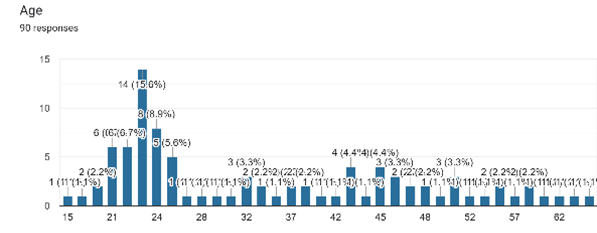


The demographic charts show that most respondents were young adults, with the largest group being 23 years old (15.6%), followed by 22 years (8.9%) and 21 years (6.7%). This indicates that the survey mainly reflects the views of people in their early twenties. In terms of gender, 54.4% were female and 45.6% were male, with no one choosing “prefer not to say.” Occupational status reveals that 51.1% were employed, 31.1% were college students, and smaller groups included school students, homemakers, and business owners. Geographically, the majority of respondents came from Ernakulam district (58.9%), with fewer participants from other districts such as Kannur, Kozhikode, Thrissur, Thiruvananthapuram, Kollam, Kottayam, and Palakkad. Overall, the sample is dominated by young Malayalis, especially from Ernakulam, with a balanced gender mix and a strong presence of employed individuals and students.
Film Exposure
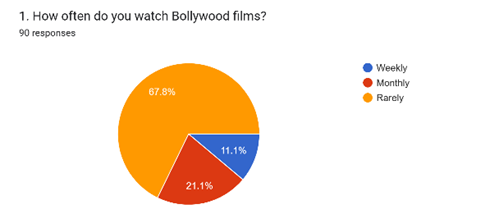
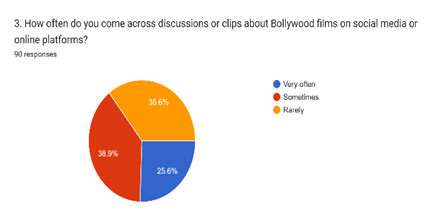
The charts show three important aspects of the participants’ viewing habits and exposure to Bollywood. First, when asked how often they watch Bollywood films, the majority (67.8%) said they watch them rarely, while 21.1% watch monthly and only 11.1% watch weekly. This indicates that Bollywood is not a regular part of entertainment for most respondents. Second, when asked which films they had seen, the most watched were Param Sundari (45.6%) and Baaghi (44.4%), followed by The Kerala Story (38.9%) and Karwaan (27.8%). Fewer respondents had seen Chef (15.6%) and Love Sitara (7.8%), showing clear differences in film popularity. Third, regarding exposure on social media, 38.9% said they “sometimes” come across Bollywood-related content, 35.6% said “rarely,” and 25.6% said “very often.” Overall, these results suggest that while Bollywood films are not watched frequently by Malayali audiences, certain titles gained more attention, and Bollywood-related content is encountered occasionally online.

Perceptions and Cultural Representation
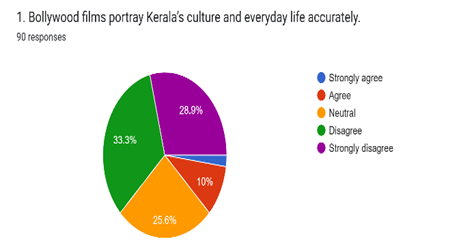

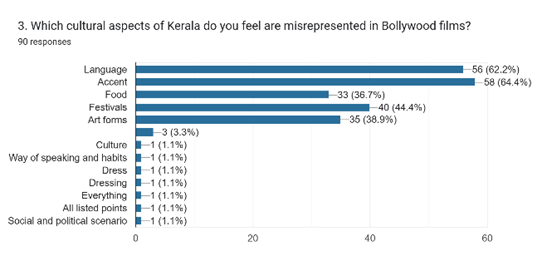


The charts show that most Malayali respondents do not feel Bollywood portrays Kerala’s culture and everyday life accurately, with a majority either disagreeing or strongly disagreeing. At the same time, most agreed that Kerala is often shown through stereotypes such as coconut trees, Kathakali, backwaters, or exaggerated accents, confirming that these clichés dominate cinematic depictions. When asked which aspects are misrepresented, accent (64.4%) and language (62.2%) were identified most often, followed by festivals, art forms, and food, showing that communication and cultural practices are the biggest concerns. Respondents also noted that they frequently encounter these stereotypes in online content, with half saying they see them “sometimes” and another 21.1% saying “very often.” Finally, a clear majority (58.9%) believed that such portrayals influence how outsiders understand Kerala, while only a small portion felt they did not. Altogether, these results highlight that Malayali audiences see Bollywood’s representation of Kerala as stereotypical and misleading, with significant impact on both insider identity and outsider perceptions.
Cultural Impact and Recommendations
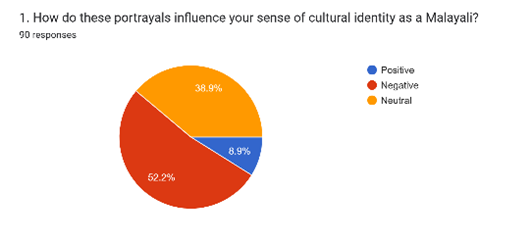
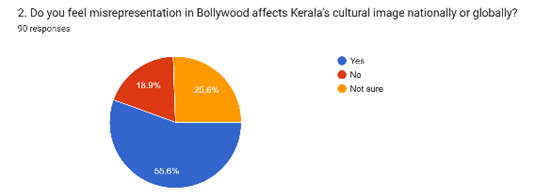
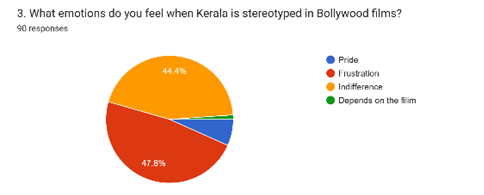
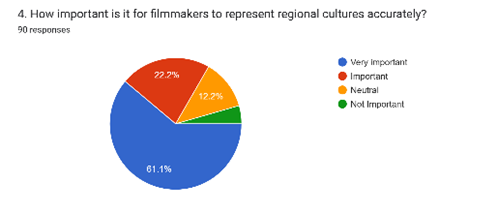
These charts highlight how Malayali audiences feel about Bollywood’s portrayal of Kerala and its impact on cultural identity. More than half of the respondents (52.2%) said these portrayals negatively influence their sense of identity, while 38.9% felt neutral and only 8.9% saw a positive effect. Similarly, 55.6% believed misrepresentation affects Kerala’s cultural image nationally or globally, with 25.6% unsure and 18.9% disagreeing. When asked about emotions, frustration was the most common response at 47.8%, followed closely by indifference at 44.4%, while only a small number expressed pride or said it depends on the film. Finally, the importance of accurate representation was strongly emphasized, with 61.1% saying it is “very important” and 22.2% saying “important,” while only a small minority felt neutral or considered it unimportant. Altogether, these findings show that Bollywood’s stereotypical portrayals are seen as harmful, shaping both insider identity and Kerala’s image outside, and audiences strongly expect filmmakers to represent regional cultures with care and authenticity.
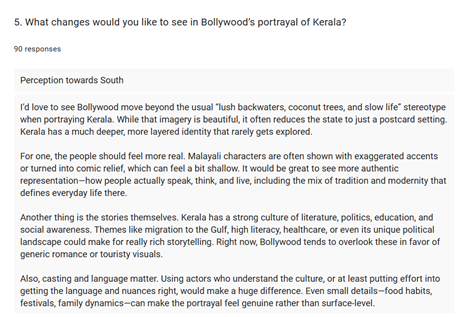
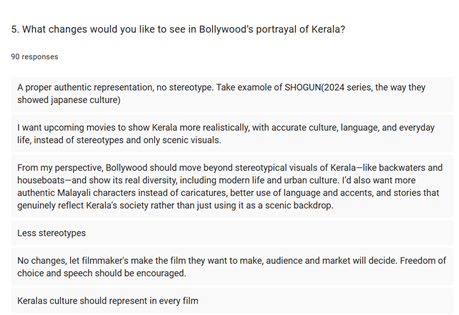
Analyzing these open-ended responses shows a strong demand from Malayali audiences for authenticity and respect in Bollywood’s portrayal of Kerala. Many participants emphasized the need for filmmakers to conduct proper research before representing the state, pointing out that Malayalam cinema often handles cultural diversity with more sensitivity and accuracy. The most common suggestions were to move beyond stereotypes like backwaters, Kathakali, and coconut trees, and instead show Kerala’s real everyday life, modern urban culture, and diverse lifestyles. Language and accent were repeatedly highlighted as areas needing improvement, with calls for accurate use of Malayalam and avoidance of caricature. Respondents also stressed the importance of casting choices, suggesting that Malayali actors or consultants should be involved to ensure credibility. Several mentioned that Kerala’s progressive society, political awareness, migration stories, and social realities could provide richer narratives than the usual tourist imagery. While a few respondents felt filmmakers should have creative freedom or even avoid portraying Kerala altogether, the overwhelming majority wanted truthful, nuanced, and well-researched representation.
Overall, these opinions reveal frustration with Bollywood’s superficial depictions and a clear expectation that future films should portray Kerala as a complex, evolving society rather than a postcard setting. The responses highlight that audiences value cultural authenticity not only for insider identity but also for shaping how Kerala is understood nationally and globally.
DISCUSSIONS
The findings of this study show that most Malayali audiences feel Bollywood does not represent Kerala in an authentic or realistic manner. Participants believed that Bollywood often depends on stereotypes such as backwaters, coconut trees, Kathakali, festivals, and exaggerated Malayalam accents while portraying Kerala. Language and accent were identified as the most misrepresented aspects, followed by festivals, art forms, and everyday lifestyle. These findings directly answer the research questions related to audience perception, authenticity, stereotypes, and cultural identity.
The results are similar to previous studies on cultural representation in cinema, which explain that Bollywood often simplifies regional cultures into easily recognizable images for wider audiences. Earlier research also suggested that Kerala is frequently portrayed as a tourist-friendly and visually attractive location rather than a socially and culturally diverse state. The present study supports these ideas by showing that Malayali audiences themselves recognize these repeated clichés and feel disconnected from such portrayals. The findings also connect with Representation Theory, which explains that media constructs reality through repeated symbols and images. Bollywood’s repeated portrayal of Kerala through limited visuals creates a fixed understanding of the state among outside audiences. Reception Theory is also reflected in the study because Malayali audiences interpreted these portrayals critically based on their own cultural experiences and insider knowledge. Instead of accepting the representations completely, many respondents questioned their authenticity and accuracy.
Another important finding is that most respondents believed these portrayals influence how outsiders understand Kerala and negatively affect cultural identity. This shows that cinema does not only entertain audiences but also shapes social understanding and public perception. The frustration expressed by many participants highlights the emotional impact inaccurate representation can have on insider audiences. At the same time, the study also shows that audiences expect more responsible and culturally informed storytelling from Bollywood. Participants suggested better research, accurate language use, and collaboration with Malayali actors and filmmakers to improve representation. These findings are important in media studies because they highlight the need for authenticity and sensitivity while representing regional cultures in mainstream cinema. Bollywood’s portrayal of Kerala therefore has wider media implications, as repeated stereotypes can strengthen cultural misconceptions instead of promoting genuine understanding and diversity.
CONCLUSION
This study examined how Bollywood represents Kerala and how Malayali audiences perceive these portrayals. The findings reveal that most respondents believe Bollywood often presents Kerala through repeated stereotypes such as backwaters, coconut trees, Kathakali, festivals, and exaggerated accents instead of showing the state’s cultural diversity and modern social realities. Language and accent were identified as the most misrepresented aspects, followed by festivals, food, and traditional practices.
The study also found that many Malayali audiences feel these portrayals influence how outsiders understand Kerala and negatively affect their own cultural identity. Instead of creating authentic representation, Bollywood often reduces Kerala into simplified visual clichés for cinematic appeal. At the same time, audiences expressed the need for more accurate, respectful, and culturally informed portrayals.
Overall, the research highlights the importance of authentic cultural representation in cinema. Bollywood has a strong influence on public perception, and inaccurate portrayals can create stereotypes and misunderstandings about regional cultures. The study concludes that filmmakers should move beyond repetitive imagery and focus on portraying Kerala in a more realistic, diverse, and meaningful way. This research also contributes to media studies by bringing attention to insider audience perspectives on cultural representation in Bollywood cinema.
ACKNOWLEDGMENTS
None.
REFERENCES
Bhattacharyya, S. (2024). Bollywood Movies and Cultural Identity Construction Among Second-Generation Indian Americans. Journal of Cultural Studies. https://ttu-ir.tdl.org/server/api/core/bitstreams/742dae9c-7dbc-46e9-b876-f96cd6b5e2ba/content
Dasgupta, S. (2024). Global Reception of Indian Regional Cinema and Its Impact on Cultural Diplomacy: A Critical Analysis. In Indian Cinema and Cultural Identity: Negotiating Tradition, Modernity, and Global Influence. https://theacademic.in/wp-content/uploads/2025/03/68.pdf
Gupta, R., and Sharma, P. (2023). Bollywood Urge to Tourism Surge: Exploring the Impact of Bollywood Cinema on Domestic Tourist Motivation. International Journal of Hospitality and Tourism Systems. https://thesis.eur.nl/pub/74773/13814.pdf
Mathrubhumi English. (2023). Hey Bollywood! There’s a Kerala Beyond Cliches and Stereotypes. Mathrubhumi. https://english.mathrubhumi.com/features/specials/kerala-cultural-inappropriation-cinema-art-bollywood-udvik7j3
Mehta, S. (2024). Crafting Connection: The Role of Storytelling Techniques in Audience Engagement in Contemporary Indian Cinema (2023–2024). Cinema & Media Journal. https://ijrpr.com/uploads/V6ISSUE5/IJRPR46482.pdf
Pandey, M. (2023). Films and Society: A Case Study of Audience Perception of Selected Hindi Films. Sociological Bulletin of Media. https://www.researchgate.net/publication/325339721_Films_and_Society_A_Case_Study_of_Audience_Perception_of_Selected_Hindi_Films
Sethi, V. (2024). Representation of Vernacular Languages in Indian Cinema: A Cultural Renaissance. Journal of Linguistic and Cultural Studies. https://www.researchgate.net/publication/319608100_Language_and_Indian_Film_Audiences
Srivastava, K. (2023). Representations of Female Characters in Bollywood Cinema: Stereotypes, Audience Perceptions, and Societal Impacts. Gender and Media Review. https://www.frontiersin.org/journals/sociology/articles/10.3389/fsoc.2025.1694300/
Verma, L. (2023). Exploring Indian Cinema: Languages, Cultural Diversity, and Cinematic Art. Academic Press. https://ijirt.org/publishedpaper/IJIRT166153_PAPER.pdf
|
|
 This work is licensed under a: Creative Commons Attribution 4.0 International License
© ShodhVichar 2026. All Rights Reserved.


