|
|
|
|
Original Article
MECHANISMS SHAPING THE DIGITAL RIGHTS AND DATA PRIVACY AMONG KERALA YOUTH
|
Shebin Philip
John 1*, S. Dinesh Babu 2
1 MA JMC Student, Department
of Visual Media and Communication Amrita Vishwa Vidyapeetham, Kochi Campus,
Kerala, India 2 Assistant Professor
(SG), Department of Visual Media and Communication, School of Arts,
Humanities and Commerce, Amrita Vishwa Vidyapeetham, Kochi Campus, Kerala,
India |
|
|
|
ABSTRACT |
||
|
Since social networking has become an essential part of everyone's life, people have been increasingly wondering if teenagers have fully understood their rights online and their private data. The study investigates the level of digital rights and data privacy awareness, observed behavior in the sharing of information online, and the social and structural determinants of their understanding among the Kerala Youth. For the study, a quantitative descriptive design was employed, and data were collected through a questionnaire distributed among 201 youth users spread across all 14 districts of Kerala through convenience and snowball sampling. Frequency and percentage analysis were used for data analysis. The Privacy Paradox, Surveillance Capitalism, Privacy Calculus Model, Communication Privacy Management Theory, and Contextual Integrity were considered. Results indicated an obvious difference between actual privacy knowledge and perceived privacy awareness. Respondents had general knowledge of digital rights but were aware only of rudimentary legal matters, such as the Digital Personal Data Protection (DPDP) Act. Common unsafe behaviors observed were not reading the terms and conditions, granting unnecessary permissions to applications and continuing to use applications even when aware of potential risks. The influence of peers and the design of the social networking platform influenced the digital behaviors to a greater extent and education had very little impact. The study concluded that digital rights among the Kerala youth have a more theoretical knowledge rather than an application based knowledge and there is a greater need to inculcate advanced digital rights knowledge among them by means of, not only to raise public consciousness and encourage interaction on data protection rights but also the need to create user friendly consent mechanisms. Keywords: Digital Rights, Data Privacy, Kerala
Youth, Privacy Paradox, Surveillance Capitalism, Consent Fatigue, Digital
Literacy, DPDP Act, Awareness Behavior Gap |
||
INTRODUCTION
With the increased
use of social networking sites in everyday lives, it has become a matter of
concern how conscious are young users of their digital rights and data privacy,
which has become an important research area in digital advanced parts of the world
such as Kerala. The purpose of this study is to assess the level of awareness
of digital rights and data privacy among youth in Kerala, examine their online
data sharing behaviour, and study the social and structural determinants of
their privacy awareness. This research study follows a quantitative descriptive
research design using structured survey which was conducted on 201 participants
across all the fourteen districts of Kerala selected by convenience and
snowball sampling techniques. Frequency distribution and percentage analysis
were done with SPSS, and it is based on the theory of Privacy Paradox,
Surveillance Capitalism, Privacy Calculus Model, Communication Privacy
Management theory and Contextual Integrity. The study has established that there
is a gulf between perception and actual privacy awareness of youth in Kerala
where respondents had vast awareness of digital rights but they did not know
much of legal regulations such as Digital Personal Data Protection Act, while
common unsafe practices like "accepting all terms and conditions without
reading", "giving a lot of app permissions", and "using a
platform even knowing its privacy risks" dominated their digital
behaviors. Peer influence and design of digital platforms are significant
determinants and formal education was insignificant in framing the digital
privacy awareness and behavior. The study concludes that young people of Kerala
are in theoretical stage awareness of digital rights, need effective digital
literacy and consent mechanisms, and public discussion regarding the data
protection policies.
SIGNIFICANCE OF THE STUDY
This study is
relevant particularly at a time when digital platforms are replacing the
physical spaces for young people to learn, interact, and engage with the world
around them. Youth today are no longer merely recipients of information online,
but they are participants in a landscape that consistently extracts and
commodifies their personal information. Learning about what they know about
their digital rights and their behaviour around privacy can therefore not only
be an academic exercise but a matter of social concern.
This study, unlike
other national surveys on this issue, attempts to shed light on how the
awareness is built, rather than solely measure the awareness levels. The
interactive examination of how digital literacy, formal education and influence
from social media shape the awareness will help provide a better insight to the
nature of gap between awareness and behavior among youth in Kerala. This study
is relevant to various aspects. For teachers, this study will lend support in
raising a voice for the inclusion of digital rights in the curriculum.
Policymakers may derive an insight from the research into building an awareness
program which would actually cater to the behaviour of youth online. Platform
designers are warned about their liability in constructing transparent and
substantive data consent process, instead of it being just a tick-box activity.
The foundation on which this study is built is the fact that active digital
participation cannot be an option but a right, and protection of youth from online
exploitation will necessitate intervention from institutions, platforms and
community together.
RESEARCH OBJECTIVES
1)
To
assess the awareness level among youth about digital rights and data privacy.
2)
To
examine youth behaviour related to sharing personal information on Digital
media.
3)
To
identify the sources through which youth learn about digital rights and
privacy.
RESEARCH QUESTIONS
RQ1: What is the awareness level among youth of
Kerala about digital rights and data privacy in the context of increasing
digital media usage?
RQ2: To what extent do young users know about
data collection practices, privacy policies, and legal protections related to
their personal information on digital platforms?
RQ3: How does the awareness level about digital
rights and data privacy influence the information sharing behaviour of youth on
digital media?
HYPOTHESIS
H₁: Although the youth of Kerala use digital
media platforms frequently, there is lack of awareness about data privacy and
digital rights which results in uninformed sharing of personal information in
the online environments.
H₂: Digital literacy, educational exposure,
awareness initiatives, and experiences with digital platforms have a
considerable impact on the level of awareness and privacy-related behaviour of
Kerala youth concerning digital rights and data privacy.
REVIEW OF LITERATURE
The varied
behavioural, social, institutional and structural mechanisms through which the
digital rights of and the data privacy of young people in Kerala understand it,
can be viewed through many aspects. Each of the papers that have been reviewed
highlights one aspect of this larger problem
Suresh (2024a) demonstrates that young Indians continue to
practice risky behaviour online like freely sharing data and using unsafe
networks even with some level of awareness. This goes to prove that increased
awareness does not necessarily translate to safer behaviour online, which is
the major area of concern in the study. It applies to the youth in Kerala. According
to Soni
(2024), the reason teenagers persist with using
social media in the ways that they do is because they are aware of being
monitored, but are driven to share and display content by social pressures and
the sense of "FOMO" (fear of missing out) This is very similar to the
kinds of social pressures faced by young people in Kerala on the platforms that
matter and for which social visibility and sense of belonging trumps personal
privacy. George et al. (2020) examine the awareness behaviour gap among
young adults in Bengaluru. Even though they are concerned about misuse, they
mostly continue accepting platform terms and conditions without reading it.
This same gap
between awareness and behaviour is central to the problem this study addresses
among Kerala youth. Das
(2022) illustrates with the example of a survey on university students in
Bangladesh that having a high level of internet access does not always build
digital literacy, as students still are unaware of common threats such as
phishing or identity theft.
This is clearly
applicable to the context of Kerala where there is wide digital access but a
possibility of shallow understanding of data privacy issues. Knijnenburg et al. (2022) highlight that while unsafe digital
behaviour has been traditionally associated with ignorance it can be better
explained by the influence of the design of online systems, social norms, and
habit formation. In this perspective, the continuing unsafe practices of young
people in Kerala can be understood as resulting from similar influencing
factors in the socio-technical ecosystem of online platforms. Sriharsha (2025) finds that Indian youth are compelled to
give consent through the implementation of dark design patterns in the design
of the interfaces, particularly through confusing design which manipulates
users into giving consent without understanding.
This suggests that
the issue of consent in digital rights is not simply about the agency of youth
but also about the systemic structures and designed interfaces, and this study
is in line with examining such structural aspects shaping privacy behaviour among
Kerala youth.
Nguyen
et al. (2023) note that the vast majority of social media
and technology platform users across major platforms do not comprehend what
they are agreeing to in privacy policies since the language is technical and
the documents too lengthy. For young people in Kerala, such consent fatigue is
highly relevant as they daily use these platforms and consent to conditions
which they do not understand. Jain
et al. (2025) discover that youth in India continue to
distrust platforms but are unable to reduce their use of social media, which
indicates the strong social imperative to remain online, overpowering privacy
concerns. This tension between mistrust and use is a key issue that this study
investigates among youth users in Kerala. Bhat
(2024) illustrates that though The Digital Personal
Data Protection Act, 2023 can be seen as a forward movement, exemptions given
to the government on several provisions and lack of digital literacy among
youth make it less effective in the real world for citizens in India, including
Kerala. Narayana
Swamy (2025) demonstrates with empirical data from Kerala, that the large chunk of
internet-active young adults still are ignorant about the provisions of
cyber-crime laws, the ways it affects them, and even basic digital security
practices and information security awareness.
This confirms the
necessity of this study to focus on young people in Kerala with the same gap of
access but limited awareness. Verma
and Mishra (2024) propose that children and adolescents are particularly vulnerable
because their knowledge of legal rights is limited, and they do not yet have
the capacity to make informed decisions regarding the data that is being
collected. This right-based perspective shapes this study as an attempt to
uncover how young people in Kerala occupy a position as part of the data
infrastructure they do not yet understand. Gallego-Arrufat
et al. (2024) conclude in a review of 54 articles that
there is a trend for schools to adapt to digital media without addressing
privacy issues and rights in their pedagogy, pointing to the lack of
institutional capacity building, which is a part of the structural framework
that shapes young people's practices regarding digital rights in Kerala.
According to Sarwatay
et al. (2021) family aspect can also be addressed where
mothers tend to control children rather than educating them about safe internet
use, which can be worse in the case of poorer economic backgrounds. So, the
family environment and education also play role in deciding about use of
internet by youngsters in Kerala and it can be seen as institutional structure.
Williams
et al. (2023) argue that having conversations with parents
about online privacy strongly correlates with higher levels of awareness and
protection, showing how dialogue can make a difference in the development of
data privacy practices among young individuals, thus being relevant for young
people in Kerala too. Augustine and Yadav (2021) study how youth in rural Kerala access information mainly through their
mobile devices, with resulting inconsistent networks, a lack of access to
supportive institutions, and increased risks. This indicates a strong disparity
along geographical lines influencing data privacy awareness among Kerala youth.
Farthing
et al. (2024). reveal that young people in countries such
as these often view privacy only in terms of what can be observed by peers and
family, not by what corporations are invisibly collecting. This narrowed
perception of privacy can be assumed to be equally applicable to youth in
Kerala, and therefore becomes a focus area of this study. Livingstone
and Third (2017) critique the present-day information
environment, noting that the designs of digital platforms mostly cater to adult
users and commercial interests, marginalizing the perspectives and privacy
concerns of youth, underscoring the need for the kind of youth-oriented
research that is proposed in this study. Christakis and Hale (2025) raise concerns over the vast amount of
personal data being produced through day-to-day usage by adolescents without
them having any understanding of how their data is being utilized and this
phenomenon is occurring on an unprecedented scale in a state like Kerala where
youth use and engagement with technology continues to grow at an accelerated
rate and this study investigates how much of this datafication process is below
the awareness radar of Kerala's young population. Singh
(n.d.) demonstrates that though many Indian users have experienced financial
losses and privacy infringements online they are still not satisfied with
available legal remedies, suggesting an inadequacy of institutions. The
disillusionment with institution building is also pertinent for this study with
the same focus among Kerala's young users. Choudhary and Patidar (2025) reflect that Indian Digital Governance was
primarily driven by goals of increasing access and delivery, with a lapse in
developing rights-based awareness among citizens. For young people
participating actively in digital governance in India and more specifically in
Kerala, this created a imbalance which will likely impact their digital rights
awareness. Sriharsha (2025) and Jana
et al. (2022) show how consent in India is ineffective and
also a weak legal safeguard, where age verification procedures are often
non-existent, or are easily bypassed, and boxes are unchecked and unchecked.
This is also true for the youth in Kerala, whose engagement with digital
technology is shaped by such a systemic breakdown of consent mechanisms.
RESEARCH GAP
From the reviewed
literature on digital rights and data privacy, one area that has not been
thoroughly explored is the gap between adolescent privacy awareness and their
online behavior. While many works talk about how young people have concerns for
their privacy, few attempts have been made to explore why they still continue
to exhibit unsafe online behavior, such as data sharing practices. This aspect
needs attention particularly in the Kerala context where high literacy and
digital access coexist withunsafe online practices among adolescents. The
influence of peers, social influence, and design of the platform on how youth
make privacy choices have not been addressed adequately. Most privacy
frameworks developed are centered on adult users, without considering the
specific factors affecting adolescents such as, the impulse driven nature, need
of peer approval and the role of digital identity.
THEORETICAL FRAMEWORK
Routine Activity Theory
The analysis in
this paper views how everyday digital routine activities of Kerala youth
provide an opportunity for privacy risks, and utilizes Routine Activity theory
from Cohen and Felson (1979), which states
that a crime occurs when three conditions occur at the same time; a motivated
offender, suitable victim, and a lack of capable guardians. IThe Indian youth
has been taken advantage of by Suresh (2024b), who states that it is not awareness but a
persistent digital culture and irresponsible supervision that can be hazardous
to the youth, and lead to various problems, like data theft, phishing, breach
of privacy etc. Due to its integration in almost all daily routines, from
waking up to going back to sleep, 18–35 year old Kerala youth are constantly
reachable targets in a realm that lacks any effective protection systems.
Socio-Technical Perspective on Privacy
This study also
analyzes how individual level awareness is indirectly determined by factors
external to it. By drawing from Knijnenburg et al. (2022) and other researchers, the Socio-Technical
Perspective on Privacy suggests that individual privacy decisions are quietly
guided by the design of platforms, by social norms, cultural context and
institutional defaults that most users are unaware of. Research by Farthing
et al. (2024) further found that younger individuals are
only interested in the visibility of their personal lives to immediate social
circles whereas corporate data collection happens outside of individual
observation and awareness. This study, given the simultaneous interplay of
closely knit familial circles, closely related peers, and behaviorally nudging
platforms in Kerala, uses the socio-technical perspective to analyze whether
these youth are actually practicing their privacy rights or just traversing the
digital world unaware of the processes that happen with their personal data.
Research Methodology
Research design
This study will
use a quantitative descriptive research design to investigate the level of
digital rights and data privacy awareness among youth in Kerala. A descriptive
quantitative research design has been used to find out about the behavior,
awareness and the affecting factors based on quantified measures that are
statistically quantifiable.
Research Method
A structured
online survey was carried out using the Google Forms platform. This involved a
structured questionnaire with multiple choice questions, Likert type scale
statements ranging from Strongly Agree to Strongly Disagree and behaviors and
awareness assessment based items that assess digital rights awareness, data
sharing practices and affecting variables such as peer cultures and design
elements.
Population and Sampling
The target
population is 18 to 35 years old young users of digital media across all
fourteen districts of Kerala. This study used non-probability sampling method
consisting of combined convenience and snowball sampling techniques. A total of
201 valid responses were gathered from students and young professionals who are
networked in academia and through social networks.
Data Collection
Primary data has
been gathered through the use of a structured questionnaire which was
administered electronically through social media and personal networks. The
questionnaire covered:
•
Awareness
about digital rights and legalities
•
Data
sharing and privacy practices
•
Factors
affecting digital rights and privacy awareness
Ethical Considerations
All participants
in the study were informed before their participation and a voluntary consent
was taken before the commencement of the survey. No identifying information of
any kind was collected, and only basic demographic variables (age, sex,
district) was taken to enable the statistical analysis. All information is kept
secure, and is accessible only by the principal investigator, for the sole use
of research.
Data Analysis
Data has been
analyzed using descriptive statistics such as frequency and percentage
analysis. The responses obtained through Likert scale has been collapsed so
that Strong Agree and Agree are considered as Agreement and Strongly Disagree
and Disagree considered as Disagreement in order to capture macro behavioral
trends among the youth surveyed.
Socio-Demographic Profile of Respondents
Demographics of
respondents are critical for context, as a backdrop of how digital privacy
awareness and behavior take shape. Aspects like, age, gender, geographic
coverage, are all tied into issues of digital exposure, engagement with
platforms, and the kinds of experiences one is having regarding privacy. As
this research has a youth focus, using the demographics allows the data to be
framed appropriately.
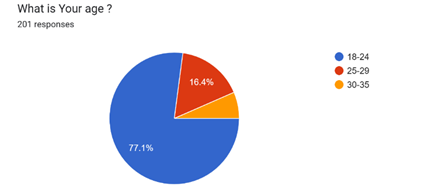
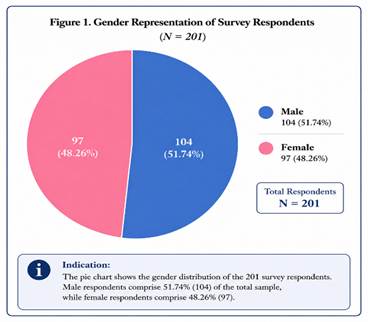
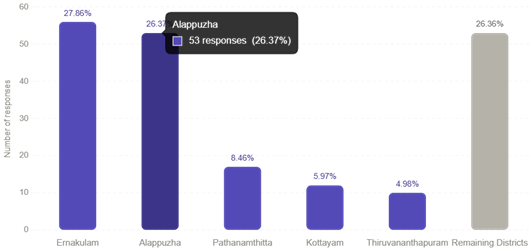
Total response = 201
The sample
comprised a young internet-savvy population that is relevant for the objectives
of the study. As 77.11% of the respondents were in the age bracket of 18 to 24,
it means a generation that heavily depends on technology for education,
interaction and socialising. Of the rest of the respondents, 16.42% are between
25 to 29 years of age and 6.47% between 30 to 35 years of age; this provided
them some level of past experience of internet use with growing
responsibilities and understanding. The respondents were approximately equally
divided by gender (51.74% males and 48.26% females). This helps ensure reliable
results without any gender specific bias. Regarding districts, response came
from all the fourteen districts of Kerala, with maximum contribution coming
from Ernakulam (27.86%) and Alappuzha (26.37%), followed by Pathanamthitta
(8.46%) and Kottayam (5.97%). More contribution from the more urbanised,
internet-driven regions reflects the extent of platform usage, but wider range
ensures regional representativeness.
Objective I: Assessing Awareness Regarding Digital Rights and Data Privacy
The first
objective of the study is to investigate the levels of awareness of Kerala
youth on digital rights and data privacy. Awareness was defined meaningfully by
not just asking specific survey questions but also collectively analyzing
survey questions pertaining to legal rights, data collection, privacy policies,
digital consent, platform surveillance and digital literacy statutes. Combined,
these could throw light on whether Kerala youth possess a mere abstract
awareness of privacy issues or have an understanding of the rights and privacy
mechanisms in which they are entitled to.
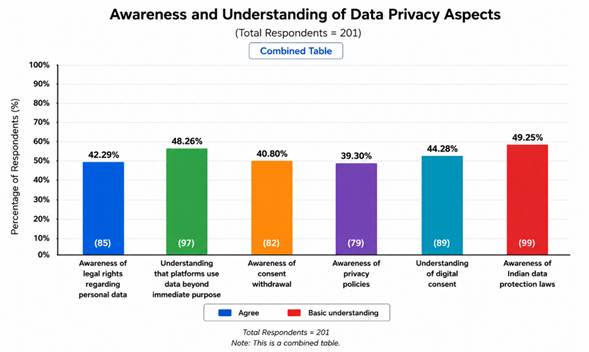
Awareness of Digital Rights and Legal Frameworks
Analysis AND Interpretation
Overall, the
respondents have an above average, yet uneven level of awareness about digital
rights and data privacy issues. While almost 48.26% of the respondents seemed
aware of data collection in the digital space exceeding required transactions
and inferred that it involved things like algorithmic profiling and targeting
ads, and 42.29% were aware of their legal rights in terms of data collection
and usage, along with digital consent, there seems to be a superficial level of
awareness. There was more awareness about data collection practices rather than
knowledge of the legal rights people were entitled to against data collection
and usage practices. Hardly half (49.25%) seemed aware of Indian privacy laws
and that to only vaguely, and a lot fewer knew about privacy laws beyond that.
Especially, awareness about the digital personal data protection act, 2023 was
almost zero. It seems evident that while technological advancements were rapid,
digital literacy wasn't and there seems to be an awareness gap which implies
that the otherwise lauded culture of education in Kerala may not have expanded
to cover digital literacy and rights. People knew data was being collected and
used but were largely ignorant about the laws that protected them against it.
Objective II: Behavioural Patterns Related to Sharing Personal Information on Digital Media
The second
objective of the study seeks to examine the behavioural practices of Kerala
youth regarding the sharing of personal information on digital platforms. While
awareness is an important indicator of digital literacy, actual behaviour
provides a more accurate understanding of how individuals manage privacy in
everyday online environments. Therefore, this section examines respondents’
practical engagement with terms and conditions, privacy settings, app
permissions, platform dependency, peer influence, and willingness to continue
platform use despite privacy concerns.
To avoid
fragmented interpretation, behaviour-related questions were analysed
collectively to identify dominant behavioural tendencies and contradictions in
privacy practices.
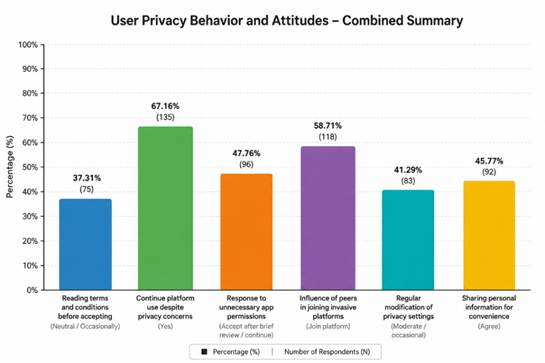
Behavioural Patterns in Data Privacy Practice
Analysis AND Interpretation
The behavioural
indicators in this survey confirm a vast difference between respondents'
knowledge about digital privacy and their actions online. With respect to terms
and conditions, respondents stated they would read them only once in a while
before clicking accept (37.31%). This is an indication of the tendency of users
to give the agreement of consent under lack of any true awareness about how
their personal data will be gathered, processed or shared. The phenomenon is
identified by academics as consent fatigue where users skip terms and condition
because of its sheer length and complexity and readily sign off with automatic
consent, rather than the consensual acceptance of a complex issue. Even more
alarmingly, respondents said that they would continue to use the platform even
when they are uncomfortable with its privacy policies (67.16%), which indicates
that the dependency on digital mediums for communication, education and social
life always comes first even in the face of potential risks associated with
privacy. This is a direct demonstration of the Privacy Paradox where users have
been shown to understand the risk involved, but nevertheless choose the course
of action in an attempt to gain certain advantages (which in this case relates
to communication, education etc) rather than for security reasons. A similar
response was also witnessed in relation to app permission: respondents (47.76%)
continued using apps even when they are asked for overreach permissions like
location, contacts and device access (even after glancing at it only briefly at
best). Social influence is another factor that perpetuates these practices:
when respondents are asked whether they would join a platform that has
questionable privacy terms and conditions if most of their peers are already
using it, the response is yes from 58.71% of respondents. This highlights that
the decision about privacy does not arise in vacuum for the youth in Kerala;
instead it depends significantly on peer group pressures, fear of isolation and
perceived digital necessity. These points combined together provide solid
support for the study's main argument, i.e., awareness about digital privacy
risks does not correspond to protection of the same by the Kerala youth.
Objective III: Sources Through Which Youth Learn About Digital Rights and Privacy
The third
objective of the study focuses on identifying the major sources through which
Kerala youth develop their understanding of digital rights and privacy. Since
awareness is shaped by exposure to information, understanding the channels
through which young people learn about digital safety becomes essential in
identifying institutional strengths and weaknesses.
Table 1
|
Table 1 Frequency Distribution of Sources of Digital Privacy Awareness
(N = 201) |
||
|
Source of Awareness |
Frequency (f) |
Percentage (%) |
|
Social Media / Online Platforms |
85 |
42.29% |
|
News Media |
38 |
18.91% |
|
Educational Institutions |
32 |
15.92% |
|
Self-learning |
30 |
14.93% |
|
Friends / Peer Networks |
16 |
7.96% |
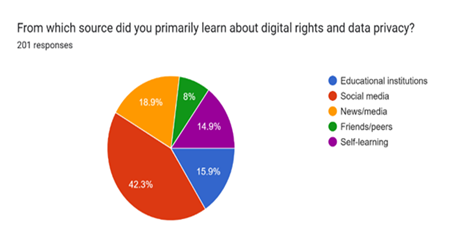
Sources of Digital Rights Awareness
Analysis and Interpretation
A very interesting
observation is that education plays only a minimal role in informing awareness
regarding digital rights among the youth of Kerala. Only 15.92 per cent of
respondents stated educational institutions to be the major sources of
information regarding digital rights and privacy-a surprisingly low statistic
in a state famous for its high literacy levels and academic reputation. 42.29
per cent learned about digital rights and privacy via the internet and social
networking media – it seems that the very sites that capture and commercialize
users' information are also the major providers of information regarding it.
There is an obvious conflict of interest where information regarding rights is
provided by the very entities that are involved in rights abuses, and so
knowledge is received from trends, discussions on social media networks, highly
publicized incidents of data breaches, and is largely without any proper legal,
formal and rights based framework. This means that young people in Kerala possess
a fragmented, specific and trend based idea of privacy and its importance; it
is not a complete and formal awareness as one might expect. The finding
confirms a wider trend seen throughout the survey: that Kerala's advanced
literacy culture has not penetrated into the world of digital rights and the
lack of digital rights based curriculum, within formal education, will result
in the continuation of a passive and superficial form of digital rights
awareness among the youth.
OVERALL ANALYSIS
The result
highlights alarming digital rights consciousness of the youngesters in Kerala.
While for privacy, formal information provider is school/educational
institution, for digital rights, knowledge on privacy were derived from digital
media /informal & unstructured manner.42.29% of the respondents expressed
that, "They came to know about digital rights & privacy as, they were
familiar to social media/internet". Paradoxical to the fact that, same
entity that uses users' data is also the major informant, this could further
result in unstructured digital literacy and domain specific knoweldge as
against cross domain. It indicates that learners will come across digital
rights and privacy either via trending, shorter forms of content, discussions
amongst social media personalities or via data breach occurrences. In contrast,
educational institution as authority on knowledge of digital rights was claimed
by15.92% of the respondents, showing much ignorance of the subject. This has to
be addressed carefully as otherwise, Kerala is noted for its highest literacy
rate and better educational background and, here also fordigital literacy the
scenario isn't the same. This would imply knowledge of digital rights not
proportionately correlated with other subjects and the information viaself
learning and news may impart only some aspect to be knowledgeable and the most
part will carry the legal & rightful aspects on digital rights for no
impact.
INTEGRATED DISCUSSIONS WITH RESEARCH PROBLEM
Collectively, the
findings of this study describe the state of digital rights awareness among
youth in Kerala with clarity. Respondents are not wholly unaware; they
recognize data being collected by platforms other than that of the direct
service provision, they have basic understandings of how consent works, they
can comprehend what micro-targeted advertising means, and they acknowledge that
their privacy is indeed under threat. However, as soon as legal and
institutional dimensions of data rights are introduced, their awareness
vanishes. The respondents' knowledge of relevant data protection legislations,
the options and actions available under those legislations, and their specific
rights under laws like the Digital Personal Data Protection Act was negligibly
low. This shows the existing awareness of the concept, but without any
practical depth to it.
This abstractness
is highlighted when awareness failed to materialize into action. Despite
expressing discomfort when it came to their online privacy policies, their
online behaviors of sharing excessive personal data, agreeing to wide ranging
app permissions, and sharing personal data remained predominantly determined by
habits, convenience, and especially, peer influence. So strong was the pressure
of conforming, that it entirely trumped even the respondents' conceptual idea
of appropriate privacy decision-making. Being excluded from the services most
of their peers used was too big an issue for most respondents to compromise.
The study also
points out to a structural inadequacy in the origin of this awareness.
Awareness was predominantly shaped on social media and not through school and
other formal institutions. In a manner of speaking, the parties that profit the
most from collection of personal data on online platforms were the only parties
to deliver fragmented and need-based education on data privacy and data rights.
For Kerala, an educationally advanced state, this gap between conventional
literacy and digital rights literacy presents a concrete and policy relevant
vacuum.
DISCUSSIONS
Two hypothesis
that were posed at the beginning of this research, about digital rights
awareness and privacy behavior among the youth in Kerala, were tested and
confirmed through analysis. Hypothesis 1: Youth in Kerala are massive digital
platform users, but are relatively unaware of their digital rights and the data
privacy issues and therefore readily share personal information on digital
platforms without full awareness.
This hypothesis is
accepted. From the above data it is clearly seen that even though there are
enormous interactions on various digital platforms, the level of understanding
about legal regimes, institutional safeguards and rights based mechanisms is
low, thereby enabling a routine sharing of personal information without due
awareness.
Hypothesis 2: The
knowledge about and behavior related to digital privacy among the youth in
Kerala is influenced by their digital literacy, platform experience,
educational background and social networks.
This hypothesis is
also accepted. It is established that formal education gives little
contribution to the level of digital rights literacy; by the mere usage of
platforms over time a normal tendency for the users to compromise their privacy
concerns will arise, while decisions to choose a platform will still be
strongly dominated by friend's advice. Both hypotheses are confirmed and
together explain the main research problem of this research, that is a
significant and important gulf between engagement with the digital and
knowledge about digital rights among Kerala youth.
CONCLUSION
This study is in
which research on factors affecting young people's awareness on their digital
rights and data privacy behavior in Kerala were explored using data collected
from a sample of 201 respondents of 18-35 year age group, distributed across 14
districts. We discovered that, respondents mostly have an awareness on digital
privacy to a moderate level of abstract concept that their privacy is prone to
threat; however, they do not have a well-understood and knowledgeable framework
of law concerning data protection, procedure for retraction of consent, and
judicial recourse. A consistent and persistent awareness-behavior gap persisted
with, a majority of the respondents accepting platform terms without even
reading them, agreeing to grant an app any requested permission, rarely
verifying their privacy settings, despite expressing disinterest in how
platforms use their data. Furthermore, we established that this behavior occurs
not necessarily as a choice of the individual, but due to the socio-technical nature
of online activities like the nature of the platform architecture, social
nudges provided by other users and algorithm recommendations, and a desire for
convenience that makes it tedious to opt out of services, which eventually
causes people to override their privacy interests. The impact of formal
education on shaping digital rights awareness were negligible; social media
were reported as being the primary although inadequate source of information on
digital rights. All these together indicated the imperative need for an
educational, technical and institutional approach towards ensuring genuine
rights-based digital literacy among the youth in Kerala.
ACKNOWLEDGMENTS
None.
REFERENCES
Augustine,
J., and Yadav, S. (2021).
Digital Divide and Youth: A Study Among Rural Students in Kerala. International
Journal of Research Culture Society, Special Issue 21, 1–11.
Bhat, I. H. (2024). Digital Rights, Data Privacy, and Social Media Regulation: A Review of Literature. Bhatt and Joshi Associates.
Boyd, d. (2014). It’s Complicated: The Social Lives of Networked Teens. Yale University Press.
Choudhary, A., and Patidar, R. (2025). India’s Digital Governance: Decoding Policies and Their Real-World Effects. World Research of Political Science Journal, 8(1), 97–108. https://doi.org/10.18576/WRPSJ/080107
Christakis, D. A., and Hale, L. (2025). Children, Screens, and Digital Wellbeing: An Interdisciplinary Review.
Das, M. C. (2022). Data Privacy on the Internet: Awareness and Attitudes Among the Students of the University of Chittagong in Bangladesh. Advances in Journalism and Communication, 10, 70–80. https://doi.org/10.4236/ajc.2022.102006
Farthing, R., Koren Oljak, K., Akuetteh, T., Camacho, K., Smith-Nunes, G., and Zhao, J. (2024). Online Privacy, Young People, and Datafication: Different Perceptions About Online Privacy Across Antigua and Barbuda, Australia, Ghana, and Slovenia. Social Media and Society, 10(4), 1–14. https://doi.org/10.1177/20563051241298042
Gallego-Arrufat, M. J., García-Martínez, I., Romero-López, M. A., and Torres-Hernández, N. (2024). Digital Responsibility in Education: A Scoping Review. Education Policy Analysis Archives, 32(3). https://doi.org/10.14507/epaa.32.7899
George, J., Sabu, A. M., and Jamir, A. (2020). A Study on Youth Perception About Social Networking Websites Violating Basic Human Privacy Rights. International Journal of Research and Analytical Reviews, 7(1), 426–429.
Jain, V., Payasi, S., and Jain, V. K. (2025). Social Media Policies and Youth Privacy Concerns. International Journal for Multidisciplinary Research.
Jana, A., Pradhan, S., Ajmera, Z., Harish, H., and Shah, D. (2022). Online Privacy and Safety of Young Adults. Internet Freedom Foundation.
Knijnenburg, B. P., Page, X., Wisniewski, P., Lipford, H. R., Proferes, N., and Romano, J. (Eds.). (2022). Modern Socio-Technical Perspectives on Privacy. Springer.
Livingstone, S., and Third, A. (2017). Children and Young People’s Rights in the
Digital Age: An Emerging Agenda. New Media and Society.
https://doi.org/10.1177/1461444816686318
Ministry of Home Affairs. (n.d.). Indian Cyber Crime Coordination Centre (I4C). Government of India.
Narayana Swamy, R. (2025). Mind the Gap: An Empirical Analysis of India’s National Cybercrime Framework and Its State-Level Implementation in Kerala. Journal of Law and Public Policy, 9(2). https://doi.org/10.55496/EFDE9816
Nguyen, T., Yeates, G., Ly, T., and Albalawi, U. (2023). A Study on Exploring the Level of Awareness of Privacy Concerns and Risks. Applied Sciences, 13, 13237. https://doi.org/10.3390/app132413237
Organisation for Economic Co-operation and
Development (OECD). (2013). OECD Privacy Framework.
Sarwatay, D., Raman, U., and Ramasubramanian, S. (2021). Media Literacy, Social Connectedness, and Digital Citizenship in India: Mapping Stakeholders on How Parents and Young People Navigate a Social World. Frontiers in Human Dynamics, 3, 601239. https://doi.org/10.3389/fhumd.2021.601239
Singh, P. (n.d.). Social Media Issues, Concern of Cyber Safety, Privacy Safety and Freedom of Speech Among Indian Masses. SSRN.
Solove, D. J. (2008). Understanding Privacy. Harvard University Press.
Soni, V. (2024). Digital Footprints of the Young: Privacy Concerns and Awareness Among Teen Social Media Users.
Sriharsha, G. (2025). Digital Distress, Legal Blindness: Gaps in
Consent Mechanisms for Indian Teenagers by the Digital Platforms. SSRN.
Suresh, K. G. (2024a). Analyzing Digital Safety Practices and Awareness Among Indian Youth: A Routine Activity Theory Perspective. Kristu Jayanti Journal of Humanities and Social Sciences, 4, 1–12.
Suresh, K. G. (2024b). Routine Activity Theory and the Online Safety Practices of Indian Youth. Cyberpsychology, Behavior, and Social Networking, 27(2), 84–89. https://doi.org/10.1089/cyber.2023.0389
Verma, V., and Mishra, A. (2024). Children’s Privacy Rights in the Digital Age: A Rights-Based Perspective. International Journal for Multidisciplinary Research.
Westin, A. F. (1967). Privacy and Freedom. Atheneum.
Williams, O., Choong, Y. Y., and Buchanan, K. (2023). A Dyadic Study of Children and Their Parents. Proceedings of the Nineteenth Symposium on Usable Privacy and Security.
Zuboff, S. (2019). The Age of Surveillance Capitalism. PublicAffairs.
|
|
 This work is licensed under a: Creative Commons Attribution 4.0 International License
© ShodhVichar 2026. All Rights Reserved.


