|
|
|
|
Original Article
THEATRICAL VIEWING VS. DIGITAL ALTERNATIVES: A COMPARATIVE STUDY OF CINEMA-GOING PATTERNS, AUDIENCE PREFERENCES, CONSUMPTION HABITS, AND FILM VIEWER EXPERIENCE IN KERALA
|
Neeraj V. R. 1*, Renjith R. 2 1 MA JMC Student, Department
of Visual Media and Communication, School of Arts, Humanities and Commerce,
Amrita Vishwa Vidyapeetham, Kochi Campus, Kerala, India 2 Assistant Professor, Department of Visual
Media and Communication, School of Arts, Humanities and Commerce, Amrita Vishwa
Vidyapeetham, Kochi Campus, Kerala, India |
|
|
|
ABSTRACT |
||
|
The relationship between audience and cinema in Kerala is undergoing its most consequential transformation in the medium's history. What was once a singular, communal social ritual anchored in the physical space of the film theatre has fragmented into a layered landscape of competing platforms, each offering a different version of the same piece of cinema at a different price. This study examines that fragmentation, mapping the specific economic, experiential, and psychological factors that shape how the 18 to 40 demographic in Kerala decides where and how to watch a film. The research is structured around four primary objectives: evaluating the role of technical fidelity in theatrical satisfaction; determining the economic thresholds governing cinema attendance; investigating whether service deficits in legal platforms are a stronger driver of piracy than financial cost; and examining the moral perception of unauthorized content consumption among digital natives. Data was collected through a structured quantitative survey administered to 143 respondents across Kerala, with responses drawn from urban, semi-urban, and rural localities spanning eleven of the state's fourteen districts. The findings challenge several assumptions that dominate industry discourse. Technical quality emerges as the primary anchor of theatrical satisfaction, with 67.9% of respondents rating it as important or critical. Yet 84.6% simultaneously report dissatisfaction with the premium infrastructure in their immediate area, revealing a state of latent underservice. The study identifies a hard psychological price ceiling at Rs. 300, beyond which willingness to pay collapses to just 5.6% of the sample. Most significantly, financial cost accounts for only 15.4% of stated piracy motivations, while service failures account for 67.2%, establishing a four-to-one ratio between service failure and economic necessity as piracy drivers. The study concludes that piracy in Kerala is not a pricing problem but a legitimacy problem rooted in the industry's own structural failures. Keywords: Cinema Consumption, OTT Platforms,
Digital Piracy, Audience Behaviour, Theatrical
Experience |
||
INTRODUCTION
For over a
century, the traditional cinema theatre functioned as the primary social and
cultural site for cinematic consumption. Kerala, with its high literacy rates
and deeply entrenched tradition of theatrical film appreciation, has
historically maintained one of the most engaged cinema cultures in India. The
local film industry depended on a strong network of single-screen and multiplex
theatres, and that dependence went largely unchallenged until the intersection
of broadband expansion, falling mobile data costs, and the global emergence of
subscription streaming fundamentally restructured the media economy.
The transition
from theatrical dominance to a fragmented digital landscape did not happen
instantaneously. Television introduced the first consistent alternative in the
latter half of the twentieth century, establishing the home as a secondary site
of cinematic consumption. Physical media formats, from VHS and VCD to DVD and
Blu-ray, extended this domestic culture while sustaining a product-based market
logic. Netflix's 2007 pivot from physical distribution to on-demand digital
delivery marked the inflection point: cinema began transitioning from an object
that a person could own into a data-driven service that a person could only
access.
By 2026, this
transition has reached a critical juncture in Kerala. The rapid spread of 5G
infrastructure and the wide availability of digital alternatives have
fundamentally altered how audiences consume cinema. Simultaneously, the
theatrical sector has raised prices and concentrated premium infrastructure in
a handful of urban centres, while the streaming sector has progressively
dismantled its own convenience proposition through advertisement
reintroduction, subscription fragmentation, and content exclusivity wars. The
result is an audience that has not abandoned cinema but has abandoned a market
that no longer competes on the audience's terms.
RESEARCH GAP
A review of
existing literature reveals several critical voids that this research addresses
within the specific context of Kerala. Global studies extensively cover the platformisation of media, but there is a significant lack
of academic focus on how the cultural eventization of
cinema in Kerala interacts with a rapidly growing digital-first population.
Most existing research treats digital piracy as a purely legal or criminal
issue, failing to examine it as a functional response to market fragmentation
and consumer frustration. There is also insufficient scholarly data defining
the specific maximum willingness to pay for the 18 to 40 age group in the
regional context, and scholarly discourse on subscription fatigue has not been
adequately applied to viewers navigating both global and niche local OTT
platforms simultaneously.
RESEARCH OBJECTIVES
This study is
structured around four primary research objectives:
1)
To
evaluate the functional experience of cinema across platforms by analysing how
technical standards like resolution and audio fidelity influence viewer
satisfaction.
2)
To
investigate whether the service deficit in legitimate platforms acts as a more
significant trigger for piracy than the actual financial cost of content.
3)
To
determine the maximum willingness to pay for a theatrical experience and
identify the price thresholds and hidden costs that lead to the abandonment of
cinema visits.
4)
To
examine the moral perception of the audience regarding digital piracy and
determine if ethical guilt influences consumption choices.
HYPOTHESES
The study tests
four hypotheses:
(H1) The perceived
technical superiority of a theatre is a stronger motivator for attendance than
the ethical desire to support the film industry
(H2) A definitive
psychological price ceiling exists beyond which theatrical attendance declines
significantly regardless of film quality
(H3) The primary
driver for digital piracy is not financial cost but the superior utility and
absence of friction on unauthorized platforms
(H4) The perceived
inconvenience of legal platforms successfully neutralizes the audience's moral
guilt over piracy.
THEORETICAL FRAMEWORK
The study draws on
four established theories. Uses and Gratifications Theory explains the active
choices audiences make when selecting between theatrical and digital platforms,
framing viewers as rational agents seeking specific need-satisfactions from each
medium. Neutralization Theory accounts for the psychological mechanisms through
which viewers engage in piracy without significant guilt, including denial of
injury and denial of victim. Deterrence Theory examines why the near-zero
certainty of legal consequence for end-user piracy renders anti-piracy
legislation functionally irrelevant. The Theory of Planned Behaviour connects
Kerala's high digital literacy to an elevated perceived behavioural control
over accessing pirated content, strengthening the intention to pirate relative
to the intention to pay.
LITERATURE REVIEW
The shift from
physical cinema attendance to digital alternatives represents a major
transformation in media sociology and audience behaviour. Historically, the
movie theatre held a cultural and economic monopoly over film distribution,
functioning as a vital communal ritual Eichler
(2019). However, the rise of widespread high-speed
internet and on-demand streaming networks has systematically transitioned
cinema from an investment in physical ownership to an access-based digital
utility Deep
(2023).
In regional
contexts like Kerala, which boasts a deeply embedded history of film
appreciation and active film societies, this transition has created distinct
market friction. Recent empirical scholarship highlights a sharp audience
migration toward home screens, driven by daily convenience and the perceived
cost-effectiveness of streaming ecosystems Abhinand
and Anuji (2025). Conversely, physical movie theatres retain
competitive value strictly through their sensory scale, relying heavily on
advanced audio-visual environments to justify attendance Fleming
(2014).
A significant
debate exists regarding the decline of traditional moviegoing. While some
industry scholars blame a collapse in audience etiquette and smartphone
disruptions within the exhibition hall Shoard (2025), others argue the issue is structural,
highlighting that technical presentation standards dictate consumer choice far
more than narrative elements. However, existing regional studies often overlook
the localized infrastructural gaps that exist outside central urban hubs, which
actively underserve secondary tiers and weaken venue loyalty.
Furthermore,
traditional media literature frequently views digital piracy as a fixed legal
infraction caused purely by financial limitations. This perspective fails to
address contemporary environments where piracy operates as a functional
convenience utility. Recent research into digital native behaviours shows that
systemic service failures—such as platform fragmentation, paywalls, and abrupt
advertising friction on premium apps—serve as more powerful catalysts for
unauthorized streaming than the direct cost of tickets or subscriptions Hastings
(2026). High-literacy audiences consistently use
internal cognitive frameworks to neutralize ethical guilt, balancing a
macro-level awareness of industry harm against immediate personal convenience.
METHOD
RESEARCH DESIGN
This study employs
a descriptive research design within a strictly quantitative framework. The
descriptive approach was selected because it provides an accurate and detailed
profile of the current media consumption landscape in Kerala, allowing for the
measurement of audience attitudes and behavioural trends across a large sample
without experimental interference. The quantitative framework converts human
behaviour into measurable data, ensuring objective, replicable findings that
can be generalized to the broader target demographic.
POPULATION AND STUDY AREA
The target
population comprises active cinema consumers within the state of Kerala between
the ages of 18 and 40. This demographic was selected because it drives the
modern media economy and is highly integrated with digital technology. The
study adopts a statewide perspective across all 14 districts of Kerala rather
than limiting itself to a single urban centre, capturing diverse habits from
major hubs such as Ernakulam and Trivandrum as well as smaller semi-urban
localities. Kerala's distinctive combination of full literacy and among the
highest mobile internet penetration rates in India makes it an analytically
rich environment for this research.
SAMPLING
Purposive
sampling, a non-probability technique, was employed to ensure respondents
possessed direct experience with the variables under investigation,
specifically familiarity with theatrical pricing, streaming platform
functionality, and digital content availability. The study aimed for a target
sample of 200 participants. Final usable responses numbered 143, distributed
across urban (48.3%), semi-urban (39.2%), and rural (12.6%) localities.
INSTRUMENT AND DATA COLLECTION
The primary
instrument was a structured questionnaire of 48 items, administered through
Google Forms. The questionnaire was organized across eight thematic sections:
Demographic Profile, Viewing Preferences and Habits, The Rise of Cost,
Convenience and Comfort, Service Quality and Experience, Illegal Digital
Downloads, Specific Viewing History, and Reflections. The instrument combined
five-point Likert scales for attitudinal items, numerical rating scales for
measuring intensity of experience, single-response and multiple-select
closed-ended items for behavioural questions, ranking questions to establish
priority ordering, matrix grid questions for longitudinal viewing history data,
and one open-ended item inviting qualitative reflection on changing consumption
patterns.
A pilot study with
a small group was conducted prior to full distribution to test question clarity
and instrument reliability. All responses were collected anonymously in
compliance with standard ethical research protocols. No personally identifiable
information was collected. Participation was entirely voluntary.
DATA ANALYSIS
Quantitative data
was processed using Microsoft Excel. Descriptive analysis using percentage
frequency distributions was employed to summarize general trends. A bivariate
analytical framework compared independent variables, specifically theatrical
cost factors, platform utility, technical quality, and social factors, against
dependent variables including cinema-going frequency, digital consumption
habits, piracy engagement, and viewer experience ratings. Cross-tabulation of
demographic subgroups with key attitudinal variables enabled comparative
analysis across age, employment status, and residential locality. Qualitative
responses from the open-ended item were analysed thematically, with recurring
patterns coded and interpreted alongside the quantitative findings.
RESULTS
DEMOGRAPHIC PROFILE
The sample of 143
respondents exhibited a broadly balanced gender distribution, with 56.6%
identifying as male and 42.7% as female, alongside 0.7% preferring not to
specify. The largest age cohort was the 25 to 34 bracket
at 45.5%, followed by the 18 to 24 group at 35%, with the 35 to 40 cohort
comprising the remaining 19.5%. Together, the two younger groups account for
over 80% of the sample, a concentration that reflects the digital-native
character of the study population.
Table
1
|
Table 1 Demographic profile of respondents
(N = 143) |
|||
|
Variable |
Category |
Frequency |
Percentage
(%) |
|
Gender |
Male |
81 |
56.6% |
|
|
Female |
61 |
42.7% |
|
|
Prefer
not to say |
1 |
0.7% |
|
Age
Group |
18-24 |
50 |
35.0% |
|
|
25-34 |
65 |
45.5% |
|
|
35-40 |
28 |
19.5% |
|
Residence |
Urban |
69 |
48.3% |
|
|
Semi-Urban |
56 |
39.2% |
|
|
Rural |
18 |
12.6% |
|
Employment |
Employed/Self-Employed |
86 |
60.1% |
|
|
Students |
50 |
35.0% |
|
|
Homemakers |
7 |
4.9% |
Geographically,
Ernakulam dominated at 41.3% of responses, followed by Thrissur at 17.5% and
Trivandrum at 14.7%, with the remaining 26.5% distributed across eight
additional districts. The concentration in these three districts reflects the
presence of the highest density of multiplexes and high-speed internet
infrastructure in Kerala. The residential profile, with 87.5% of respondents in
urban or semi-urban localities, confirms that the sample population has genuine
and regular access to both theatrical venues and broadband-quality streaming,
making their consumption choices reflective of preference rather than
constraint.
Employment status
introduced an important dimension of price sensitivity into the sample. The 35%
student population, representing a cohort with limited and largely dependent
income, is the demographic most likely to find theatrical ticket prices prohibitive
and to rationalize piracy as a rational rather than deviant response to access
barriers.
THEATRICAL ATTENDANCE PATTERNS
Table
2
|
Table 2 Current Frequency of Theatre Visits |
||
|
Attendance
Frequency |
Frequency |
Percentage
(%) |
|
Weekly
/ Twice a month |
25 |
17.5% |
|
Once
a month |
37 |
25.9% |
|
Only
for 'Event' films (Big Star/Big Budget) |
64 |
44.8% |
|
Rarely
/ Never |
17 |
11.9% |
Cinema attendance
within the sample has undergone a pronounced bifurcation. Only 17.5% of
respondents attend theatres weekly or twice a month, and 25.9% attend once a
month. The dominant pattern is event-selective attendance: 44.8% now visit
theatres exclusively for high-budget productions with major stars or
significant production scale. An additional 11.9% attend rarely or never,
confirming that a measurable segment has functionally withdrawn from the
theatrical market.
OBJECTIVE FINDINGS OBJECTIVES, FINDINGS, AND INTERPRETATIONS
Objective 1: To evaluate the impact of technical
presentation quality and regional infrastructure gaps on physical theatre
attendance.
Figure 1
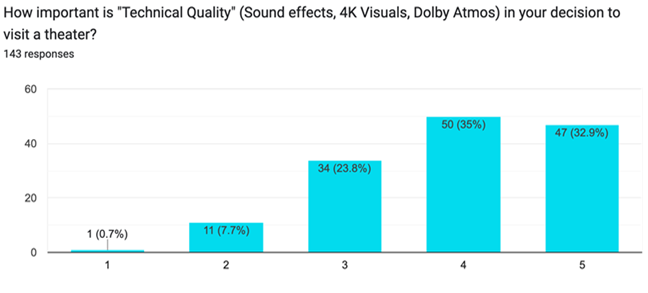
|
Figure 1
Importance of Technical Quality (Sound, 4K Visuals, Dolby Atmos) in Theatre
Selection Decisions (N = 143) |
•
The
Empirical Finding: Premium audio-visual presentation serves as the main anchor
for physical cinema attendance, with 67.9% of viewers prioritizing top-tier 4K
visuals and Dolby Atmos sound. However, a major infrastructure mismatch leaves
84.6% of the audience completely dissatisfied with their regional exhibition
options. Because advanced formats like IMAX are missing outside central hubs
like Ernakulam, 51.0% of the audience actively loses enthusiasm for local
screens.
•
The
Theoretical Interpretation: Under Uses and Gratifications Theory, movie
theatres no longer survive on content alone; they survive strictly on the
sensory spectacle they offer. When local municipal infrastructure fails to
provide that premium environment, it creates latent audience underservice. This
breaks venue loyalty and drives digital native populations to replace poor
local cinema trips with high-quality home downloads.
Objective 2: To identify the economic thresholds and
psychological price boundaries of contemporary theatre consumers.
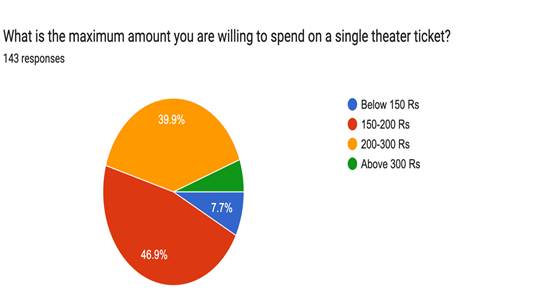
Maximum
willingness to pay for a single theatre ticket (N = 143)
•
The
Empirical Finding: Cinema attendance faces a hard psychological price ceiling,
with public willingness to pay dropping off sharply to just 5.6% the moment a
single ticket crosses the ₹300 mark. This pricing resistance is heavily
multiplied by heavy ancillary costs like travel fuel, parking, and food, which
push the total cost of a single visit to a ₹500–700 range. These combined
financial pressures have forced 44.8% of the audience to skip regular
theatrical runs completely, saving their money exclusively for high-budget
visual event films.
•
The
Theoretical Interpretation: This represents a massive shift in audience
spending. Cinema has transitioned from an affordable weekly hobby into an
occasional luxury. The steep decline in consumer willingness to pay past the
₹300 point, combined with high total costs, creates an
"Event-Only" consumption model. This effectively leaves regular
mid-budget regional dramas and narrative-driven Malayalam cinema financially
abandoned in the theatrical market.
Objective 3: To compare the influence of systemic digital
service deficits against direct financial constraints in driving audience
piracy adoption.
Table 5
|
Table 5 Primary
Catalysts for Choosing Unofficial Sources Over Paid OTT Platforms |
|||
|
Catalyst
Category |
Specific
Reason |
Frequency |
Percentage
(%) |
|
Service
Deficit |
Content
unavailability (not on any platform) |
38 |
26.6% |
|
Service
Friction |
Speed
/ No advertisements |
33 |
23.1% |
|
Fragmentation |
Content
on an unsubscribed platform |
25 |
17.5% |
|
Economic |
High
financial cost of subscription |
22 |
15.4% |
|
Non-Users |
Does
not use unofficial sources |
25 |
17.5% |
The Empirical
Finding: Unauthorised
distribution channels are deeply embedded in regional viewing habits, with
82.5% of the sample using these networks. Traditional industry assumptions that
financial limitations cause piracy were disproven, as direct costs account for
just 15.4% of usage. Instead, a combined 67.2% of piracy adoption is triggered
by legal service deficits, establishing a 4-to-1 ratio where platform
fragmentation (17.5%), delayed content releases (26.6%), and intrusive ads on
paid tiers (23.1%) drive users toward unofficial channels far more than
pricing.
The Theoretical
Interpretation: Applying the
Theory of Planned Behaviour, high digital literacy grants users
complete control over their media environment. Piracy in Kerala does not
operate as an economic crime driven by poverty; it operates as a functional
convenience utility. Unauthorised channels like Telegram do not compete with
the legal market on cost. They compete on utility by delivering an ad-free,
consolidated, and frictionless user experience that corporate streaming
platforms fail to deliver.
Objective 4: To analyse the psychological accountability
gap and mechanisms of moral neutralization regarding digital copyright
infringement.
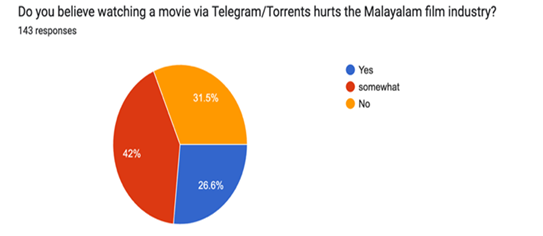
Perception of
piracy as hurting the film industry (N = 143)
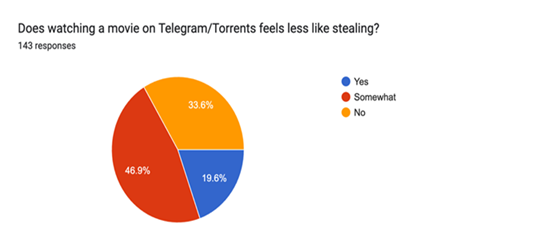
Perception of
piracy as equivalent to stealing (N = 143)
•
The
Empirical Finding: A distinct psychological disconnect exists among regional
viewers. While 68.5% of the sample openly acknowledges that piracy actively
hurts the regional film ecosystem, only 19.6% view personal streaming or
downloading as actual theft. The remaining majority operates within a space of
moral flexibility 33.6% say it does not feel like stealing, and 46.9% view it
with situational moral ambiguity ("somewhat").
•
The
Theoretical Interpretation: This perfectly validates Neutralization Theory and
Deterrence Theory. Because users face near-zero tracking or legal penalties
under current setups, the legal deterrent effect is absent. Viewers resolve
their internal ethical tension by shifting blame onto platform deficiencies,
framing piracy as a logical, defensive reaction to a predatory commercial
market. Traditional anti-piracy campaigns based on moral shaming are completely
ineffective because the audience has successfully minimised its personal guilt
HYPOTHESIS TESTING SUMMARY
All four
hypotheses were supported by the data. H1 was supported: 67.9% prioritise
technical standards as their primary theatrical driver, while only 19.6% view
unauthorized consumption as stealing, confirming that functional demand for
high-fidelity experience is a statistically stronger motivator than moral or
ethical obligation. H2 was supported: willingness to pay collapses to 5.6%
beyond the Rs. 300 mark, confirming a hard
psychological abandonment threshold. H3 was supported: financial cost motivates
only 15.4% of piracy, against 67.2% attributable to service failures,
validating the premise that piracy is a service problem rather than an economic
one. H4 was supported: the clear disconnect between industry harm awareness and
personal guilt categorisation confirms the operation of Moral Neutralization as
the mechanism through which audiences resolve the ethical tension of
unauthorized viewing.
|
Hypothesis |
Focus |
Primary Finding |
Result |
|
H1 |
Technical Anchor |
Tech immersion is the
primary theatre driver (67.9%) |
Supported |
|
H2 |
Economic Threshold |
Attendance collapses
after the Rs. 300 price point (5.6%) |
Supported |
|
H3 |
Service Deficit |
Utility/friction
drives piracy 4x more than cost |
Supported |
|
H4 |
Moral Neutralization |
Service friction
overrides ethical responsibility |
Supported |
OTHER EMPIRICAL FINDINGS
PRIMARY MOTIVATIONS FOR HOME VIEWING MIGRATION
When consumers
were asked to isolate their top two reasons for choosing a home viewing
environment over a physical movie theatre, economic and comfort variables stood
out. The high cumulative cost of theatre ticket pricing and ancillary expenses
was selected by 62.2% of the sample. The sheer flexibility, physical comfort,
and immediate playback/pause control of the home environment followed closely,
being selected by 58.7% of respondents as a primary driver.
DIGITAL DEVICE DOMINANCE
The hardware
preference data shows a distinct trend toward personal, portable screens for
digital media consumption. Laptops and personal computers lead as the primary
device used to watch movies digitally for 41.3% of the sample. Smartphones and
mobile devices follow closely at 35.0%, highlighting the strong hold of mobile
viewing. Home Smart TVs account for 18.2%, while tablets make up the remaining
5.5%.
ADVERTISING FRICTION: THEATRES VS. OTT PLATFORMS
The survey
monitored consumer irritation levels toward advertisements using a 1-to-5 scale
(where 1 is "Not at all" and 5 is "Highly Irritating"). For
physical movie theatres, 42.7% of respondents rated onscreen commercials at a
highly irritating level of 4 or 5, noting frustration with delayed movie start
times. However, irritation peaked sharply within subscription streaming
environments; a massive 73.4% of respondents rated OTT advertisements as highly
irritating (scores of 4 or 5), expressing deep frustration with unskippable mid-roll ad breaks on platforms they already
pay for.
BASELINE PIRACY PENETRATION
When asked
directly, "Have you ever used unofficial platforms (Telegram channels,
Torrent sites, unofficial websites) to watch a movie?", a massive 82.5% of
respondents answered Yes. Only 17.5% stated they have never used these
channels. This confirms that accessing unofficial networks is an established
baseline habit for the vast majority of media consumers in the state.
PRIMARY DRIVERS OF UNOFFICIAL PLATFORM CHOICE
When users were
asked, "When you choose an unofficial source over a paid OTT platform,
what is the primary reason?", systemic platform issues heavily outweighed
cost:
26.6% cited
content unavailability or regional streaming release delays.
23.1% cited
intrusive commercial advertisement friction.
17.5% cited
platform fragmentation (the burden of managing too many individual apps).
Only 15.4% cited
direct financial constraints/subscription cost barriers. (Note: The remaining
17.4% represents absolute non-users of pirated channels).
SUBSCRIPTION FATIGUE AND OVERWHELM
The data reveals
widespread consumer frustration regarding market distribution. When responding
to the statement, "I feel overwhelmed by the number of monthly
subscriptions I have to manage and pay for," a combined 72.1% of
participants expressed active agreement (41.3% strongly agreeing and 30.8%
agreeing). Only 9.1% actively disagreed, showing deep subscription fatigue
across the demographic.
HYPOTHETICAL LEGAL COMPLIANCE TRADE-OFFS
To test consumer
loyalty, the survey asked users to rate their agreement with the statement:
"If a movie is available on a paid OTT platform (like Netflix), but also
available for free on Telegram in High Quality, I would still prefer to pay and
watch legally." Only 19.6% of respondents Strongly Agreed. The remaining
80.4% expressed neutrality, disagreement, or active rejection, proving that
when technical quality is equal, convenience and zero-cost systematically
override legal compliance.
GENRE-BASED VENUE PREFERENCES
When asked,
"For a mid-budget drama or comedy (non-action/mass movie), where would you
prefer to watch it?", the response was overwhelmingly digital. A
substantial 76.2% of respondents stated they prefer to watch mid-budget genres
at home via digital or OTT formats. Only 23.8% preferred watching these
smaller-scale narratives in a physical movie theatre.
DISCUSSION
OVERVIEW OF MAIN FINDINGS
This study set out
to map the specific economic, experiential, and psychological factors governing
cinema consumption among the 18 to 40 demographic in
Kerala. The findings, taken together, establish a coherent picture of an
audience that is not disengaged but is engaged on terms the existing market
structure is failing to meet. The data does not describe a population that has
abandoned cinema out of indifference. It describes a population that has
developed a precise, hierarchical set of demands and continues to patronise
whichever platform, authorized or otherwise, most consistently meets them.
The four research
objectives converge on a single central argument: the theatrical sector and the
streaming sector have each, through distinct and compound failures, accelerated
their own audience displacement. The theatrical sector has raised prices while
concentrating premium infrastructure in a small number of urban centres,
creating the latent dissatisfaction documented in the technical quality
analysis. The streaming sector, which initially succeeded by eliminating the
friction of physical distribution, has progressively reimposed the very
conditions, namely advertisements, fragmented content libraries, and escalating
costs, that justified its own existence as an alternative. The audience has not
moved past cinema. The market has moved away from the audience.
TECHNICAL FIDELITY AND THE INFRASTRUCTURE GAP
The finding that
67.9% of respondents rate audio-visual quality as a primary driver of
theatrical attendance confirms a structural shift in the terms on which cinema
justifies itself to a digitally literate population.
For much of the
twentieth century, the theatre's case rested on monopoly access: it was simply
where new films were. That monopoly has been dissolved. In the current
landscape, the theatre must compete on the quality of experience it delivers
relative to alternatives.
This study's data shows that audiences have
internalized this logic precisely: they demand that the theatre deliver
something the home environment cannot replicate, and they evaluate attendance
decisions accordingly.
The critical
implication of the 84.6% aggregate dissatisfaction rate regarding premium
screen access is that this demand is not being met for the majority of the
sample. Latent dissatisfaction of this kind is strategically dangerous for the
theatrical sector because it does not manifest as visible boycott but as
habitual selective attendance.
The audience in
semi-urban Kerala does not stop going to the cinema. It stops going to the
local cinema for anything other than films whose scale demands the largest
available screen. The mid-budget, the character-driven, the experimental, all
migrate to digital. The theatre becomes an event-only venue by default rather
than design, and the cultural breadth of the theatrical experience narrows
accordingly.
This finding
aligns with global trends identified in the literature, including Bijli's
documentation of the eventization of Indian cinema
and the r/IndianCinema community's strategic
segregation model, in which the theatre is reserved for spectacle while the
everyday film-watching experience has migrated entirely to streaming.
What this study
adds is the regional specificity: the eventization in
Kerala is being accelerated not only by the availability of alternatives but by
the failure of local theatrical infrastructure to deliver on the technical
promise that the multiplex era established.
THE RS. 300 THRESHOLD AND THE ECONOMICS OF ABANDONMENT
The identification
of Rs. 300 as a hard psychological abandonment threshold is, on its own, a data
point with immediate practical value for the exhibition sector. But the more
significant finding lies in the relationship between the ticket ceiling and the
total cost of attendance. The ticket price does not represent the total
financial exposure of a cinema visit. Travel, parking, and concession purchases
compound the effective outlay to Rs. 500 to Rs. 700 for a typical outing.
This is the figure
the demographic is actually calculating against, and it is this total that
fails the value-utility test at the point where any individual component,
ticket, snacks, or travel, pushes the aggregate over the audience's
psychological tolerance.
The 44.8%
event-only attendance rate is the behavioural expression of this calculus. The
audience has not concluded that cinema is overpriced in the abstract. It has
concluded, through repeated experience, that cinema is overpriced for most
films. The event-only strategy allows the audience to maintain its relationship
with the theatrical format while radically limiting its financial exposure to
it. The practical consequence for the industry is the one documented in the
literature by Long Live Cinema and Ganeshan: mid-budget films, which do not
trigger the event threshold, cannot generate the theatrical revenues needed to
justify their costs, accelerating their migration to digital windows and
reinforcing the very pattern the industry is attempting to reverse.
The concession
pricing dimension of this finding deserves particular attention. Ancillary
revenue, primarily food and beverages, has become structurally central to the
multiplex business model as average ticket prices have been constrained by
market resistance. The consequence is a compressive dynamic: as the industry
attempts to extract higher total revenue per visitor through ancillary charges,
it simultaneously increases the total cost of attendance to levels that trigger
avoidance, reducing the frequency of visits the ancillary charges were designed
to capture. This is the mechanism that a flexible ticketing strategy, such as
monthly passes or significant weekday discounts, could potentially interrupt by
converting event-only visitors into habitual ones at a lower per-visit revenue
but higher total lifetime revenue.
PIRACY AS A SERVICE PROBLEM
The finding that
service failures account for 67.2% of piracy motivations against 15.4%
attributable to financial cost represents the study's most consequential
finding from a policy and industry strategy perspective. The four-to-one ratio
between service failure and economic necessity as piracy drivers directly
contradicts the dominant framing of the piracy problem in industry and
regulatory discourse, which consistently emphasises price as the primary lever.
The three
service-failure categories that dominate the motivation data tell a specific
structural story. Content unavailability, cited by 26.6% of respondents,
reflects the windowing gap during which a film has completed its theatrical run
but has not yet appeared on any streaming platform the respondent subscribes
to.
This gap, which
the industry maintains to protect theatrical revenue, functions in practice as
a demand generator for piracy rather than a protective period for legitimate
consumption. Platform fragmentation, cited by 17.5%, is a direct consequence of
the competitive dynamics of the streaming market: as platforms seek exclusive
content to differentiate their catalogues, the audience's cost of accessing any
given film on a legitimate channel increases. The
viewer who pays for three platforms and discovers that a film they want to
watch is available only on a fourth faces a subscription wall that the pirated
version of the same film does not erect. Advertisement friction, cited by
23.1%, represents the most direct failure of the streaming sector's value proposition.
Viewers who originally migrated to streaming platforms to escape the commercial
interruptions of linear television now encounter the same interruptions on
services they pay for. The unauthorized channel, in this context, is not
competing on price. It is competing on the elimination of a user experience
failure that the legitimate market has reintroduced.
These findings are
consistent with the theoretical framework established at the outset of this
study. Uses and Gratifications Theory predicts that audiences will select the
platform that best satisfies their defined needs, and the data confirms that a
consolidated, frictionless, advertisement-free experience is the need that the
unauthorized channel is uniquely positioned to satisfy among the alternatives
currently available. Hastings' characterization of contemporary piracy as a
service problem rather than a pricing problem, and Gabe Newell's formulation
that piracy is a service problem rather than a pricing problem, are empirically
supported by the specific proportions established in this study.
The practical
implication is significant: anti-piracy strategy premised on reducing the
financial cost of legitimate alternatives will not produce proportionate
reductions in piracy behaviour, because cost is not the dominant motivation for
the majority of piracy users within this demographic. Strategies capable of
achieving meaningful behavioural change must address content availability,
platform consolidation, and advertisement policy on paid services. An
aggregated subscription model that consolidates multiple platform libraries
under a single payment interface would directly address both the fragmentation
and availability motivations that collectively account for 44.1% of piracy
cases in this sample.
THE ACCOUNTABILITY GAP AND THE FAILURE OF MORAL DETERRENCE
The Accountability
Gap documented in this study, the distance between recognising that piracy
causes harm (68.5%) and categorising the act as stealing (19.6%), represents
the operationalisation of Neutralization Theory within Kerala's digital piracy
landscape. The majority of respondents who pirate content do not do so under a
sense of moral licence or indifference to harm. They do so under a sense of
justified grievance, having successfully reframed the act not as theft from a
specific creator but as a rational consumer response to a market structure that
fails them.
The specific
neutralization mechanisms at work align with the conditions documented
elsewhere in the findings. The high ticket pricing and
hidden costs identified in the willingness to pay analysis provide the audience
with a credible Denial of Victim narrative: if the industry charges what the
audience perceives as exploitative prices, it has forfeited the moral standing
to claim injury from unauthorized consumption. The service failures identified
in the piracy motivation analysis provide a Denial of Injury justification: if
the audience's willingness to pay is being met with advertisements, fragmented
libraries, and windowing gaps, then accessing the content through an
unauthorized channel is a corrective response rather than a criminal one. The
combination of these two justifications with the near-zero certainty of
detection for end-user piracy, as explained by Deterrence Theory, produces the
stable equilibrium of mass piracy with residual guilt but no behavioural change
that this data describes.
The theoretical
implication is that the Accountability Gap will not close through awareness
campaigns or legal threats. It will only close when the conditions that
produced it are addressed. As long as a viewer must subscribe to four platforms
to access the films they want, endure advertisements on services they pay for,
and spend Rs. 600 on an outing to watch a film on an average screen, the moral
case for paying will remain abstract and the practical case for piracy will
remain concrete. The gap is not a failure of audience ethics. It is a market
failure rendered legible through the mechanism of moral justification.
The findings have
important implications for how industry stakeholders and policymakers
understand and respond to the piracy problem. Moral shaming campaigns, which
assume that awareness of harm is the binding constraint on behaviour, are
targeting the wrong variable. The data shows that awareness of harm is already
widespread. The binding constraint is the perceived legitimacy of the legal
alternative, and that legitimacy will only be restored by improvements in
technical access, pricing structure, and service quality across both the
theatrical and digital sectors.
COMPARISON WITH EXISTING LITERATURE
The findings of
this study are broadly consistent with, and in several respects extend, the
existing literature on theatrical-to-digital transition. YouGov's 2022 survey
of urban Indians, which found that 69% of respondents had reduced cinema-going
frequency with convenience of streaming as the primary driver, is corroborated
by this study's attendance data. Krishna's documentation of surge pricing in
Kerala multiplexes as a structural deterrent to habitual attendance aligns with
the Rs. 300 abandonment threshold identified here.
Rejo and Ramadevi's 2024 study of OTT consumption in Ernakulam, which found
convenience to be the primary driver of platform adoption, is consistent with
the service-friction motivation data that makes the unauthorized channel
competitive.
Where this study
extends the literature is in the quantitative specificity of its findings and
in its treatment of piracy as a demand-intelligence signal rather than a legal
problem. The four-to-one ratio between service failure and economic necessity
as piracy motivations is a finding with no direct precedent in the regional
literature. The precise identification of Rs. 300 as a hard psychological
ceiling, and the documentation of the Accountability Gap as a stable
psychological equilibrium rather than a transitional state, contribute
empirical granularity to theoretical frameworks that have previously been
applied to this context at a more abstract level.
LIMITATIONS
The study
acknowledges several methodological limitations. Self-reporting bias is an
inherent risk in research on unauthorized consumption: respondents may have
under-reported piracy behaviour to avoid social stigma, and over-reported
theatrical attendance or legal streaming habits to project a pro-industry
identity. The cross-sectional design captures a moment-in-time snapshot of
audience behaviour in a landscape that is changing rapidly, and the findings
may not represent behaviour across different points in the annual calendar,
particularly in light of seasonal patterns driven by major festival releases
and examination cycles. The sample's concentration in Ernakulam and the
urban-semi-urban dominance limit the generalizability of findings to rural
populations and districts outside the study's geographic concentration. The
absence of income-variable cross-referencing means that the economic threshold
findings represent general behavioural observations rather than financially
stratified analyses. The study also does not measure the influence of
promotional activities, social media spoiler dynamics, or companion-driven
viewing decisions, all of which may modify the consumption patterns that price
and service variables predict.
RECOMMENDATIONS
FOR THE THEATRICAL SECTOR
The theatrical
sector's most immediate and tractable intervention is the geographic expansion
of premium exhibition infrastructure. Dolby Atmos and 4K projection should not
remain exclusive to Ernakulam and Trivandrum. The 84.6% latent dissatisfaction
rate identifies an unmet demand in semi-urban districts that is currently
driving audience loyalty away from local theatres toward digital alternatives.
A structured re-evaluation of the total cost of attendance, particularly
concession pricing, is essential: the current dynamic in which ancillary costs
push the effective cost of an outing into the Rs. 500 to Rs. 700 range is the
single most visible mechanism converting habitual viewers into event-only ones.
Flexible ticketing models, monthly passes and weekday discounts in particular,
offer a route to converting the event-only majority back into regular attendees
for a broader range of films.
FOR THE OTT SECTOR
The streaming
sector's most direct intervention is the development of an aggregated
subscription model that consolidates multiple platform libraries under a single
interface and payment. The fragmentation motivation accounts for 17.5% of
piracy cases in this sample and is entirely structural: it is produced by
competitive platform dynamics rather than consumer preference. Eliminating or
significantly reducing advertisement interruptions on paid tiers is the second
priority, given that ad friction on legal platforms was identified as a
stronger piracy trigger than subscription cost for 23.1% of the audience. A
reduction in windowing periods between theatrical and OTT release would reduce
the Social FOMO-driven demand for pirated copies during the theatrical
exclusivity gap.
Eliminate Premium
Ad Friction: Address the severe 73.4% ad-irritation metric by removing unskippable mid-roll ads from premium paid accounts.
Introduce rigid policy caps that restrict advertising strictly to pre-roll
formats to prevent rapid user migration toward ad-free unofficial copies.
Build Consolidated
Billing Bundles: Directly counter the 72.1% subscription overwhelm metric by
partnering with telecom networks to aggregate fragmented content libraries into
unified, single-billing digital subscription packages.
FOR POLICYMAKERS
Anti-piracy
strategy should be reoriented away from moral shaming campaigns and toward
structural interventions that remove the service and economic conditions that
justify unauthorized consumption. Piracy data should be treated as demand
intelligence: spikes in unauthorized consumption should be read as signals of
where legitimate access is failing, not as a measure of criminal activity
requiring prosecution. Policy frameworks that incentivize OTT platform
consolidation and regulate predatory concession pricing in theatrical venues
would address the specific consumption conditions that this study identifies as
the primary drivers of market displacement.
CONCLUSION
The findings of
this study do not signal the death of cinema in Kerala. They document the
conditions under which a highly engaged, technologically literate, and
cinematically invested audience has been progressively pushed out of the
legitimate market by the compounding failures of both the theatrical and
digital sectors.
The 18 to 40
demographic that this study maps is not an audience that has lost interest in
cinema. It is an audience that grew up inside it, that distinguishes
intuitively between a Dolby Atmos hall and a
smartphone screen, and that still chooses the theatre when the conditions
justify it. The problem is that those conditions are met with declining
frequency. The theatrical sector has responded to digital competition by
raising prices and concentrating its best assets in the fewest locations. The
OTT sector, having built its legitimacy on the promise of convenient,
comprehensive, interruption-free access, has progressively dismantled each
element of that promise through commercial expansion. The audience has not
abandoned cinema. It has abandoned a market that no longer competes on the
audience's terms.
The Accountability
Gap documented in this study will not be closed by awareness campaigns or by
legal threats directed at the end user. It will close only when the conditions
that created it are addressed. As long as a viewer must subscribe to four separate
platforms to access the films they want, endure advertisements on services they
pay for, and spend Rs. 600 on an outing to watch a film on an average screen in
a hall without premium audio, the moral case for paying will remain theoretical
and the practical case for the unauthorized channel will remain concrete.
The future of
Malayalam cinema's relationship with its audience depends on whether the
industry chooses to compete with the unauthorized channel on the channel's own
terms: consolidation, convenience, and genuine value. The data in this study
shows what the audience is willing to pay, what experience they are willing to
travel for, and what failures they are using to justify the choices the
industry least wants them to make. The information is available. What the
industry does with it is a choice it has yet to make.
Kerala has a
historically celebrated culture of high film literacy, film societies, and deep
appreciation for narrative nuance. The ironic twist your study uncovers is that
this very literacy is what drives the migration to digital platforms and
alternative networks. Because the audience is highly analytical, they demand
absolute technical perfection (Dolby Atmos, 4K resolution, exact audio
calibration). When regional theatres fail to provide this premium setup, the
audience's high film literacy causes them to reject the subpar theatre
experience entirely in favour of pristine, high-bitrate digital files at home.
They aren't abandoning cinema; their high standards are outgrowing local
infrastructure.
Historically, a small or mid-budget Malayalam
film could start with a weak opening Friday and recover over two weeks through
positive word-of-mouth. Your data on economic thresholds proves that this
"cushion" is functionally dead for the theatrical market. Because a
single theatre outing now triggers a rigid ₹500–700 cost barrier per
person, consumers completely refuse to take financial risks on unverified
content. Word-of-mouth no longer saves mid-budget films in theatres; instead,
it simply tells the audience: "This is a great movie, I can't wait to
stream it next month." The theatre space has become a high-stakes arena
reserved exclusively for sensory, big-budget spectacles.
The most profound
conclusion your data offers is that digital piracy in Kerala is not a legal or
moral failure it is a clear signal of an inefficient legal market. By
exhibiting a 4-to-1 ratio where platform service friction outpaces cost, the
data shows that digital natives are entirely willing to pay, but corporate
streaming platforms are failing them. When platforms split content libraries
across separate paywalls, introduce intrusive ads on paid tiers, and delay
regional releases, they create artificial barriers. Unofficial networks like
Telegram are succeeding because they operate like an ideal open market: a
single, frictionless user interface that provides immediate access. Piracy will
only decline when legal platforms match the functional utility of the
unofficial networks.
ACKNOWLEDGMENTS
None.
REFERENCES
Abhinand, S. S., and Anuji, S. (2025). Digital Distribution and Production Transformation in Malayalam Cinema: A Secondary Data Analysis. European Economic Letters, 15(3), 3650–3658.
Deep, A.
(2023). The End of Induna and Physical Film Releases in India. The Hindu.
Eichler, A. (2019). The Death of Physical Media: The Dangers of Streaming and the End of the Home Library (Honors thesis, Portland State University). PDXScholar. https://doi.org/10.15760/honors.821
Fleming
Jr., M. (2014). CinemaCon:
Christopher Nolan Warns Theatre Owners
How ‘Interstellar’ Is Presented
Will Be More Important Than Any Film He’s Done Before. Deadline.
Hastings,
C. (2026). The Inevitable Comeback of Piracy [Video]. YouTube.
Jha, L. K. (2025). Why the Music Industry Is Struggling Despite the OTT Boom. Livemint.
Paulo Miguel Martins (n.d.). Ciência-UCP.
Reich, J. S. (2017). Cannes Film Festival
Jury Answers the Netflix Question. Celluloid Junkie.
Shoard, C. (2025). Martin Scorsese No Longer Watches
Films in Cinemas Due to Audience Bad Behaviour. The Guardian.
Stuckmann, C. (2024, January 13). Why
Physical Media Matters to Me [Video]. YouTube.
|
|
 This work is licensed under a: Creative Commons Attribution 4.0 International License
© ShodhVichar 2026. All Rights Reserved.


